
A former boss used to tell me that fear is the emotion that cancels out all other emotions. The Crucible, the opera, is a witches’ brew of fear transforming people and institutions. When you read about it in history books, the Salem Witch Trials seem a shocking historical oddity that happened a long time ago, but there is more to the story than fear of witches gone wild. Be prepared: Arthur Miller’s play, turned into an opera by composer Robert Ward and librettist Bernard Stambler, bites, revealing the human factors that led to the atrocity, factors still lurking among us today; in 1682, would you have been willing to die rather than sign a false confession to save yourself, a confession that you conspired with satanic forces? What would the price of your integrity be today? Washington National Opera’s excellent production that began Saturday night leaves teeth marks. Throw in the dramatic storytelling, excellent music, singing, and staging, and that’s a great night at the opera.
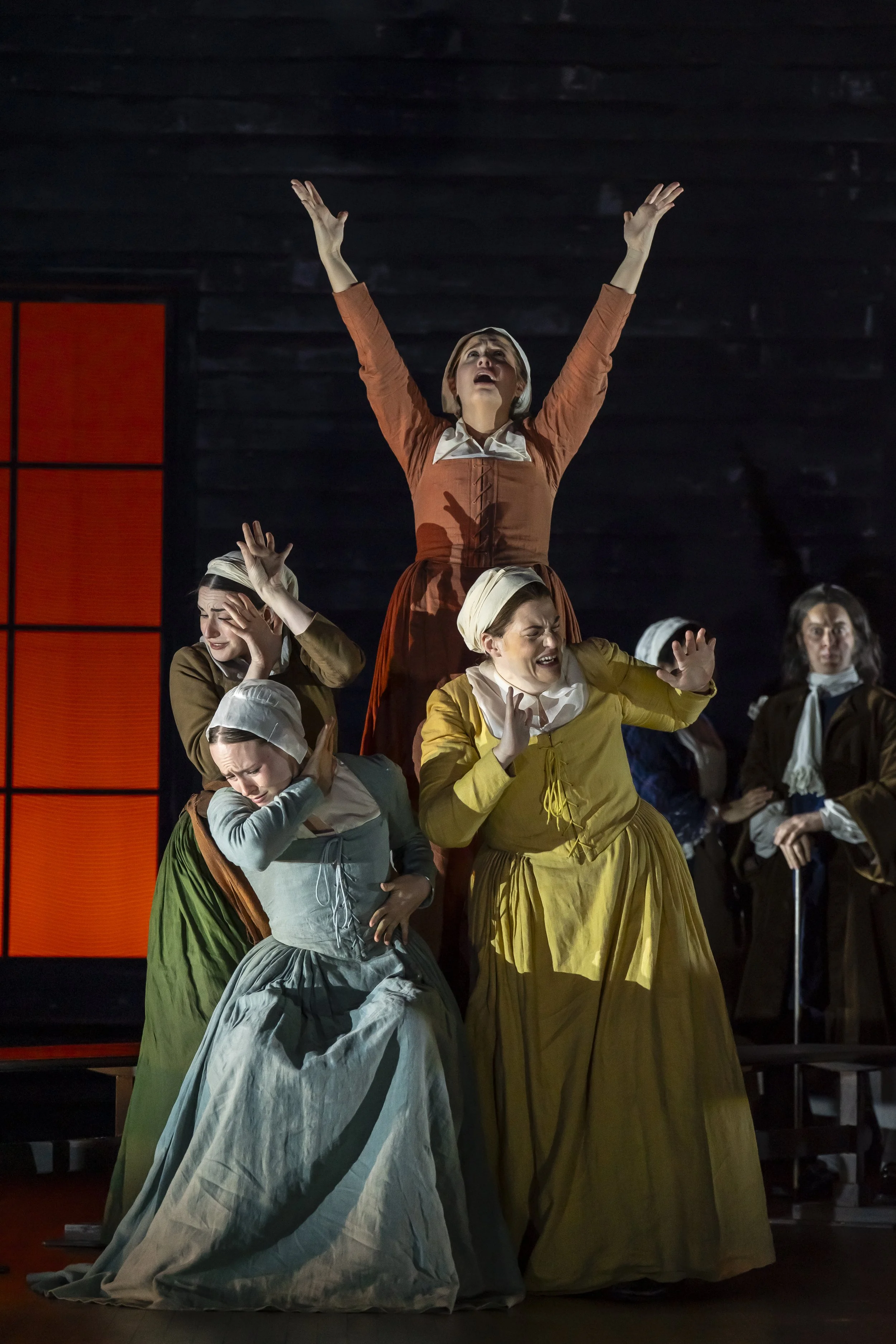
Village girls discuss who may be guilty of witchcraft in Washington National Opera’s The Crucible. Photo by Scott Suchman; courtesy of Washington National Opera.
Once again, WNO’s General Director Timothy O’Leary and Artistic Director Francesca Zambello opened the proceedings to a well-deserved standing ovation, even before O’Leary revealed that Director Zambello, in recognition for her distinguished career dedicated to producing and directing operas, had been elected into the Opera Hall of Fame by OPERA America. Imposing transitional challenges were faced after ending the alliance with the Kennedy Center; Director O’Leary has said it was like learning to fly an airplane while building it; as an example, not only did a new performance venue have to be found, but the 17 named singers and members of the orchestra for The Crucible had to be maintained with changed terms of contracts, including new arrangements for medical insurance while moving at flight speed. Impressively, WNO’s seventieth season goes on as planned with three American operas from the nineteenth and twentieth centuries, which include the previously performed Treemonisha, the currently being performed The Crucible, and West Side Story, coming soon. Kudos and a special tip of the hat to Director Zambello!
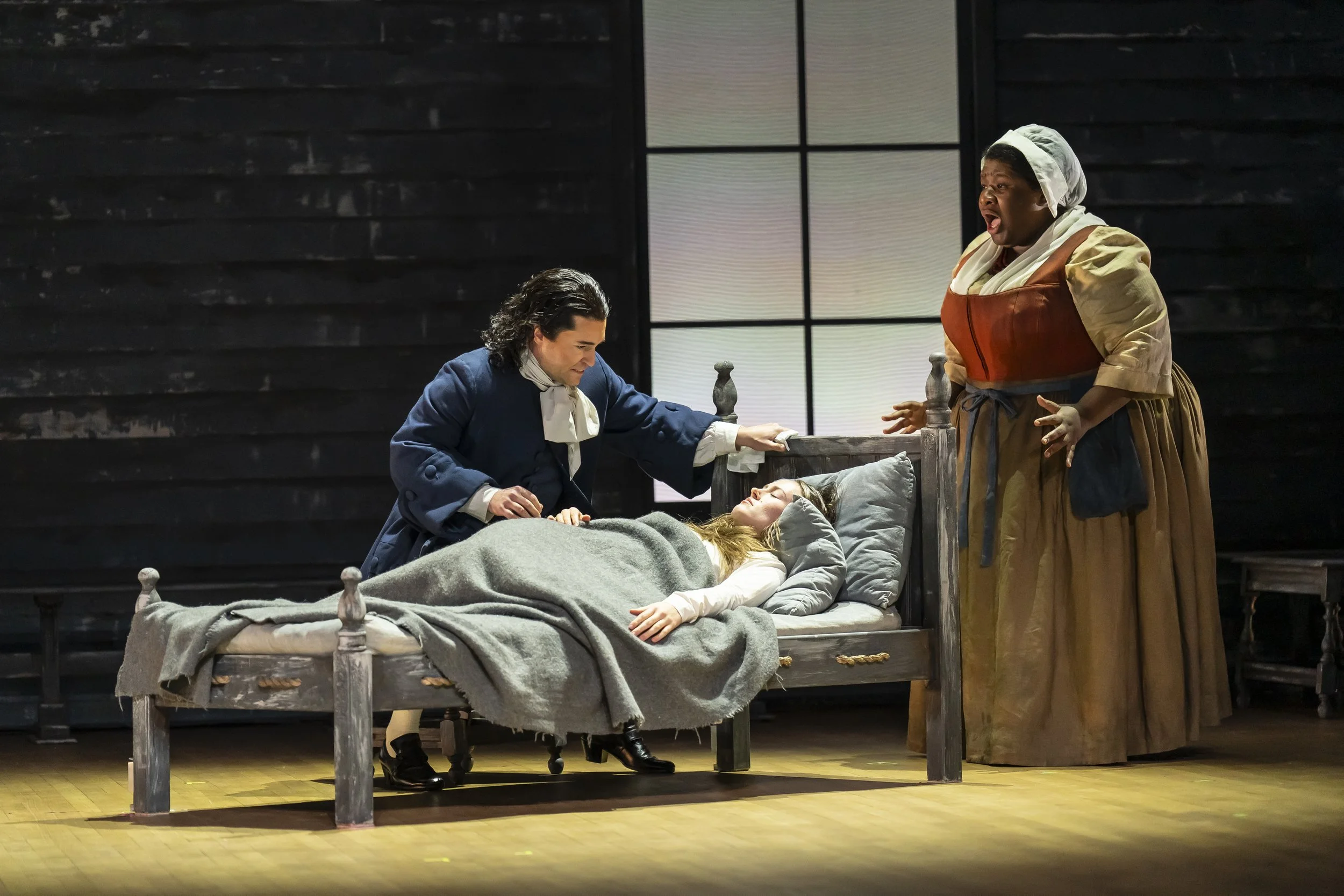
Betty Parris (Veronica Siebert) lies in bed as her father Reverend Samuel Parris (Alexander McKissick) and Tituba (Ronnita Miller) look on. Photo by Scott Suchman; courtesy of Washington National Opera.
The Crucible, the opera, omits some details covered in the play but adds acted scenes only articulated in the play, and deepens the emotional impact with music. The plot (spoiler alert): Several young girls were seen dancing in the woods, some unclothed and drinking blood; a member of the group was a slave, Tituba. As this news circulated in a community already imperiled by personal, business, and religious conflicts, the young girls started to exhibit strange behaviors, leading some to posit that the Devil was at work in their midst. Under threats, Tituba confesses a relationship with the Devil, though she resisted his orders; her confession gave her exoneration, but witchcraft suspicions were validated. As this storm was brewing, farmer John Proctor was having marital difficulties with his wife Elizabeth, caused by his past affair with a servant girl, Abigail, an unhinged influencer among the young girls. He sought Abigail out to confront her over her role in the arrest of his wife. The girls who danced in the woods began to name those suspected of engaging in witchcraft to deflect attacks on themselves, and some townspeople impugned neighbors with witchcraft lies to gain financial and property advantages. Many accused were jailed, and a court, more concerned with protecting the court than the truth, handed out death sentences. John attempted to save his wife by confessing to his affair as a reason for Abigail’s charges against Elizabeth, but not knowing this, Elizabeth denies he had an affair to protect him. Abigail silently flees the community invalidating her charges and freeing Elizabeth. John is offered exoneration if he will sign a confession of guilt. With Elizabeth’s support for whatever he decides, he makes a decision to confess, but then is unwilling to sign the confession or incriminate others. This flawed man, as all men are, rises to offer us a ray of hope for mankind. While this story is fictionalized, many of the named characters are real people. In all, the Salem Witch Trials caused 19 people, men and women, to be hanged for fabricated charges of conspiring with the Devil. Many saved themselves by falsely confessing to witchcraft.
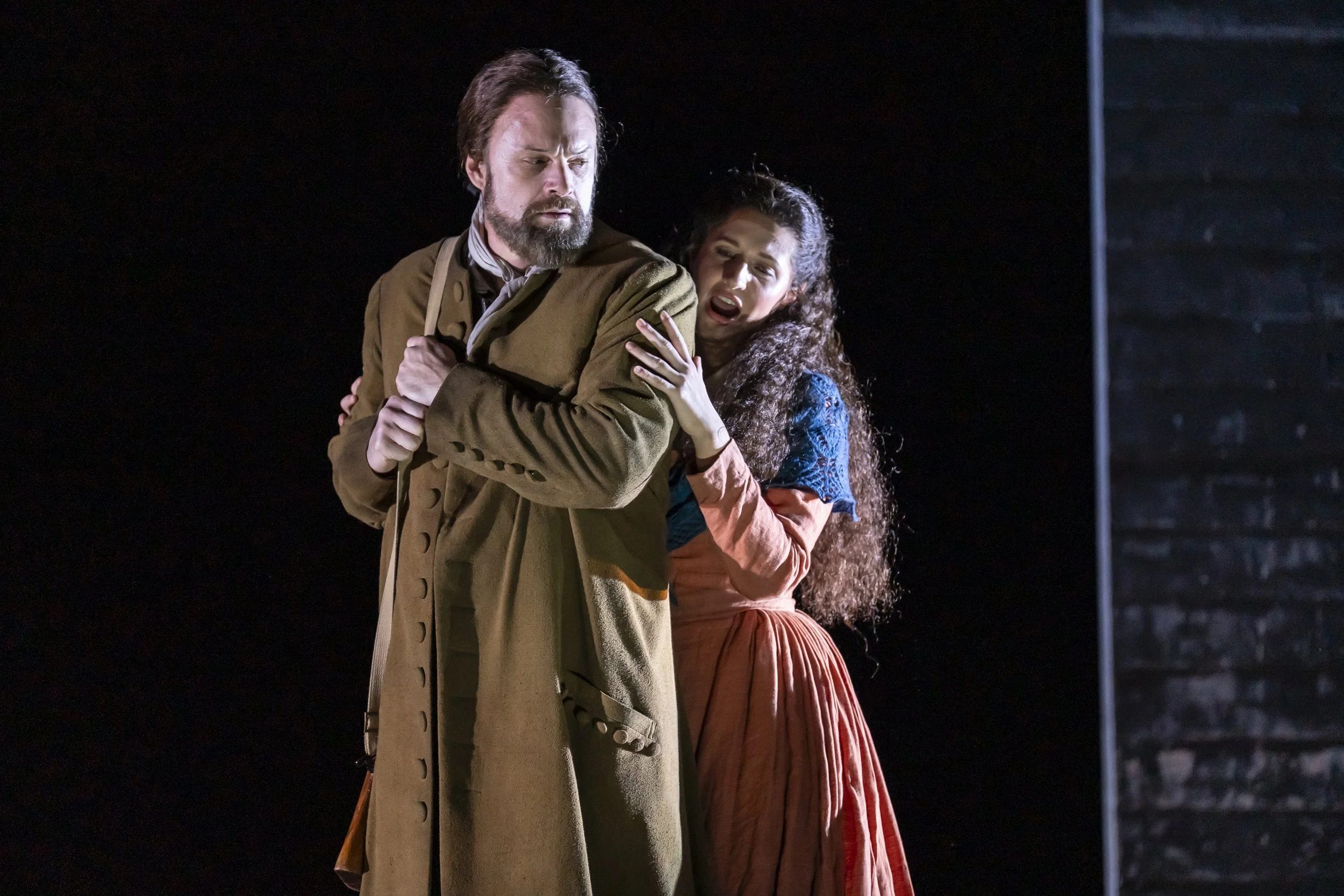
A confrontation between John Proctor (Ryan McKinny) and Abigail Williams (Lauren Carroll). Photo by Scott Suchman; courtesy of Washington National Opera.
My first worry with modern operas from the last half of the 20th century to the present day is what is the music like. I am happy to report that composer Ward’s music was excellent and very well played by the Washington National Opera Orchestra led by Conductor Robert Spano. Several times during the opera my focus shifted to the music and how enjoyable it was. This is a story-driven opera; I was concerned the music would only be recitative, but it is lyrical and melodic in sections as characters reveal their feelings. It is driven by focused musical detail supporting the action on stage, rather than grand musical themes, and it fits the libretto perfectly.
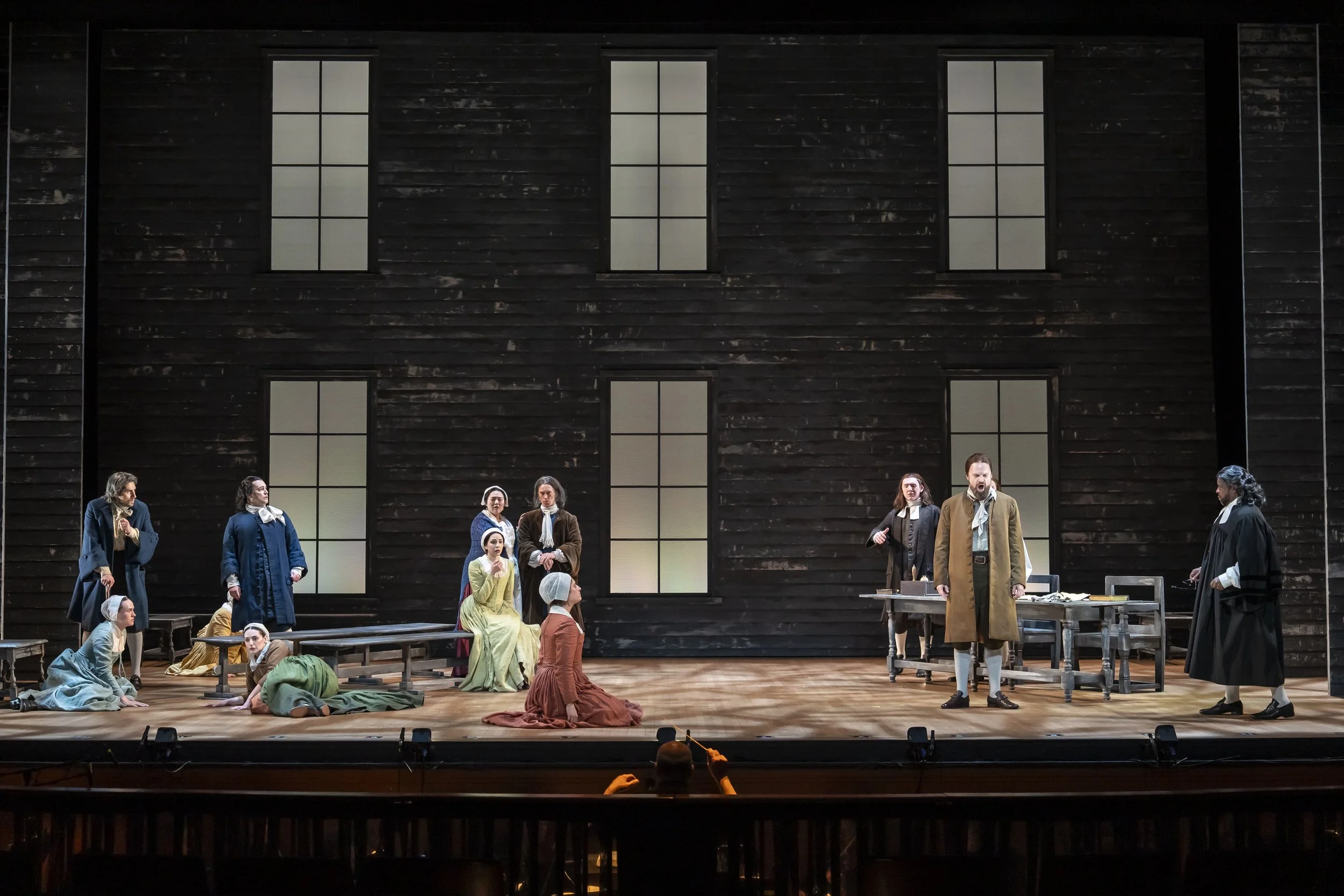
Cast photo of the trial scene. Photo by Scott Suchman; courtesy of Washington National Opera.
Certainly, a highlight of the performance was the overload of talented performers, opera stars in the lead roles, and WNO’s highly talented Cafritz Young Artists in many of the supporting roles (8 currently in the program and 3 graduates). There were seventeen named singers, and all were excellent. It was a pleasure to hear star mezzo-soprano J’Nai Bridges and star baritone Ryan McKinney back in the Washington area again. McKinney sang the role of John Procter and Bridges played Elizabeth, his wife. Bridges’ voice and singing fit beautifully with Elizabeth being the emotional center of the opera. Although she could bring the fire, there was a softness in her singing, revealing the tenderness of Elizabeth’s heart. McKinney fit the role well bringing full measure of his impressive, stage-commanding baritone voice. Cafritz Young Artist and prize-winning soprano Lauren Carroll demonstrated a striking soprano voice, affectingly portraying Abigail as the piece of work she was. Slave Tituba was played effectively by mezzo-soprano Ronitta Miller, another impressive showing for a Cafritz Young Artist. Soprano Kresley Figuerroa was thoroughly engaging vocally and the object of frustration as the weak-willed Mary Warren.
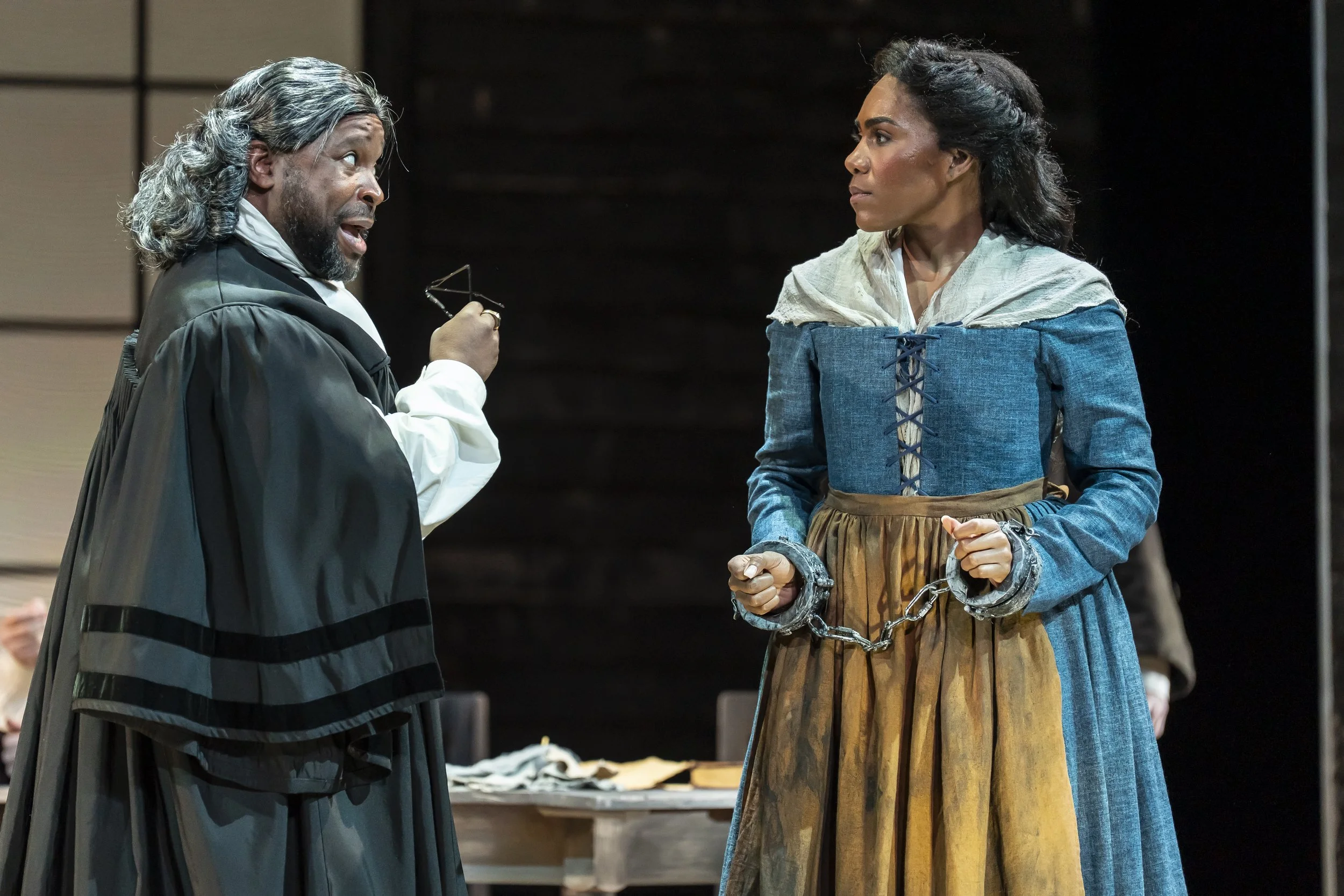
Judge Danforth (Chauncey Packer) confronts Elizabeth Proctor (J'Nai Bridges). Photo by Scott Suchman; courtesy of Washington National Opera.
Another character who chose honor over clemency was Nurse Rebecca, sung beautifully by mezzo-soprano Michelle Mariposa, with a voice so lovely I wished her part had kept her on the stage more. Soprano Tiffany Choe played the role of Ann Putnam, singing perfectly her role of a distraught woman who first suggests witchcraft was causing the young girls’ problems. I heard her and Mariposa sing in last year’s Mud Girl, one of the American Opera Initiative’s new twenty-minute operas. I referred to them then as singing treasures; that label still works. Ann’s husband, Thomas, was scarily played by baritone Chandler Benn as her co-conspiracy theorist. Another role sung impressively was Judge Danforth, played by tenor Chauncey Parker, previously heard in WNO’s Porgy and Bess. Tenor Alexander McKissick and bass-baritone Robert Frasier sang and acted well as Reverend Parris and Reverend Hale. Tenor Nicholas Huff was bold and endearing in his attempt to defend John Proctor. While there was some ensemble singing, a specific chorus was not used.
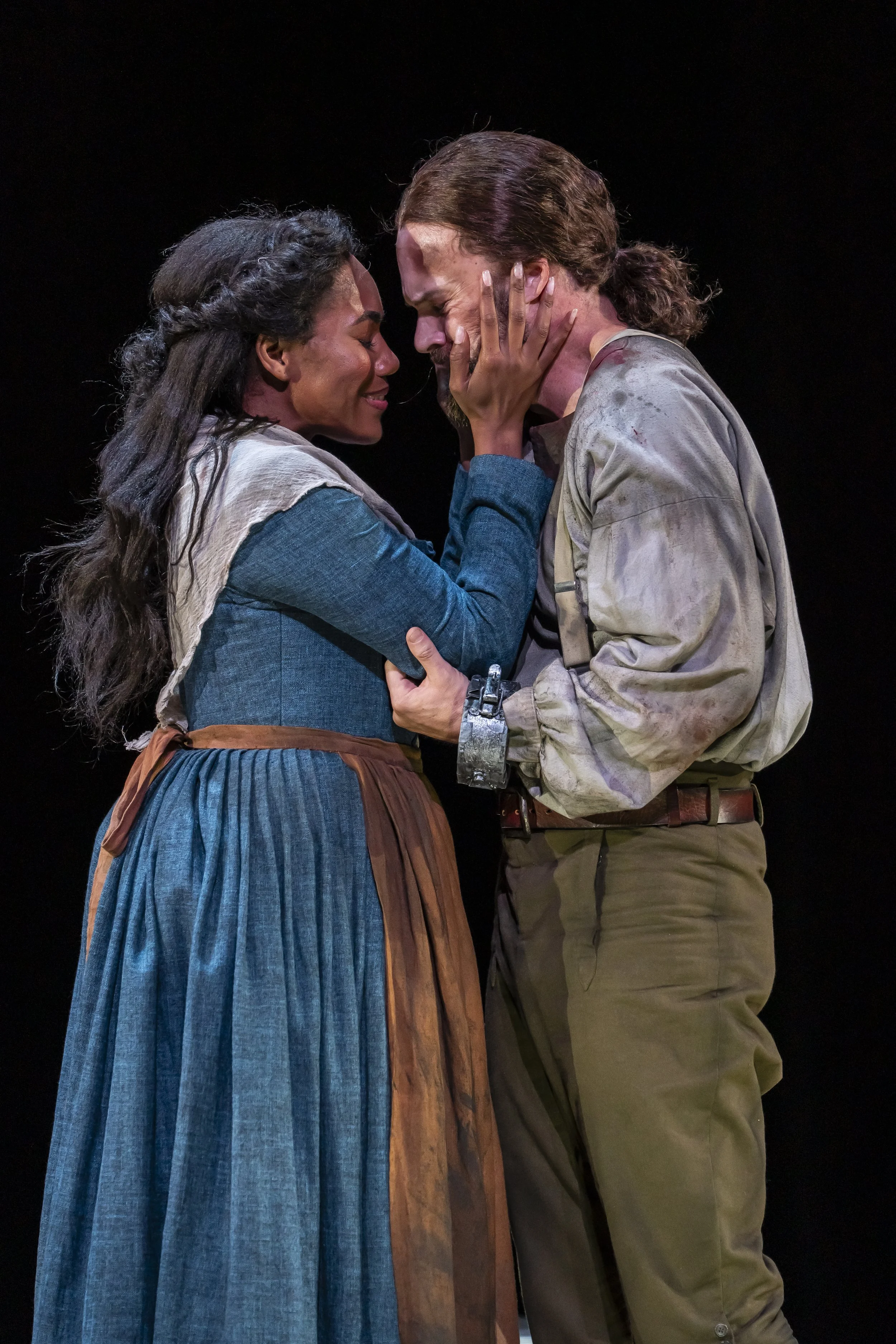
Elizabeth Proctor (J'Nai Bridges) comforts her husband John Proctor (Ryan McKinny) in jail. Photo by Scott Suchman; courtesy of Washington National Opera.
Francesca Zambello’s swift-moving staging was effective at maintaining the tension throughout. The austere set by Neil Patel with lighting enhancements by Jason Lynch and original lighting designer Mark McCullough, worked effectively in supporting the moods, and with small set changes for the forest scene and the courtroom, the stage was sufficient to showcase the drama. Period costumes by Jessica Jahn were perfect.
My picadillos with The Crucible are that we didn’t have time to get to know the characters better and feel more deeply for them; this story deserved the Ring Cycle treatment. I also wonder how well audiences will identify with 17th-century Puritans as the complexities of the situation are revealed. These could lower its intended impact. Of course, my wife wonders now if I’ve become a bit stoic.
Arthur Miller’s play was written as a response to the Red Scare and McCarthy hearings of the 1950s. Artistic Director Zambello also directed the highly acclaimed 2016 Glimmerglass Festival production of The Crucible. She brought it to DC because she recognized that the elements leading to the tragedy long ago were rising in society then, and the divisiveness has gotten even worse today, when trust in news sources and the government is trending downward, conspiracy theories abound, and our politics has reached a new level of divisiveness. It’s good to be reminded where this could lead.
WNO’s production is excellent all around in bringing its powerful message to DC audiences. The music is good and the singing terrific. Don’t let fear of modern opera keep you home instead of in the opera house. This one will serve you well.
The Fan Experience: Washington National Opera scheduled performances of The Crucible for March 21, 23, 25, 27, and 29 in Lisner Auditorium. The opera is sung in English with English supertitles shown on a screen overhead. The opera lasted about two hours and forty minutes with one 25-minute intermission. A pre-opera talk was given one hour before the performance.
Washington National Opera will continue the second season with an American opera lineup celebrating America’s 250th anniversary with performances of West Side Story in May to be performed in both the Lyric Baltimore and the Music Center at Strathmore.
In my experience, all the seats in Lisner Auditorium are fine for viewing and hearing the performance, though the sound is probably better towards the center of the auditorium. The seats in Lisner Auditorium were recently upgraded with more legroom for the orchestra section and more comfort for all. However, be aware, the terrace seats above the first row continue to have limited legroom.
Parking on the street around the auditorium is catch-as-catch-can; be sure to read the signs! There is a convenient underground pay parking lot on H Street across from Lisner. You can pay with a credit card at stations after you return from the performance or on exit from the lot. Beverages, but not snacks, are sold at bars upstairs and downstairs in Lisner. More attendance info can be found at this link.