
Let me play a bit: Imagine an opera performance where the singers sing their butts off, and the orchestra excels in delivering Mozart’s engaging music. Well, that’s Washington Concert Opera for you. Now, suppose you thought that the plot of production had enough stories to be a four-part mini-series. Yes but, one can argue that opera lets you do that to an extent, with music filling in the emotion that must be built up over a longer time with words alone. Maybe you thought the Greek god Neptune, a main character, was oddly missing from the stage. True, but he did sing a bit off stage. And suppose it seemed to you that the story seemed contrived to the point that Elletra’s story didn’t end but set the stage for season 2, likely named “Electra’s Revenge, Redux”. Okay, I don’t really have a good answer for that one, though it is argued that she represents the pre-Enlightenment focus of opera featuring uncontrolled passion consuming itself for contrast… regardless, I’m grateful her arias were included in the opera! One wonders how Lorenzo da Ponte would have handled all this, though somehow the Enlightenment-modified ancient Greek themes of virtue and redemption made me care about the characters, and let me also add that the singing and music charmed, sometimes thrilled me for over three hours. There, in a nutshell, is my report on Washington Concert Opera’s performance of Mozart’s Idomeneo. Explanations follow.
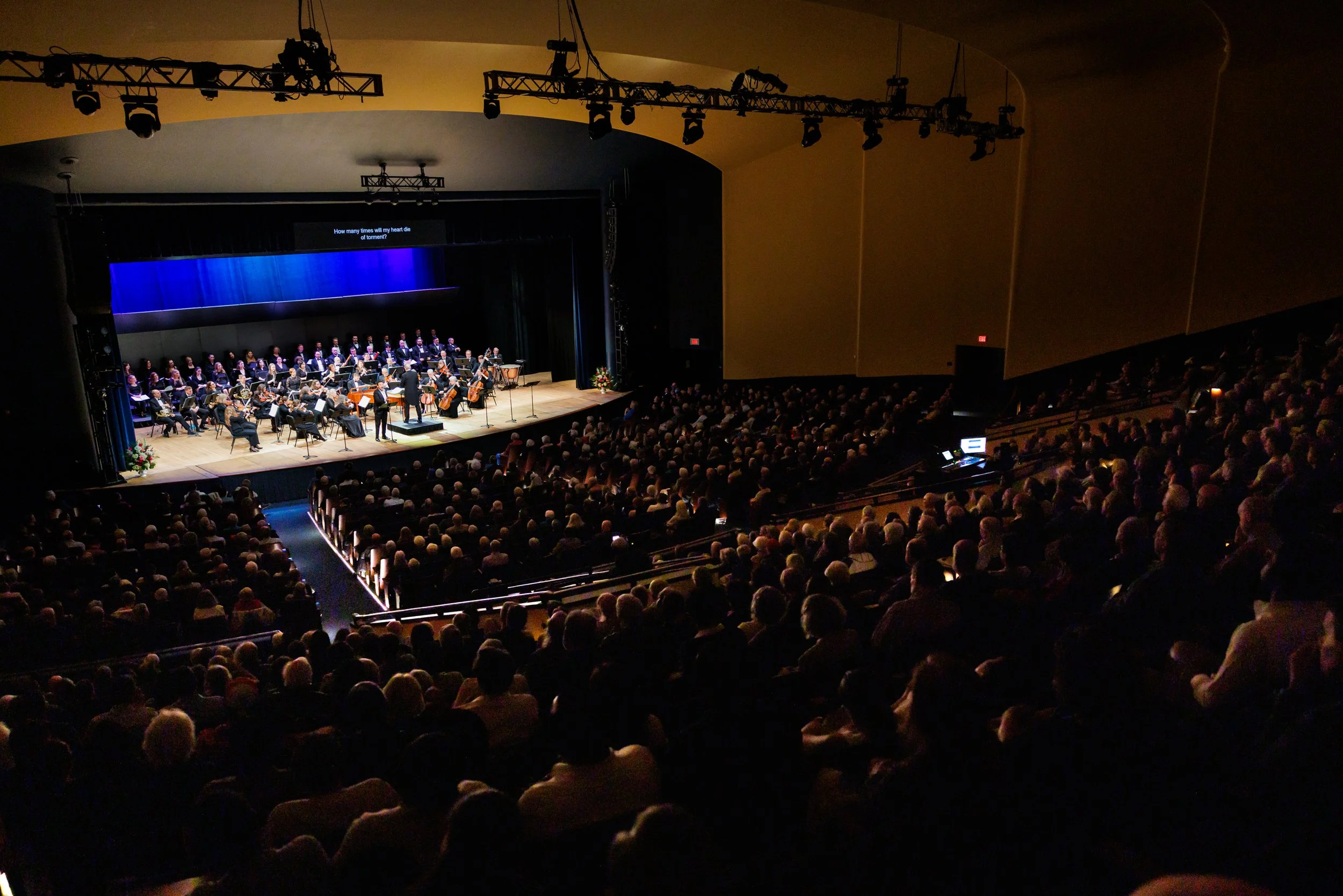
Photo of Washington Concert Opera cast, orchestra, and chorus on stage at Lisner Auditorium for their performance of Idomeneo. Photo by Elman Studio; courtesy of Washington Concert Opera.
Composer Wolfgang Amadeus Mozart and librettist Giovanni Battista Varesco based Idomeneo (1791) on Antoine Danchet's French libretto for composer André Campra’s Idoménée (1712), which used a Greek myth: On returning from success in the Trojan War, Idomeneo, King of Crete, makes a devil’s bargain with Neptune, Greek god of the sea. During a life-threatening storm at sea, to save his life, he agrees to sacrifice the first person he sees when he steps ashore on his homeland. Let that sink in, the pre-Enlightenment relationship between man and gods, which often became ‘be careful what you wish for’ stories. The first person that Idomeneo sees on shore is his son and only heir, Idamante. What’s a father to do in that situation? Let that sink in, the relationship between a father and son. Let’s digress further for a moment. Mozart’s father Leopold recognized his son’s extraordinary musical gift as a young child and led/pushed Wolfgang towards success as a musician and composer. Amadeus had reason to resent some of his father’s controlling actions, even though he loved him deeply. At this point, Mozart had not had a major success in opera. Was picking this story about a well-meaning father inadvertently risking his son’s life a coincidence? The opera premiered in January 1791, when Mozart turned 25. Idomeneo became a success. Leopold, a successful musician, composer, and teacher himself, took pride in his son’s accomplishments and his role in Mozart’s development, though in later years the relationship became strained when his guidance was no longer needed or wanted.
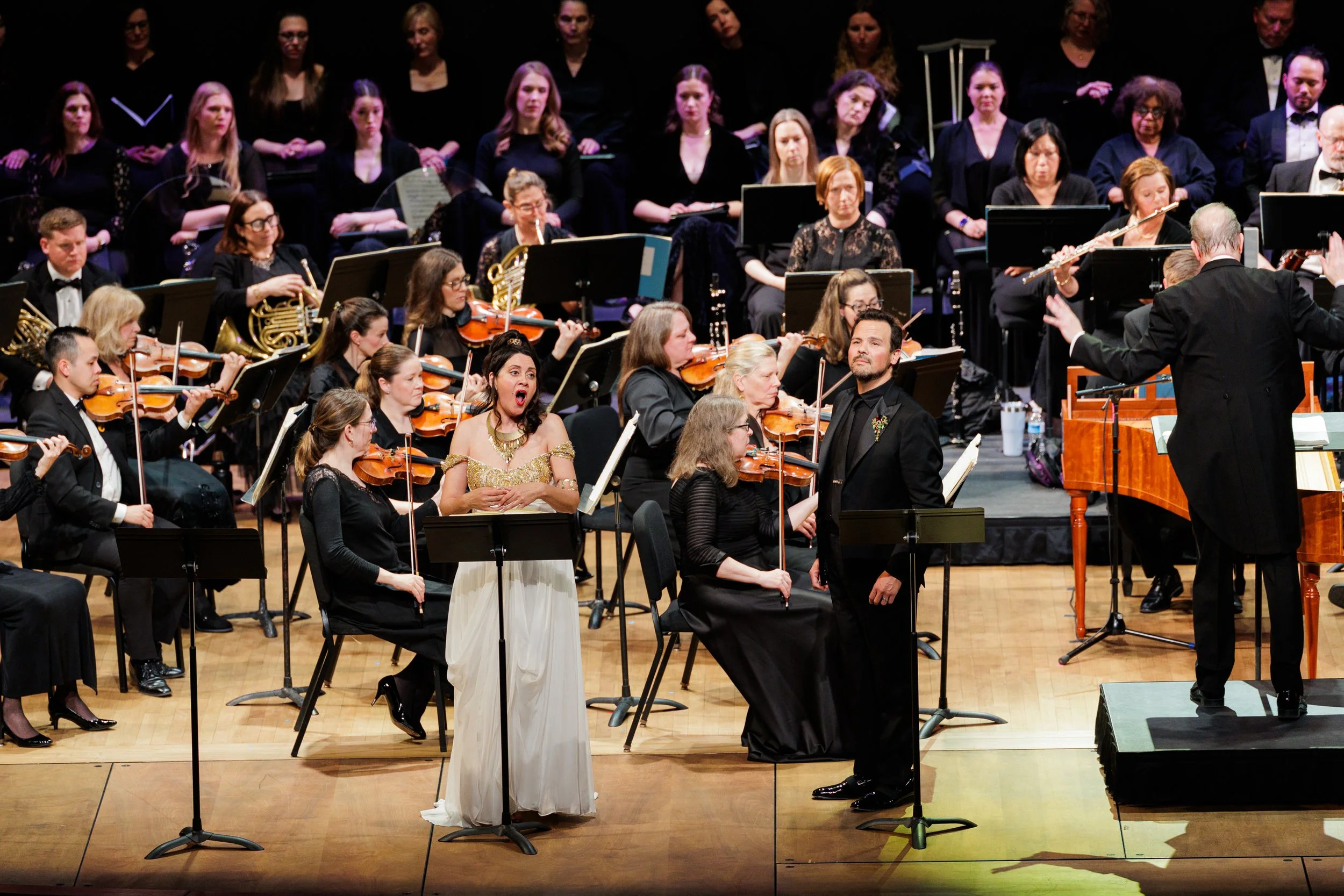
Amanda Forsythe as Ilia and David Portillo as Idomeneo. Photo by Elman Studio; courtesy of Washington Concert Opera.
Back to our story: One might think that repercussions around Idomeneo’s misstep might be enough for one opera, but this one has more, a lot more. Ilia, a captured Trojan princess, theoretically the enemy, has captured the heart of Idamante, and she is falling for him. Still more, let’s add that princess Elettra (also known as Electra) is in court, having fled Greece after successfully plotting the revenge murder of her mother, Clytemnestra. She is also in love with Idamante and not one to take kindly to being spurned. Add to the mix also that Neptune brings forth a sea monster to wreak death and destruction, putting pressure on Idomeneo’s decision making; the Greek gods cared not how many humans had to die to make a point. Throw in a chorus of townspeople who want Idomeneo to do something fast, and something has got to give. In this case, that something was an Enlightment era composer and librettist who diverted from the tragic myth (Idamante’s death and Idomeneo’s descent into madness) to give us instead a god’s benevolence after Idamante proves worthy of surviving and replacing Idomeneo, a virtue-affirming happy ending for all, with one uncomfortable exception – Elletra is not happy and tells us about it in an aria highlight of the show. All the humans having suffered and repented sufficiently to satisfy the gods, opera ends, and a well-deserved standing ovation concludes the evening.
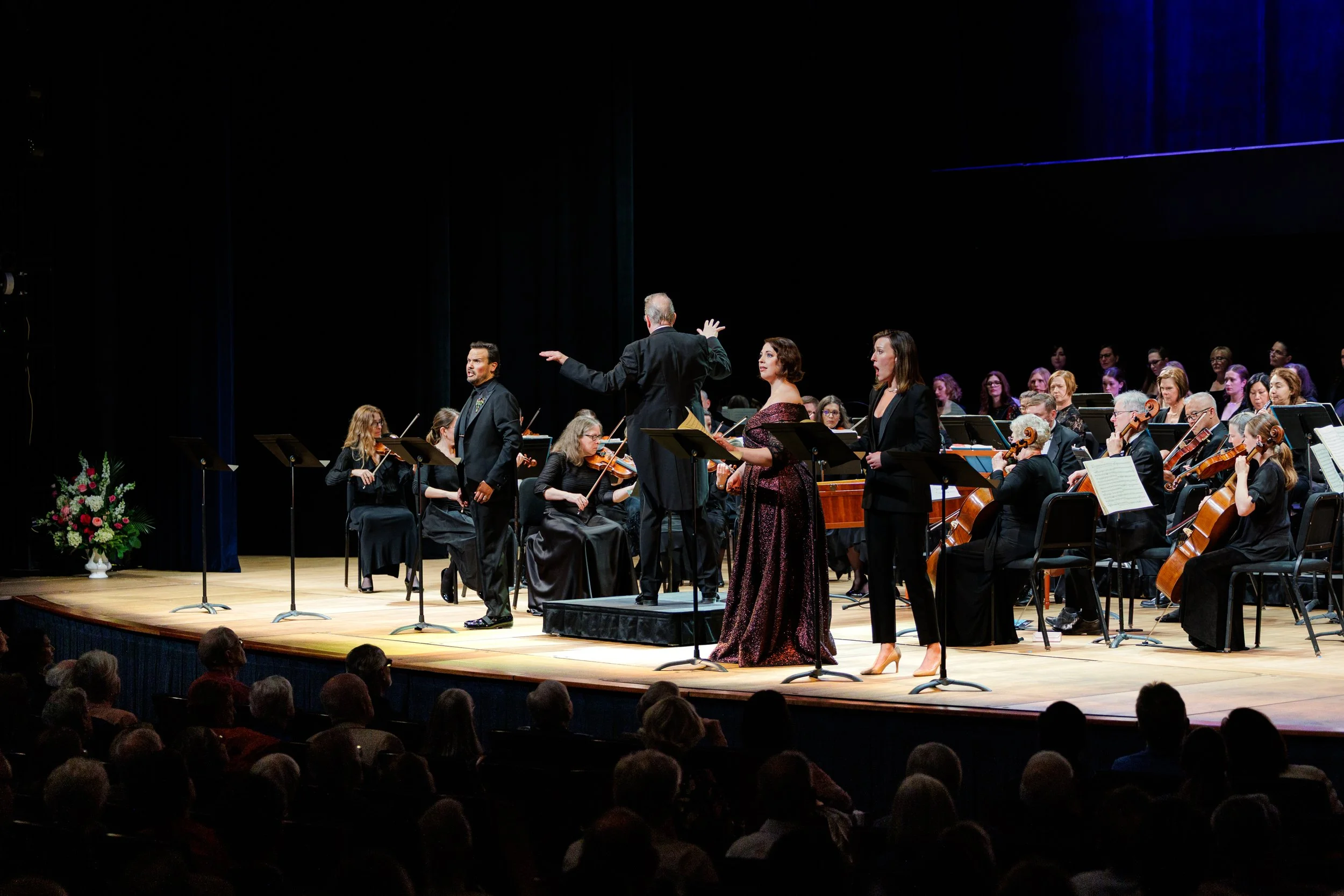
David Portillo as Idomeneo, Aviva Fortunato as Elletra, and Stephanie Doche as Idamante. Photo by Elman Studio; courtesy of Washington Concert Opera.
Maestro Antony Walker, as is typical, chose a terrific group of singers, some late replacements. As a group, they seemed there to not only entertain but to impress and, with the help of Mozart’s music, to fully convey the nature and feelings of their characters. They sang in character with some interactions between them, such that I got caught up in their many stories and forgot this was a concert opera, where the music and the singing are the focus. Idomeneo was played by star tenor David Portillo, well known to DC audiences. He has one of the most pleasing tenor voices I have heard and sang the role with expert craftsmanship and convincing passion. Princess Ilia was played by light lyric soprano Amanda Forsythe, a Grammy Award winner. She has appeared in many of the major opera venues in the US and Europe. She sang beautifully, her voice having a youthful endearing quality in this role. Idamante is a pants role (in Mozart’s day, a castrato role) and was sung by rising mezzo-soprano Stephanie Doche. Her voice commanded the stage and was well suited to the pants role; she was impressive, regally maintaining her composure despite having to pursue a love, face rejection from her father, fight a sea monster, and willingly accept the call for her mortal sacrifice. In reporting on a previous Mozart pants role in WCO’s La Clemenza di Tito last year, I commented that she “was stunning, a definite wow”, also apt for her performance in Idomeneo. Rising star soprano Aviva Fortunato (a late replacement for soprano Amanda Woodbury who had to withdraw) gave her own ‘wow’ performance. She sang with power, emotion, and ravishing coloratura, her final aria a highlight of the evening.
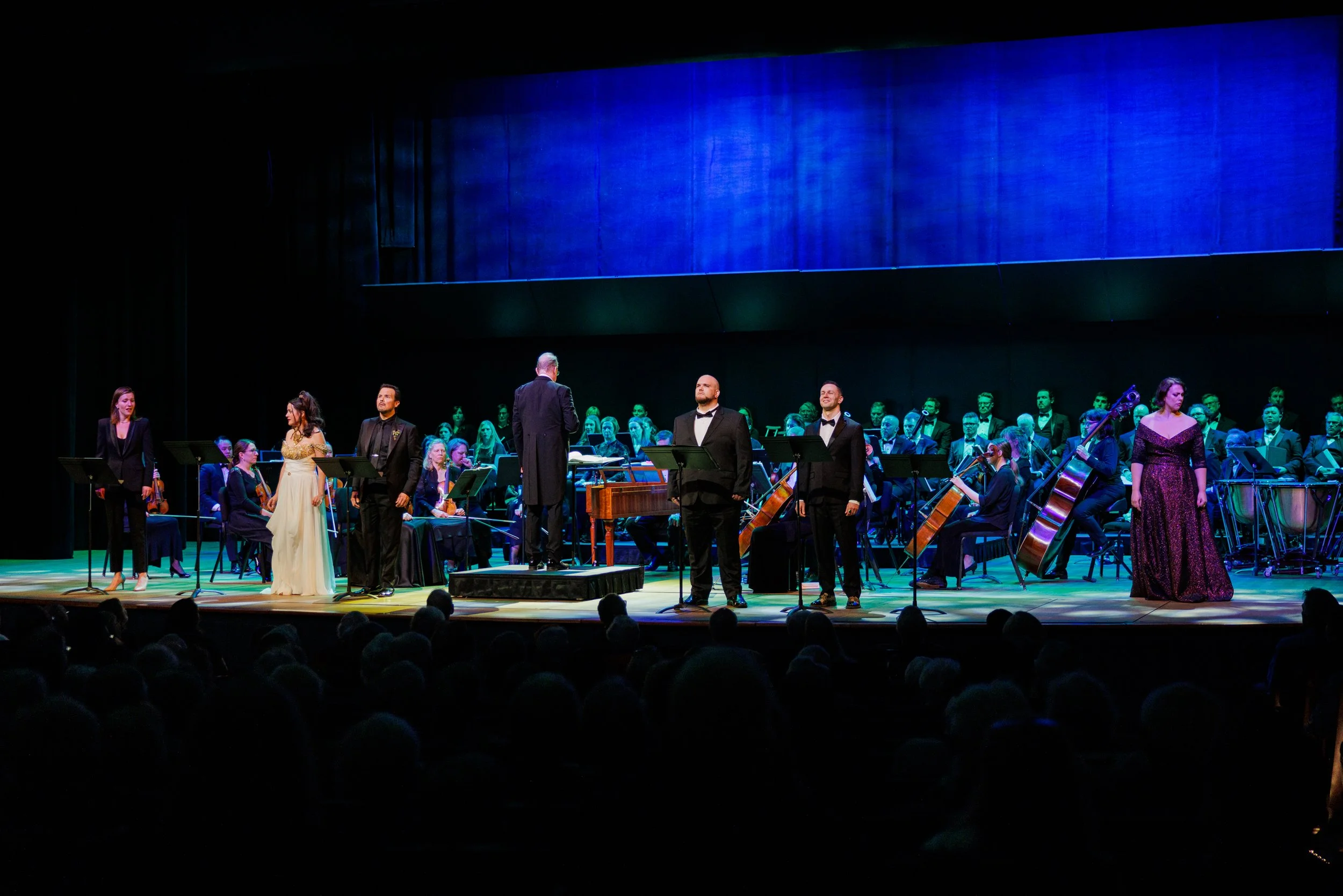
l to r: Stephanie Doche as Idamante, Amanda Forsythe as Ilia, David Portillo as Idomeneo, David Artz as High Priest, Matthew Hill as Arbace, and Aviva Fortunato as Elletra. Photo by Elman Studio; courtesy of Washington Concert Opera.
Local, highly regarded tenor Matthew Hill, now a veteran with WCO, made Arbace, the King’s advisor, seem like a major role with his singing, as he helped Idomeneo confront the problem of how to save his son. Master Sgt. Hill is also a vocalist and enlisted conductor of the US Air Force Singing Sergeants. Also adding to the performance admirably were bass-baritone Jim Williams as the off-stage voice of Neptune and tenor David Artz as the High Priest, pleading with Neptune to spare Idomeneo. Joining the orchestra on stage was the Washington Concert Opera Chorus under the excellent direction of Chorus Master David Hanlon. Mozart used the chorus in Idomeneo more than in any of his other operas, serving many roles. The Chorus vocals were impressive in serving these needs and as a group, they were one of the stars of the night.
Mozart received a commission to write this opera for the Munich winter festival and went there alone to compose the opera. He communicated with the librettist by mail through his father. Mozart’s attention to detail was such that he molded the score to fit the capabilities of the singers he had available to him. Artistic Director and Conductor of WNO, Antony Walker contends that one reason Mozart put so much into this opera was that he wanted to show his father what he could do. We were the beneficiaries of attention to detail of both Mozart’s and Walker’s conducting. The music in Idomeneo had the qualities we want and expect from Mozart, music that was beautiful, creative, inventive, and melodious in helping the opera’s characters to express a range of emotions, though I must admit to the feeling that at a few points his musical playfulness lessened the match of music and emotions being expressed in the lyrics. The cohesion between orchestra and singers was well done, especially considering the limited rehearsal time for some of the participants. As I listened to the expert playing of the Washington Concert Opera Orchestra led by Conductor Walker, I thought the music was not only Mozartian in its beauty but also fun, drawing me more into the music.
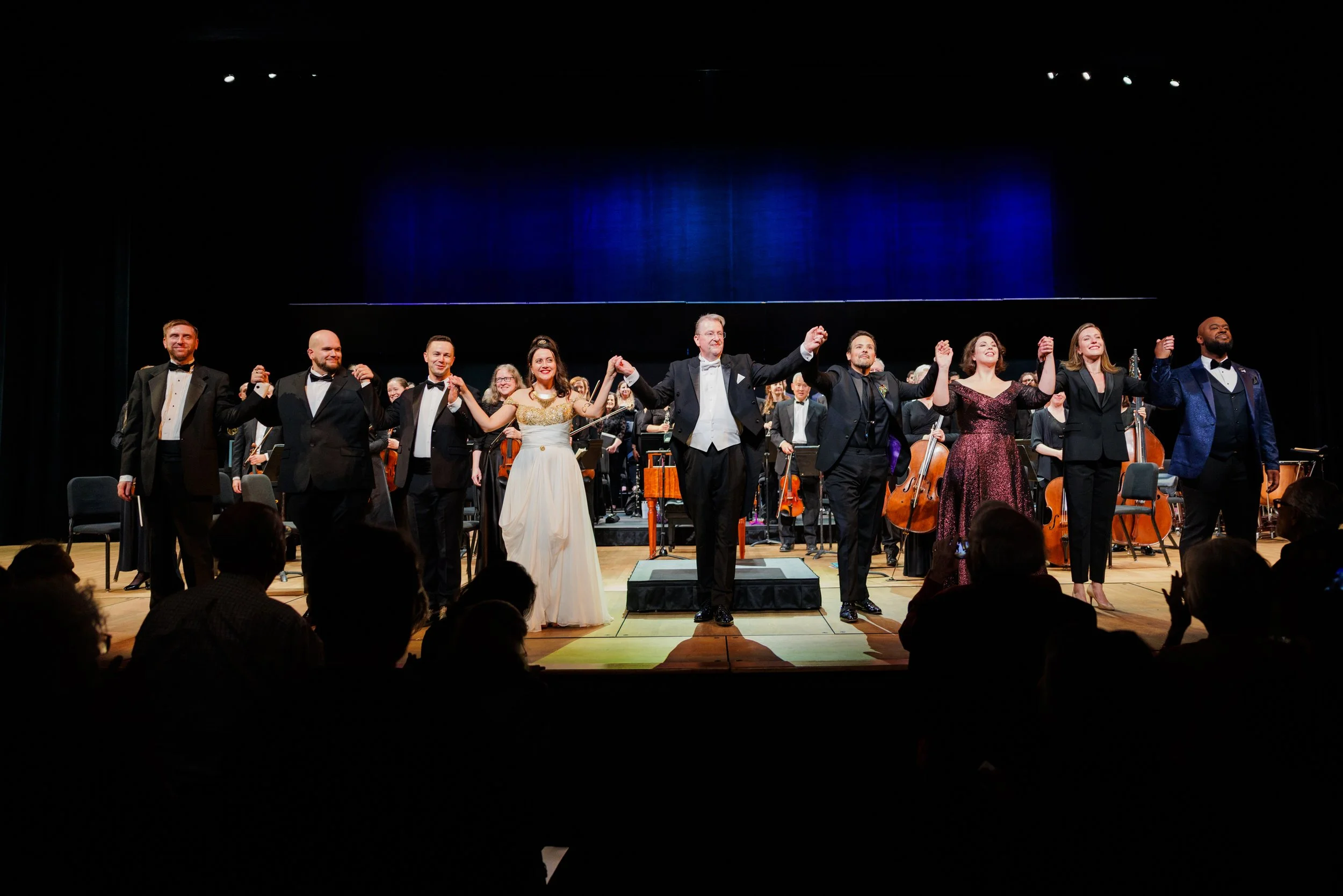
l to r: Chorus Master David Hanlon, David Artz, Matthew Hill, Amanda Forsythe, Conductor Antony Walker, David Portillo, Aviva Fortunato, Stephanie Doche, and Jim Williams. Photo by Elman Studio; courtesy of Washington Concert Opera.
In my blog report on Wolf Trap Opera’s 2017 performance of Idomeneo which expressed my concerns with the plot while enjoying the singing and music, I stated: “it strikes me that Idomeneo might make an excellent concert opera.” WCO turned Idomeneo into an outstanding concert opera and made me a fan of Mozart’s breakout opera, which I’m sure had made his daddy proud. The moral of this story is that when you have beautiful music by Mozart played this well and singers of this caliber to handle the vocals, you will respond like Neptune that all has been redeemed. Leopold would be proud.
The Fan Experience: Washington Concert Opera scheduled one performance of Idomeneo, held on May 9 in Lisner Auditorium. The opera was sung in Italian. Supertitles in English were shown overhead. The performance lasted slightly over three hours, including one 25-minute intermission. A video recording on YouTube is available that features Co-Founder Peter Russell and Artistic Director Maestro Antony Walker discussing Idomeneo as part of WCO's Opera Gems.
Idomeneo was WCO’s final opera for the current season. WCO has announced three productions for next season: Haydn’s Armida, September 24; Massenet’s Don Quichotte, March 14; and Bellini’s Il Pirata, May 2. Sounds like fun to me.
In my experience, all the seats in Lisner Auditorium are fine for viewing and hearing the performance, though the sound is probably better towards the center of the auditorium. The seats in Lisner Auditorium were relatively recently upgraded with more legroom for the orchestra section and more comfort for all. However, be aware, the terrace seats above the first row continue to have limited legroom. Parking on the street around the auditorium is catch-as-catch-can; be sure to read the signs! There is a convenient underground pay parking lot on H Street across from Lisner. You can pay with a credit card at stations after you return from the performance or on exit from the lot. Beverages, but not snacks, are offered for sale at bars upstairs and downstairs in Lisner. More attendance info can be found at this link.