
Pyotr Ilyich Tchaikovsky composed Eugene Onegin in 1879, the most popular of his eleven operas. For this opera, Tchaikovsky chose a deep dive into the human emotions of people you might know, even when looking into a mirror, rather than the grandeur of opera focused on leaders and major events. The music in Onegin is pure Tchaikovsky: gorgeous melodies and lush orchestration that illuminate the emotions consuming the characters, touching the audience deeply. The opera is based on an eponymous novel in verse authored by the great Russian poet, Alexander Pushkin. The libretto is by Tchaikovsky and composer friend Konstantin Shilovsky, which stays close to Pushkin’s poetry. Tchaikovsky is reported to have been a sensitive soul who felt things deeply, and he is also said to have selected this story, partially motivated by his having married a young woman for the wrong reasons, quite a story in itself. He called this opera ‘lyrical scenes’ to distinguish it from ‘grand opera’. He was telling the story of how a young man and a young woman failed to connect, one terribly flawed.
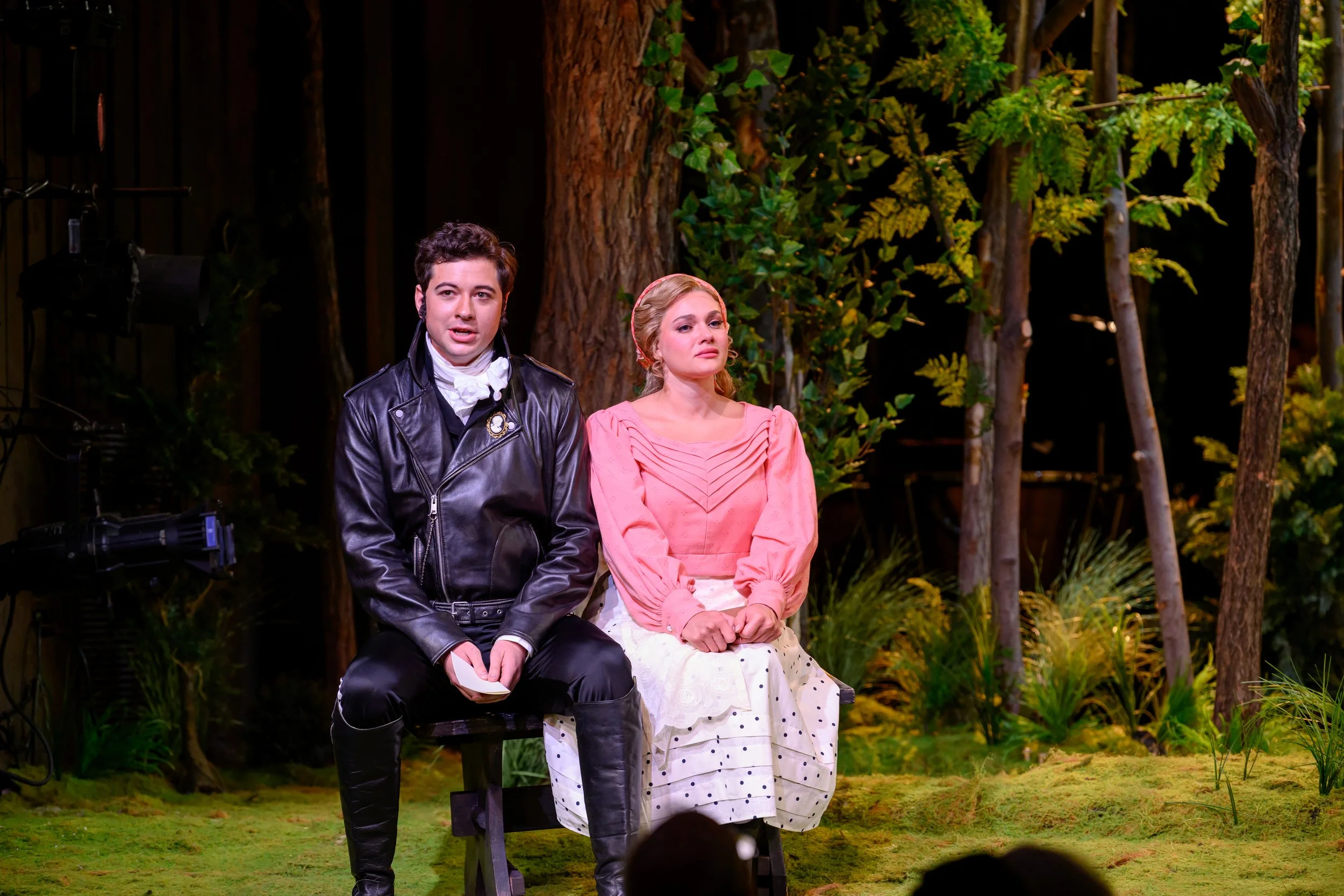
Onegin (Finn Sagal) sits with the young Tatiana (Magdalena Kuźma). Ah what might have been. Photo by Rich Kessler; courtesy of Wolf Trap Opera.
The plot: Tatiana is a young woman coming of age on a country estate in Russia in the 1800s. She meets and falls deeply in love with a young aristocratic nobleman, Eugene Onegin. She is pure-hearted and sincere. Onegin, of higher stature, is arrogant and self-centered. He tells her he appreciates her honesty and sincerity, but while he might have considered her, he has no interest in marriage; he warns her to beware of her naivete – a less noble man might take advantage; she is humiliated. He attends Tatiana’s party with his friend Lensky. Annoyed at Lensky for dragging him to a boring party, he flirts with Olga, Tatiana’s sister and Lensky’s intended. Lensky becomes incensed, declares Onegin no longer his friend, and challenges him to a duel. They duel, neither man really wanting to, and Lensky is killed to everyone’s horror and dismay. Onegin goes traveling for a few years to get away from it all, and on his return, he sees Tatiana at a party, and his feelings for her are rekindled. He discovers she is married to an acquaintance, Prince Gremin, who loves her deeply. She is now a Princess. Onegin is consumed by passion, and he declares his love to her. He pleads with Tatiana to leave Gremin and go away with him. She admits her love for him but tells him, with conviction, that she will remain faithful to her husband. Tatiana has accepted the life she is living. Eugene Onegin is a distraught, broken man. A soap opera plot? Sure, but presented with the impact of high art.
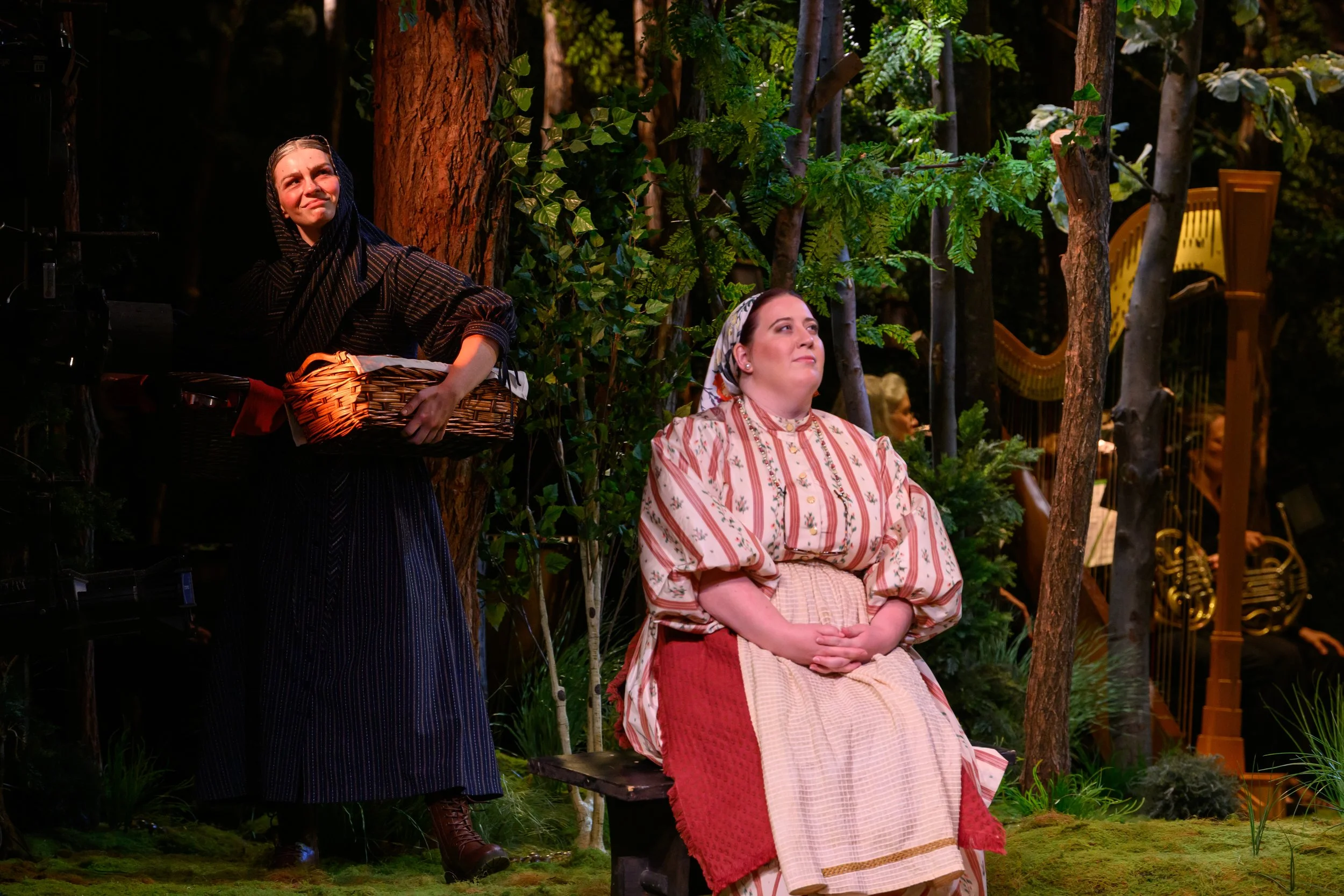
l to r: Nurse Filipyevna (Cecilia McKinley) and Madame Larina (Aubrey Odle) reminisce. Photo by Rich Kessler; courtesy of Wolf Trap Opera.
Eugene Onegin’s themes are as relevant today as they were 150 years ago: feelings of love can be all-consuming and worth the risk, but rejection is painful and degrading; feelings strongly felt hold primacy over society’s rules, but the rules provide protective railings and have power; emotional immaturity has consequences; genuine integrity requires personal sacrifices; and opportunities have time limits. Tatiana’s nanny/nurse Filipyevna early in the opera sings that we seek happiness and heaven sends us habit. That’s the playing field. Gear up.
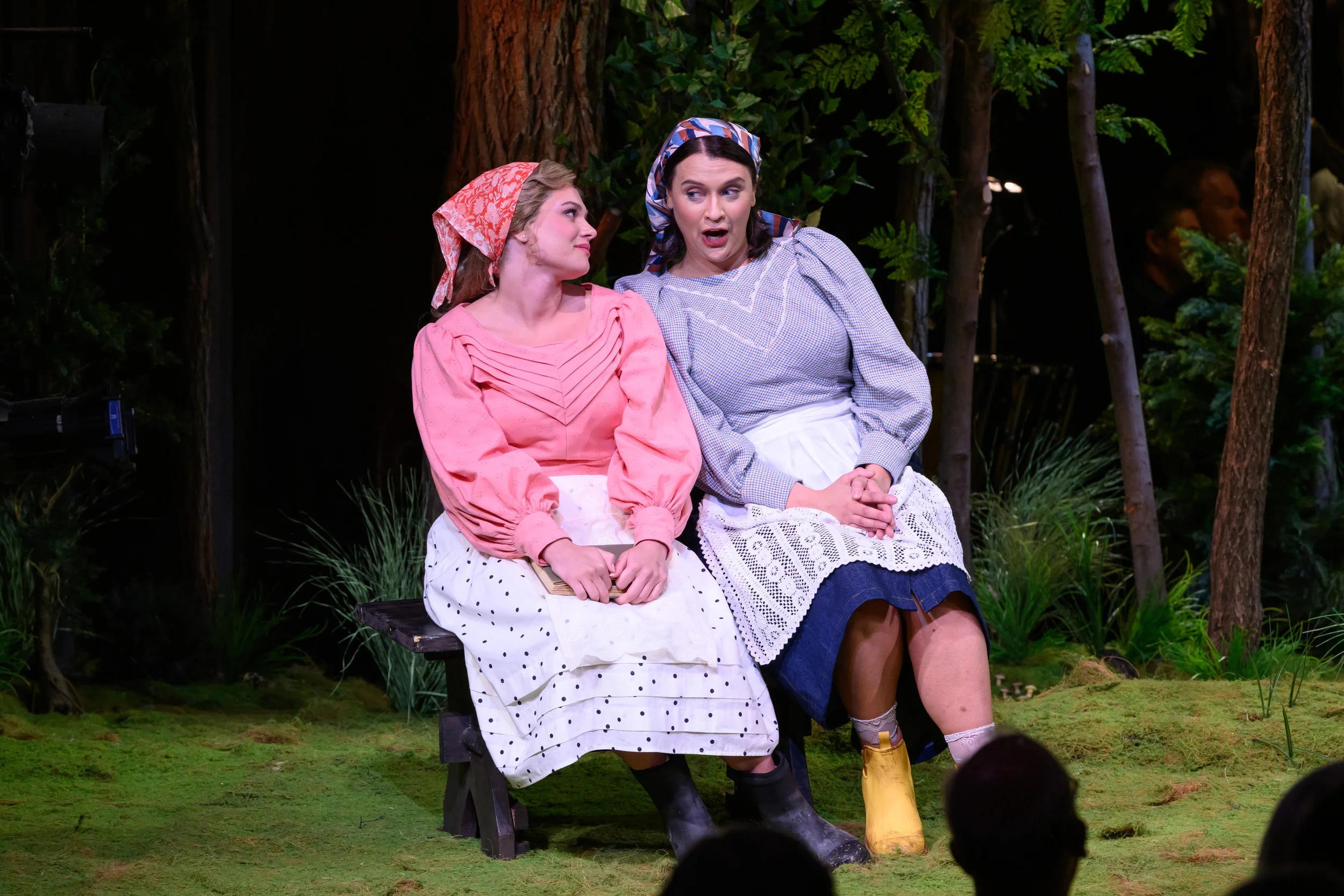
Tatiana (Magdalena Kuźma) and Olga (Elissa Pfaender) chat. Photo by Rich Kessler; courtesy of Wolf Trap Opera.
Tchaikovsky’s music in Eugene Onegin is among his most beautiful compositions. The Wolf Trap Orchestra, which included thirty-three musicians, was led by Conductor Steven White, who has conducted for many of the nation’s leading opera houses, including the Met. I thought the orchestra got off to an unimpressive beginning but soon wrapped us thrillingly in Eugene Onegin’s beautiful music, swept up and along with Tatiana’s recurring theme, enchanted by the embellishments of the oboe and clarinet. Lapses in coordination between the singers and the orchestra were few. Having the larger orchestra necessitated their placement on the stage, which was definitely the right move!
Wolf Trap Opera’s cast of emerging artists delivered a powerful, affecting performance of Tchaikovsky’s drama, both singing and acting; this group of soloists and the chorus deserved the larger orchestra. The central role of Tatiana was played by soprano Magdalena Kuźma, who has collected high praise for her performances as Papagena for the Metropolitan Opera and as Juliette for the Glimmerglass Festival. She did not disappoint, singing beautifully and proving an excellent actress in conveying the range of emotions experienced by both the young and the more mature Tatiana. Her performance in the famous “Letter scene” was a highlight of the performance, as it should be. Early singers in the opera were mezzo-soprano Aubrey Odle playing mother Larina, nanny/nurse Filipyevna sung by contralto Cecelia McKinley, and Tatiana’s sister Olga played by mezzo-soprano Elissa Pfaender. All were sung impressively. Ms. Odle seemed natural onstage and in voice. Ms. McKinley who impressed in last year’s Dialogues des Carmélites, impressed again. Ms. Pfaender, who sang Carmen for WTO last season demonstrated a lovely, engaging, low-toned mezzo voice.
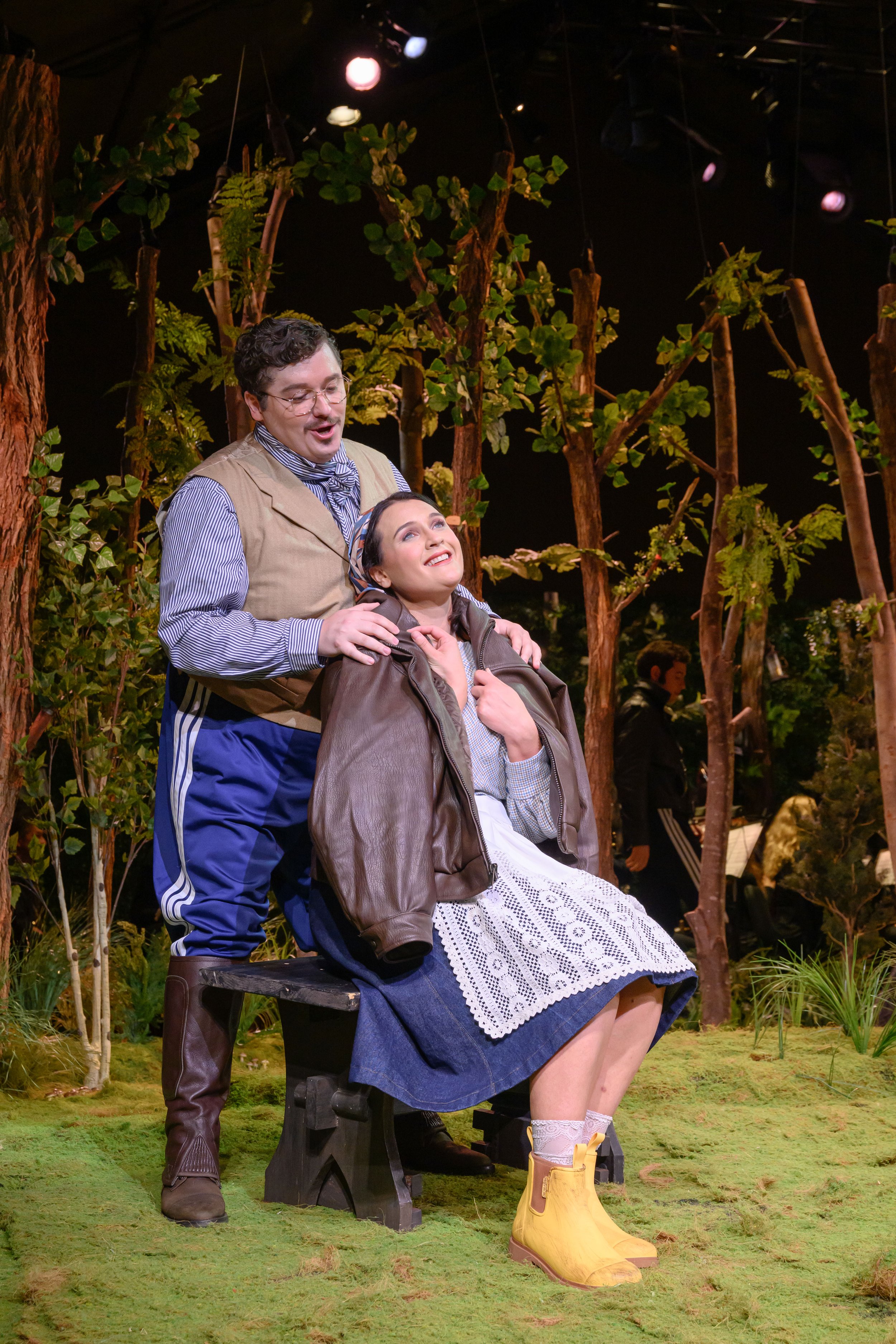
Lensky (Daniel O’Hearn) courting Olga (Elissa Pfaender). Photo by Rich Kessler; courtesy of Wolf Trap Opera.
Lensky played by tenor Daniel O’Hearn and Onegin played by baritone Finn Sagal had an entrance made auspicious and perplexing by wearing leather jackets and gym pants in 19th-century Russia. Mr. O’Hearn sang beautifully in an endearing way with Olga before demonstrating impulsive, angry responses to Onegin. Mr. Sagal has a sit up and take notice baritone voice that I suspect will make him a much sought-after baritone. He sang well and portrayed Onegin so well that I grew to dislike him immensely, maybe a little envious of his youthful good looks. Jack Hicks was a delight as Triquet, the French singer at Tatiana’s party, and for Sunday’s performance, John Arlievsky played the role of Zaretsky, singing well as the person officiating the duel.
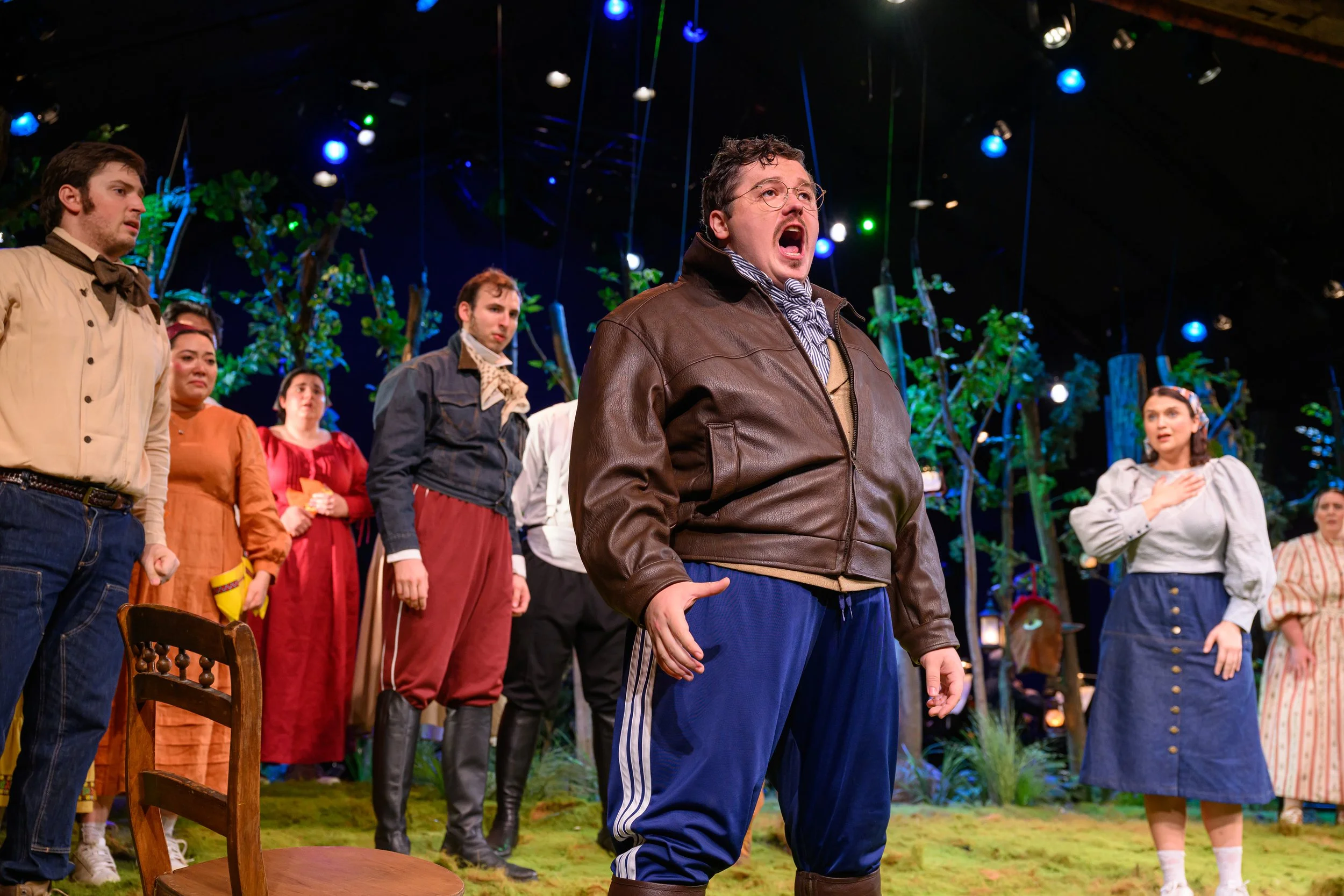
An emotionally wounded Lensky (Daniel O’Hearn) vents his anger as Olga (Elissa Pfaender) looks on in distress. Photo by Rich Kessler; courtesy of Wolf Trap Opera.
As impressive as the soloist cast was, the chorus was their match; kudos to Chorus Master and Principal & Russian Diction Coach, Ksenia Leietkina. The Chorus was provided by Wolf Trap’s Studio Artists and my first response to hearing them sing as they entered down aisles from the back of the room was “Wow!”. Every time called on in Eugene Onegin, this group was knock your socks off good!
Okay, we have gorgeous music, beautiful singing, and excellent acting performances. What about the staging? Let’s talk, this aspect led to some strong disagreements between my wife and me. First, the elements on which we agree:
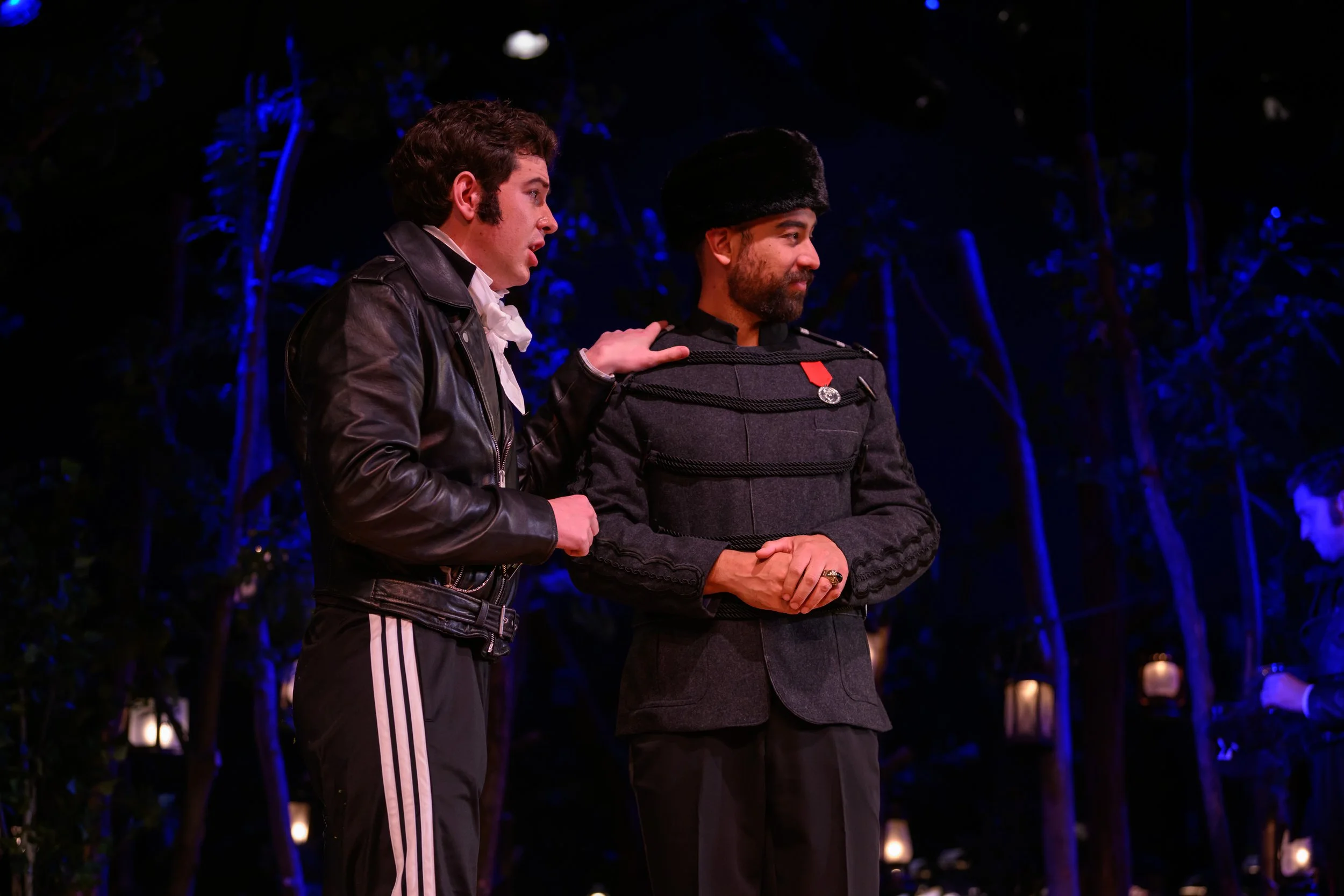
Eugene Onegin (Finn Sagal) learns that Prince Gremin (Sergio Martinez) has married Tatiana. Photo by Rich Kessler; courtesy of Wolf Trap Opera.
The overall performance of this opera by Wolf Trap Opera was strong and enjoyable. Director Emma Griffin did an excellent job of organizing the elements of the drama into a smooth and compelling flow, especially given the size of the cast with a sizeable chorus on stage together; the story was well told. Director Griffin managed well with the usual constraints imposed by budgets, and the special constraints of the small stage made smaller by having the orchestra placed at the back of the stage. The lighting was well done by Alejandro Fajardo, helping to focus attention away from the trees, and the costumes by Christopher Ford were supportive of the drama overall.
The biggest bone of contention was the set which had a stand of trees separating the orchestra and the role performers and creating pathways for entry and exit or wandering about for the players. My wife thought it was fun and refreshing to have something different. For me, though the setting was appropriate for some scenes, it was a mood breaker to have scenes normally played inside…the estate or the royal ballroom, played in front of an attractive but distracting stand of trees. Our second biggest difference in response was the director’s choice to include characters wearing a bear mask and other masks of other animals included in Pushkin’s serial poem, but not in Tchaikovsky’s drama, for the purpose of adding fantastical elements to convey the threats the situation posed for Tatiana. Tschaikovsky chose to keep a tight focus on the human drama, a staging that I prefer, though the inclusion of the bear scene can be impactful. We agreed on the oddity of having Lensky and Onegin wear 1950s leather jackets and gym pants.
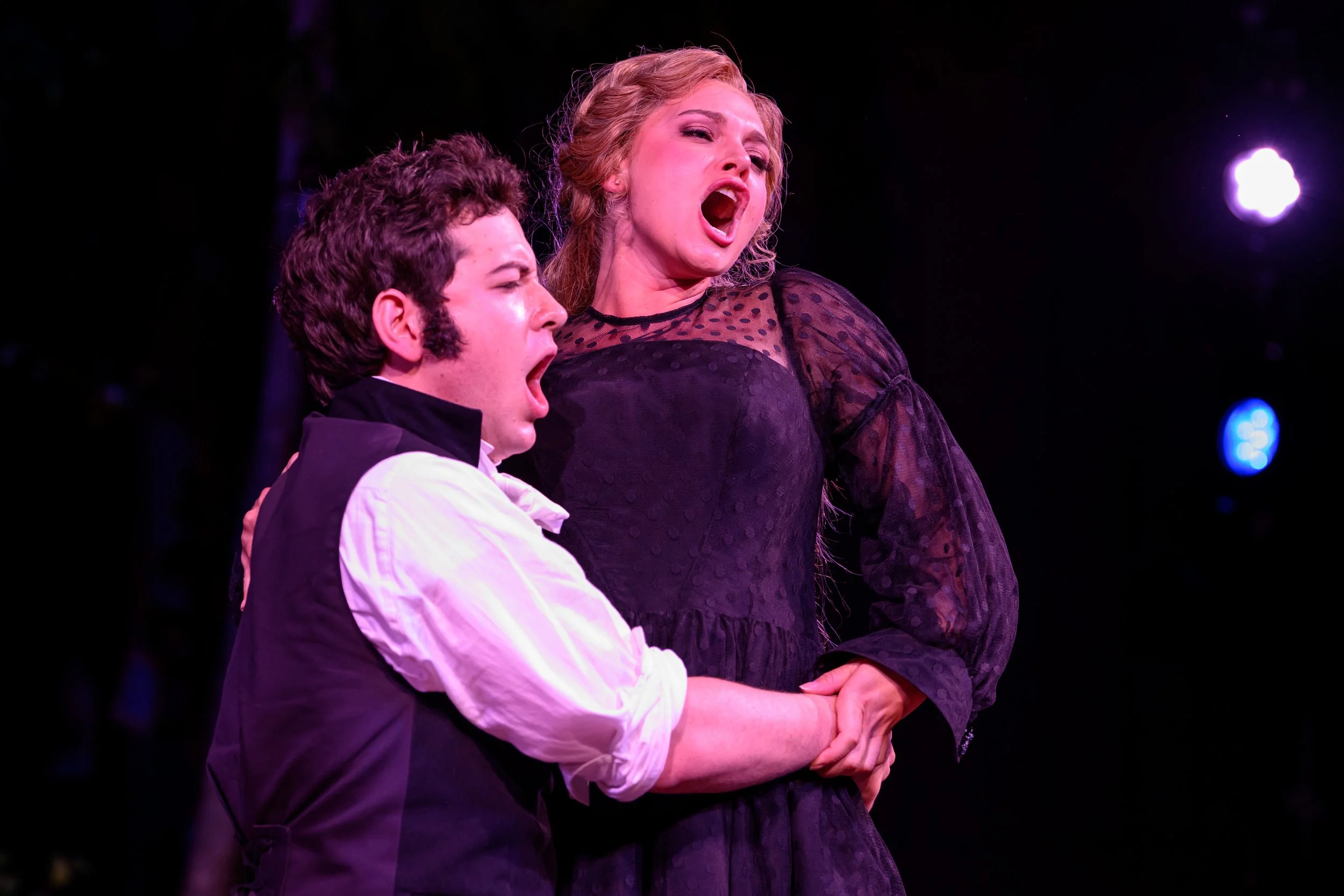
A desperate Eugene Onegin (Finn Sagal) pleads with Tatiana (Magdalena Kuźma) to choose him. Photo by Rich Kessler; courtesy of Wolf Trap Opera.
I looked back over two other productions of Eugene Onegin that I have reported on, one by the Met and one by Washington National Opera. I loved the Met 2017 production, but for the WNO 2019 production, I was highly critical, calling it ‘Opera in a Box’. Bottom line: For most operas, I enjoy seeing the experimentation directors try to make points or add to the entertainment value, but for Eugene Onegin, I guess I am guilty of wanting this opera one way, a personal thing, I suppose. That way was served impressively by the singer/actors, the orchestra, and the chorus; I loved those. I’ll stop there. If you want more, talk to my wife. Oh, the title – Roadblocks to Love – Onegin had some, and I guess I do too, though not for my wife of 41 years.
The Fan Experience: Wolf Trap Opera scheduled performances of Eugene Onegin for July 17, 19, 23, and 25 in The Barns. The opera is sung in Russian with supertitles shown on screens overhead. The performance lasted a little over three hours with one intermission. A pre-opera talk was given one hour before the performance. All performances were sold out but check with the box office for returns.
Wolf Trap Opera’s final opera production this season will be Tosca in the Filene Center on August 7.
The Barns, overall, is an excellent venue for opera, intimate and with good acoustics. Even the seats at the back and in the balcony are relatively close to the performers, but some in the very front and in the back on the floor lack a view of the surtitles. The floor seats are not tiered but those in the balcony are; some balcony seats are restricted view by structural posts. Food and beverages are available before the performances and during intermissions; drinks are allowed in the theater. During DC’s hot, humid summers, it has excellent air conditioning. Parking is free, plentiful, and easy-in/easy-out.