
The “truth”. In the 1992 movie A Few Good Men, actor Tom Cruise shrieks, “I demand the truth,” and famously, actor Jack Nicholson exclaims, “You can’t handle the truth!” Accepting the truth can be a journey that sets you free, as the aphorism states, but…the journey doesn’t end there, and you can’t go home again. Lili Elbe, in its American premiere by Santa Fe Opera, tells the story of an artist, Einar Wegener, living as a man in Denmark, who comes to the full realization, as though crossing through a one-way door, that Einar is a woman. How she and her family deal with the aftermath is the focus of the story, the choices she makes and those forced on her by her spouse, family, friends, and society in the 1920s and 30s. There was no happy ending for Lili Elbe. Attending the performance was meaningful but painful; other compensations for the experience included expressive music, fabulous staging, and a beautiful arts experience.
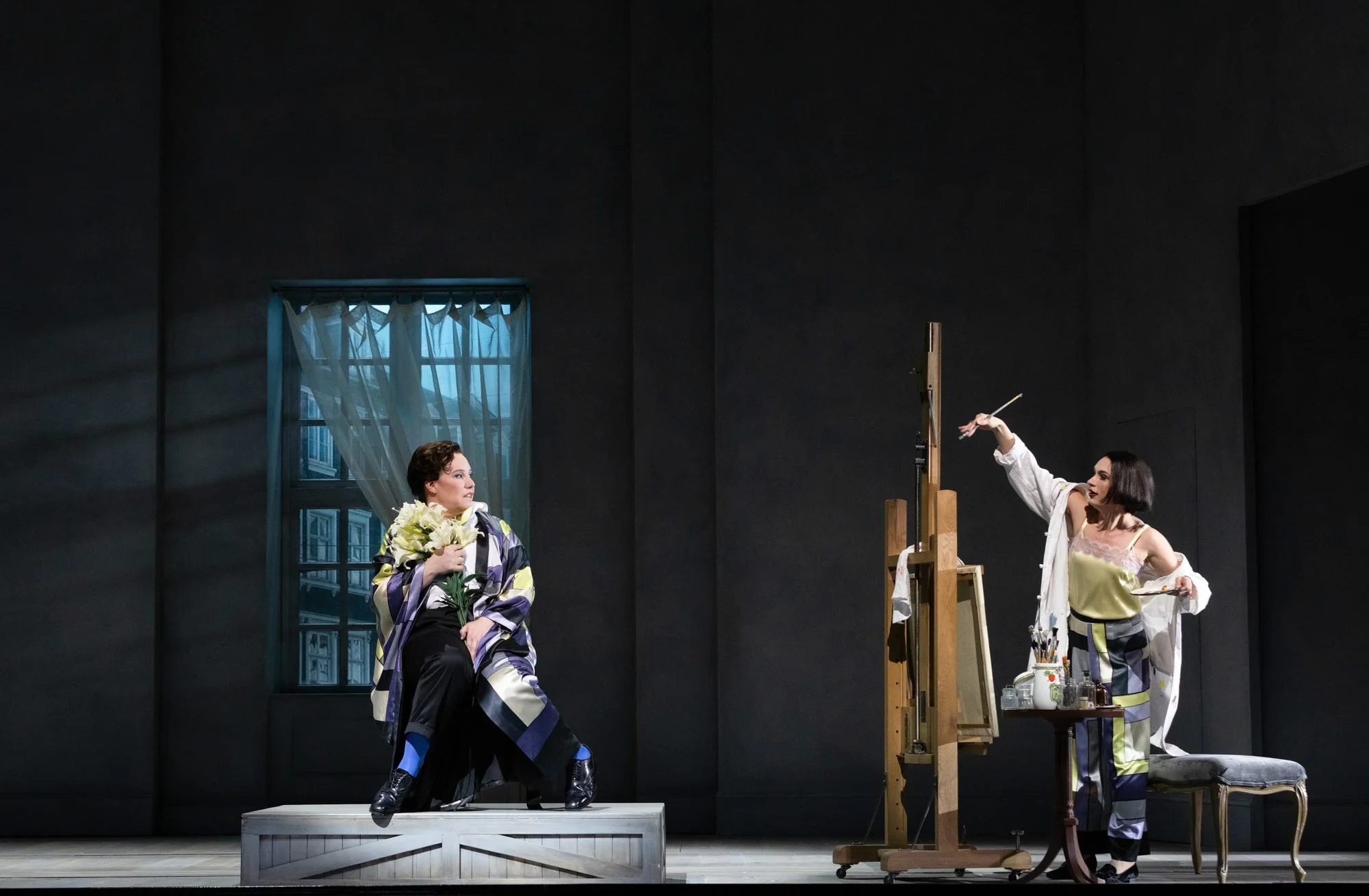
The pivotal moment when Einar (Lucia Lucas) poses as a female actress for wife Gerta’s (Sylvia D’Eramo) painting. Photo by Bronwen Sharp; courtesy of the Santa Fe Opera.
Lili Elbe, known originally as the landscape painter Einar Wegener, was a real person who later recognized and accepted her transgender identity in a pivotal moment, posing as a female model for her portrait painter wife and setting out on a course to become her idea of a complete woman. Composer Tobias Picker, librettist Aryeh Lev Stollman, and trans baritone/dramaturg Lucia Lucas present her journey as a human one, pioneering but not heroic in a grand sense, living her life, rather than promoting a cause. Through a series of 15 scenes presented in chronological order. We come to know a woman, complete with human flaws, born a man genetically and who lived so for most of her life, her struggle to self-actualize, her and her wife’s move to the more artsy accepting society in Paris of the 1920s, her rejection of same sex marriage, the dissolution of her marriage with King Christian of Denmark granting her an annulment, Lili’s and her wife Gerda’s selection of new partners, the mixed response of her family, her belief that to remarry she must be able to bear children, and efforts to be among the earliest to receive gender affirming surgeries, the last of which, to receive a uterus transplant, led to her death, and an ending where Lili and Gerda reaffirm their deep abiding love for one another. This is the outcome of a composer/librettist/dramaturg team wanting to promote understanding. Composer Picker has expressed the opera’s extra-musical message in stronger terms, commenting that the opera’s message is “we are all siblings”.
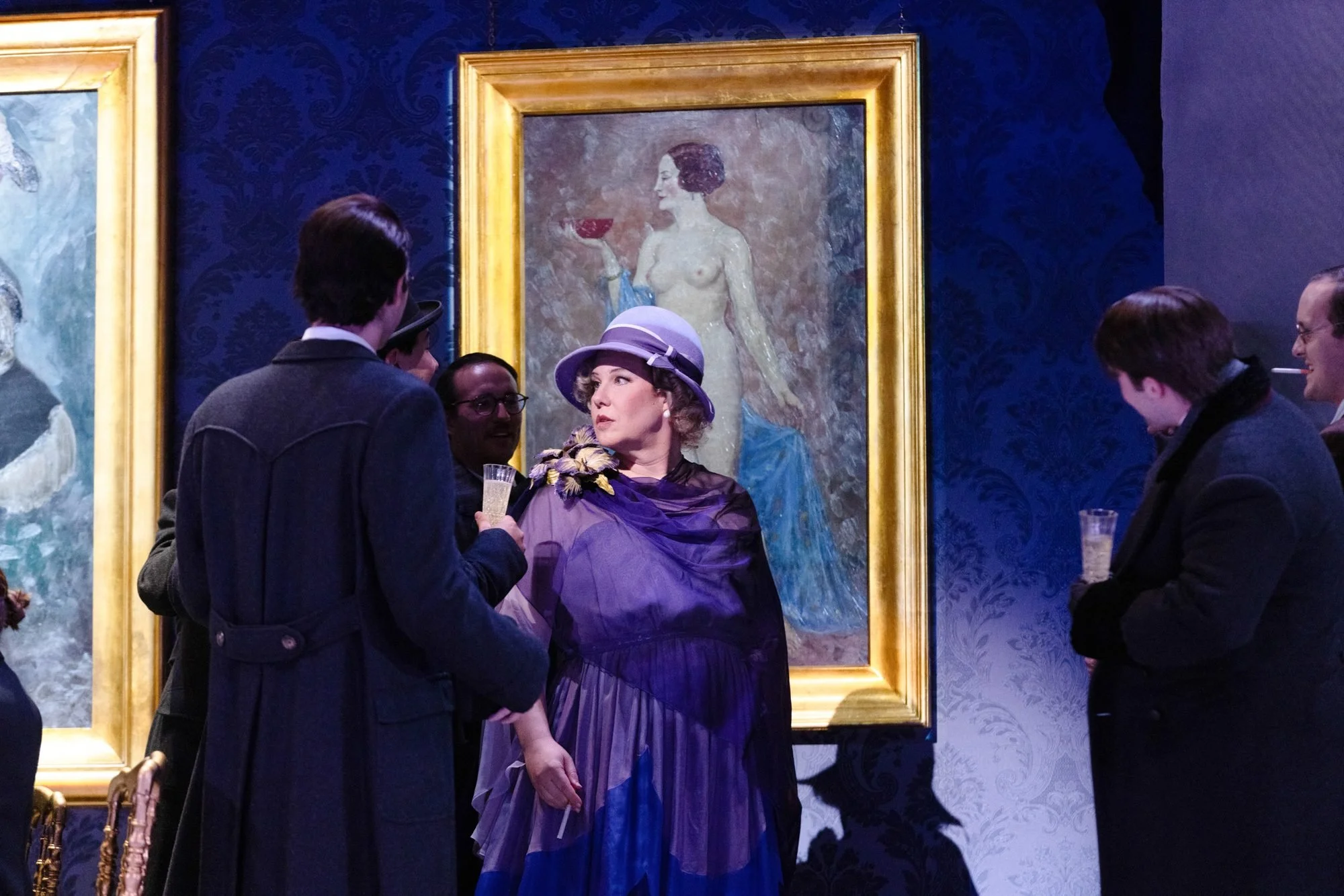
In her first outing as Lili (Lucia Lucas), she is the hit of the party. Photo by Bronwen Sharp; courtesy of the Santa Fe Opera.
Some background I found interesting: Composer Tobias Picker’s first opera, Emmeline, was premiered at the Santa Fe Opera 30 years ago. Composer Picker and librettist Stollman are married and have composed one other opera together, Awakenings, which was premiered in 2022 by the Opera Theatre of St. Louis. I saw that premiere and thought it was excellent. Composer Picker originally wanted to compose an opera to commemorate the 50th anniversary of the 1969 Stonewall Uprising, but shifted to his interest in Elbe’s story, which he saw in the 2015 film, The Danish Girl. He was Artistic Director of Tulsa Opera when he invited baritone Lucia Lucas to audition and cast her as Don Giovanni, another transgender first; since 2022, she has performed in two different Met Opera productions. Their shared interest, along with Stollman’s blossomed into the creation of Lili Elba. Stollman brings a high level of medical expertise to the effort; his day job is as an MD neuroradiologist at Mt. Sinai Hospital. In one scene where Lili’s abdomen has been damaged by ill-advised X-ray treatments, he has Lili’s brother Marius make a disparaging comment on radiologists of the period. Dramaturg Lucia says that in measure Lili’s story was her story; she had similar conversations with her own wife 20 years ago which occurred between Lili and Gerda; fortunately, she and her wife were okay with same-sex marriage. Gerda was a successful artist herself and used her earnings to help Lili afford her surgeries, another demonstration of the love between them. While the team drew heavily on Lili’s published memoir, the storyline was heavily researched in available resources. Some aspects are generally agreed on, and likely what happened, but had to be inferred since existing medical records from that time are incomplete. For example, Lili’s real-life surgeon Dr. Warnekos is portrayed as more interested in seeking fame than in his patients’ well-being. The team felt justified in this portrayal given that Warnekos later joined the Nazi party and participated in many sterilizations of individuals to prevent them from having children.
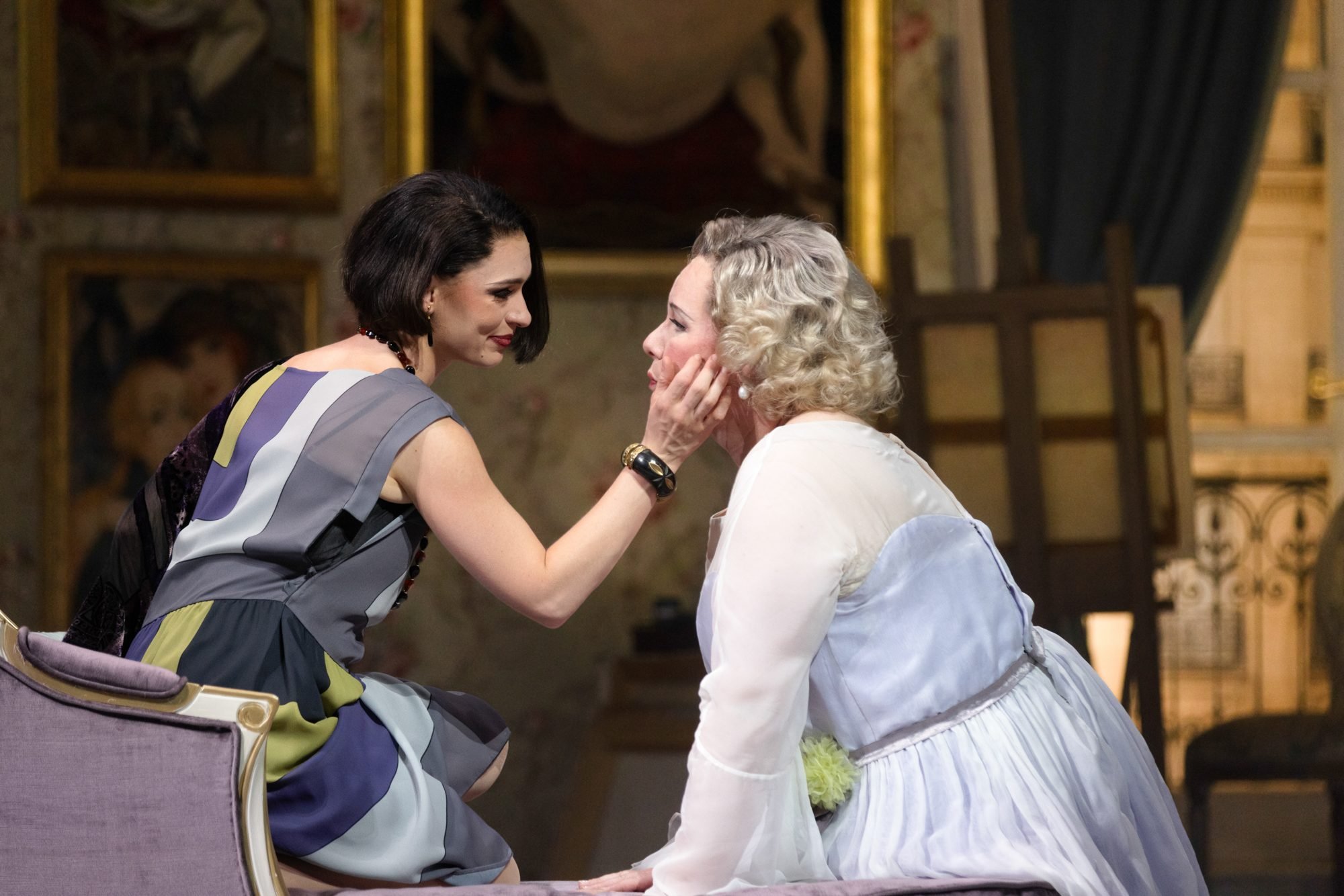
Gerda (Sylvia D’Eramo) and Lili (Lucia Lucas) share a tender moment. Photo by Bronwen Sharp; courtesy of the Santa Fe Opera.
While I appreciated other aspects more deeply, what I “liked” best about Lili Elbe was the staging. The theme of trans, particularly transitions, is interwoven throughout many aspects of the telling of this tale, including the staging. The staging opens in a startling fashion, people in theater balcony box seats are looking in the direction of the audience for the opera, almost like seeing a reflection. The audience on stage is watching a version of Orpheus and Eurydice performed on a stage below. Orpheus violates Hades’s warning not to look back at Eurydice as he leads her out of the darkness back to life; Eurydice is returned to hell and lost to Orpheus. The theme of not looking back permeates Lili Elba, with specific references in the libretto and throughout the staging. We see video projections of ghostly versions of Orpheus and Eurydice in changing hues of black and white. We see the dresses of Lili and Gerda changing in hues of black and white throughout the opera. The hair and makeup, costumes, and sets make one feel they are in 1920s Paris. Sets and props are moved by sliding platforms as scenes change. We are treated to an on-stage violin solo, beautifully played by Concertmaster Nikki Chooi, as a party with a string ensemble assembled. Scenes of Lili and Gerta as artists, with friends, family members, and in medical facilities are effectively done. A scene where Lili and the woman who will give up her uterus against her wishes, neither knowing of their relationship to each other, is heartbreaking, offering some of the most beautiful music and singing in the opera. Many kudos to Director James Robinson, Scenic Designer Allen Moyer, Costume Designer Marco Piemontese, Projection and Video Designer Greg Emetaz, and Choreographer Seán Curran. The staging is very different from that used for Lili Elbe’s 2023 premiere with Theater St. Gallen in Switzerland.
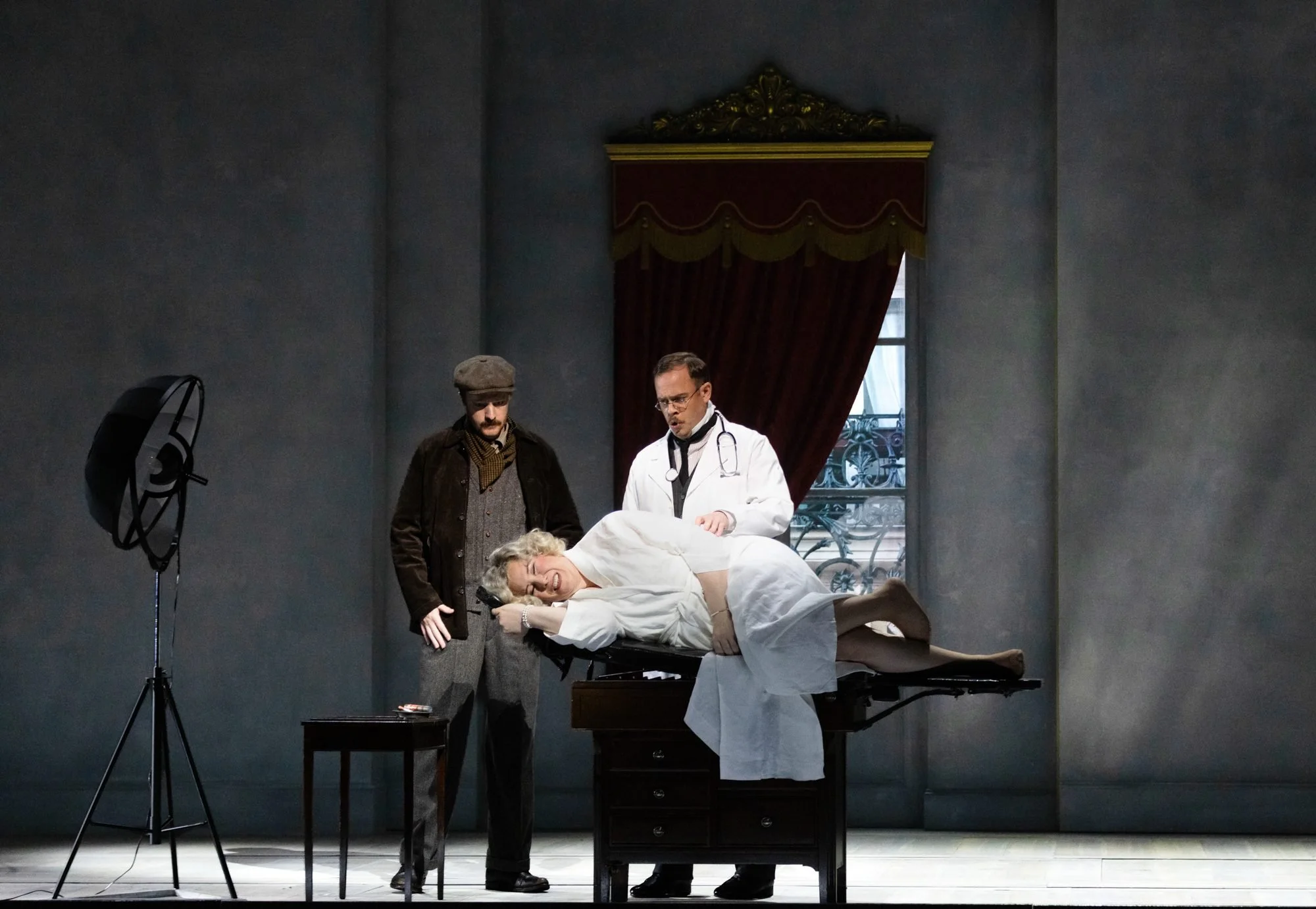
Brother Marius (Ryan Wole) is with Lili (Lucia Lucas) as she is examined by Dr. Warnekros (Andrew Harris). Photo by Bronwen Sharp; courtesy of the Santa Fe Opera.
Composer Picker also describes the music he composed for Lili Elbe as trans, meaning transitional. The music is tightly interwoven with the action on stage, almost constantly changing to my ears; the music and what happens on stage are two parts of a whole. The music is enjoyable, melodic, and varied in styles, and in which section of the orchestra is taking the lead, as the scenes change. Musical interludes are played as scenes change. The music was well played by the Santa Fe Opera under the direction of Conductor Roberto Kalb. The Santa Fe Opera Chorus was made up of ensembles of the seventeen named vocalists in the opera, who were occasionally used in the way of a Greek chorus. Their performance was excellent; kudos to Chorus Director Susanne Sheston. One additional thought: the singing style is mainly conversational, sung in English. It is not a favorite style of mine to listen to, though it is very well done in Lili Elbe, highly communicative not only of the action, but thoughts and emotions as well. It’s growing on me.
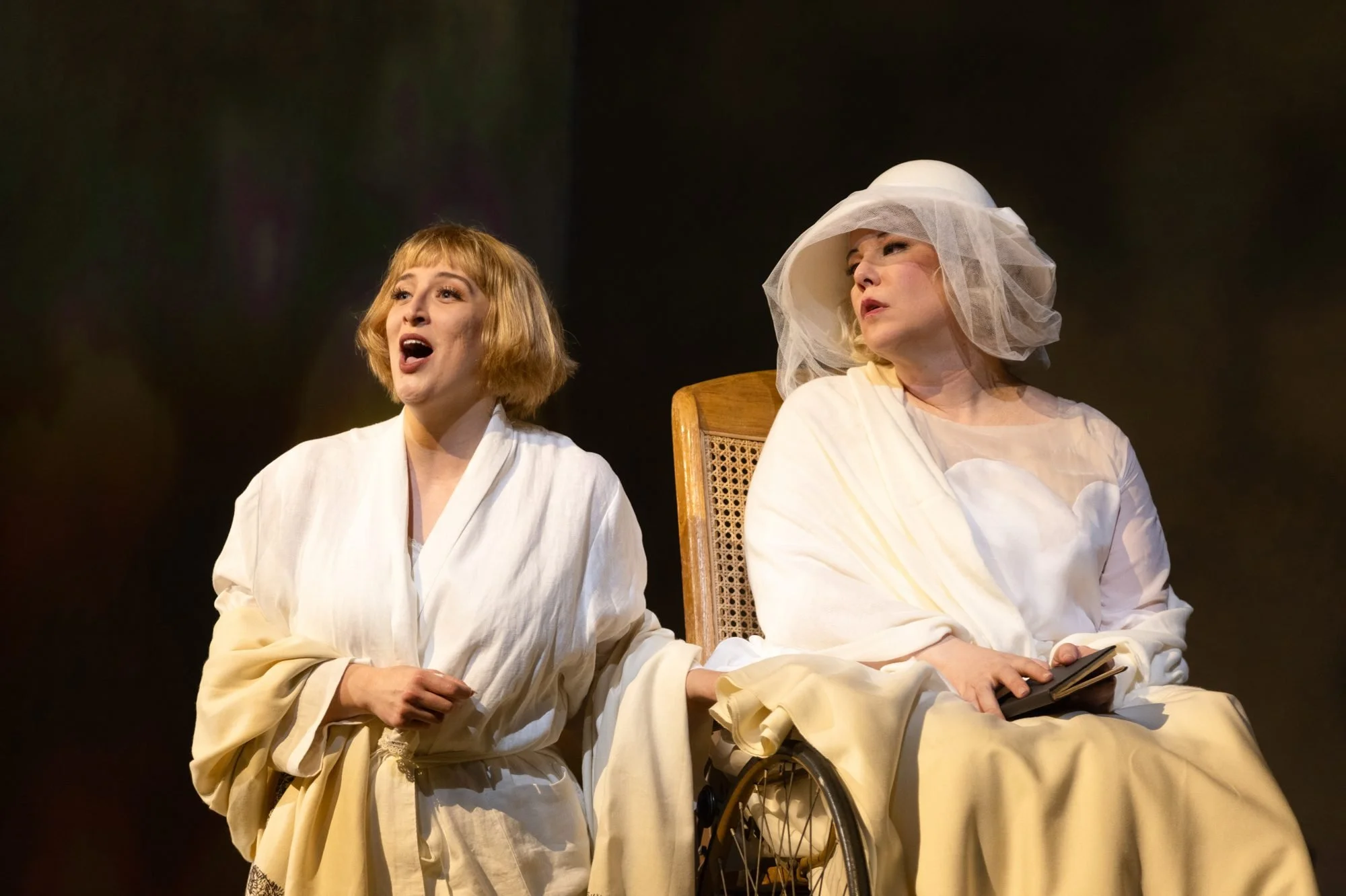
The young woman donor (Audrey Welsh) sits with Lili (Lucia Lucas). Photo by Bronwen Sharp; courtesy of the Santa Fe Opera.
Overall, the singing was expertly done by talented singers. I will single out only a few. It is fair to say that baritone Lucia Lucas embodies the role, since in real life she has lived the role in significant measure. She sings expertly with a rich baritone voice and delivers some emotionally touching moments in her arias. There were hints in the beginning scene when Einar was looking at himself in the mirror that the feelings had been there all along but not recognized. I particularly remember Lili’s aria, where she faces the uncertain outcome of her surgery and the previously mentioned interaction with the young woman who was to give up her uterus. I thought soprano Sylvia D’Eramo was an excellent vocalist and an outstanding actress in the role of Gerda. She was impressive in mirroring the nuances of her attempts to negotiate with Lili to only be Lili part of the time. She probably plucked my heartstrings the strongest as I imagined how I would feel in such a situation. Her actions, as presented by D’Eramo, spoke well of her character. Tenor Josh Lovell, playing the role of Claude, gave us a sweet next partner for Lili; his arias were endearing, though his love was not completely returned by Lili. Baritone Ryan Wolfe, as brother Marius, sang well and provided some emotional relief in being supportive of his sister Lili. One of the strongest singing performances came from bass Andrew Harris who seemed too perfect singing and portraying Dr. Warnekros; that guy needed to be disliked, and it would have been so much easier if Harris didn’t sing so well. Mezzo-soprano Deanna Ray Eberhart as Einar’s sister, mezzo-soprano Lindsay Ammann as Einar’s mother, and mezzo-soprano Audrey Welsh as the young woman donor and as Eurydice, all gave strong performances,
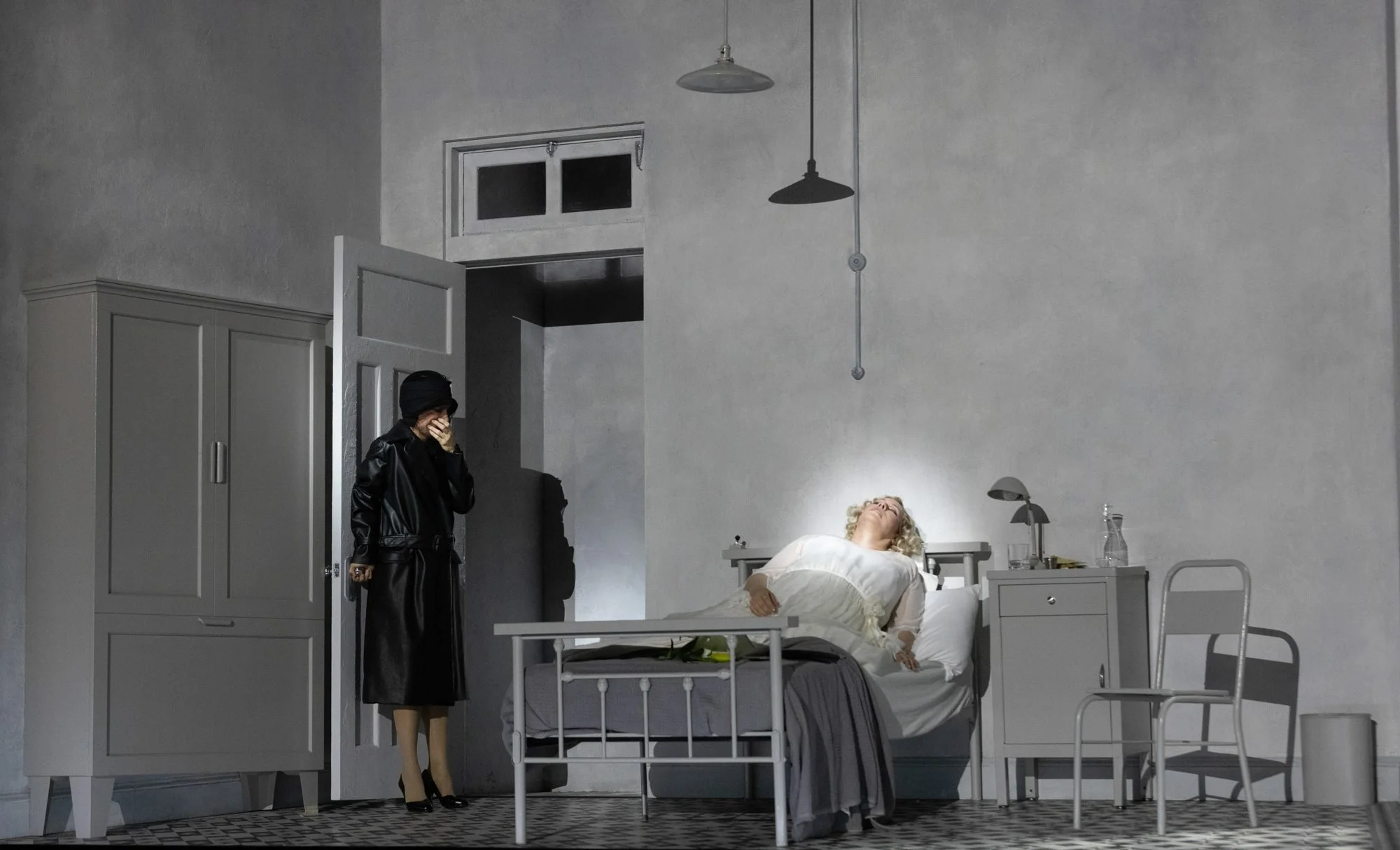
Gerda (Sylvia D’Eramo) enters as Lili (Lucia Lucas) dies. Photo by Bronwen Sharp; courtesy of the Santa Fe Opera.
My bottom line: In a sense, viewing the opera was like watching one train wreck after another, with each wreck involving the little engine that could. In the end, all I had left was my love for that little engine. With all the collateral damage, love survives. Director Robinson offered moments of enjoyment in the staging. There was an elegance to Lili’s journey as portrayed by Lucia Lucas that drew me in, an honest struggle by a flawed human to be true to herself.
In closing, let me pose a question: Why was the audience for Santa Fe Opera’s American premiere of Lili Elbe not only standing and clapping but also cheering at the end? Was it just appreciation for the music, staging, and performances? This opera wraps itself around the myth of Orpheus and Eurydice and that work’s theme of sometimes there is no going back. Was the intensity of the audience’s response to Lili Elbe saying things have changed for trans people, and there is no going back?
The Fan Experience: Performances of Lili Elbe by Santa Fe Opera were scheduled for August 1, 5, 14, 18, and 27. The opera is sung in English with subtitles in English and Spanish available on screens located on seat backs. The opera lasts about two and a half hours, including one 25-minute intermission. A half-hour pre-opera talk presented by Alexis Corbin, a KHFM classical radio host, offered many insights into the opera and was much appreciated.
Santa Fe Opera held many outreach activities to engage the Santa Fe community in discussions about the transgender issues related to Lili Elbe. A list can be found at this link.
Attending the Santa Fe Opera is a special experience. The Crosby Theatre of the Santa Fe Opera, which seats about 2,000 patrons, is an open-air structure on each side and at the back of the stage. The design is modern and attractive. Sunsets and thunderstorms become part of the opera experience. See SFO’s detailed and helpful website for information on food/dining options available and for directions.
The tailgating parties at SFO performances, some astonishingly elegant, are a tradition. In general, the SFO patrons were most often dressed in a casual style, but those in tuxedos and evening gowns seemed to be adding to the fun. Bring a sweater or light jacket; Santa Fe is seven thousand feet above sea level; though warm the night I was there, the nights can be chilly even in July and August, and breezes flowing through the opera house can make it feel cooler.
Santa Fe Opera is located about five miles north of the city with easy access via highways 285/84 or a couple of backroads, if you are adventurous. As you move away from the heart of the city, you quickly enter the vast expanse of sky that New Mexico offers. The SFO program book includes this statement, “We acknowledge and pay deep respect to the people, elders, and ancestors – past, present, and future – of the Tesuque Pueblo whose beautiful lands have provided the stunning backdrop for our theatre and performances for over sixty years.”