
You know the old bromide. When life gives you a lemon, make lemonade. Last season, after a contentious period with Kennedy Center’s new administration, Washington National Opera broke with the Kennedy Center and its Opera House, which had been home for the company for the last 55 years. General Director and CEO Timothy O’Leary described the ensuing period of rebuilding the company and putting together the 2025 season as building an airplane while you were flying it. The systems have been rebuilt, but WNO is still nomadic without a resident home. My overall assessment of their productions I attended last season was that they had successfully made some excellent lemonade in different flavors. My impression after Saturday night’s performance of Giacomo Puccini’s Madama Butterfly is that the new Washington National Opera under the brilliant direction of Artistic Director Francesca Zambello has achieved a new level, opera with a touch of magic – lemon to lemonade to champagne.
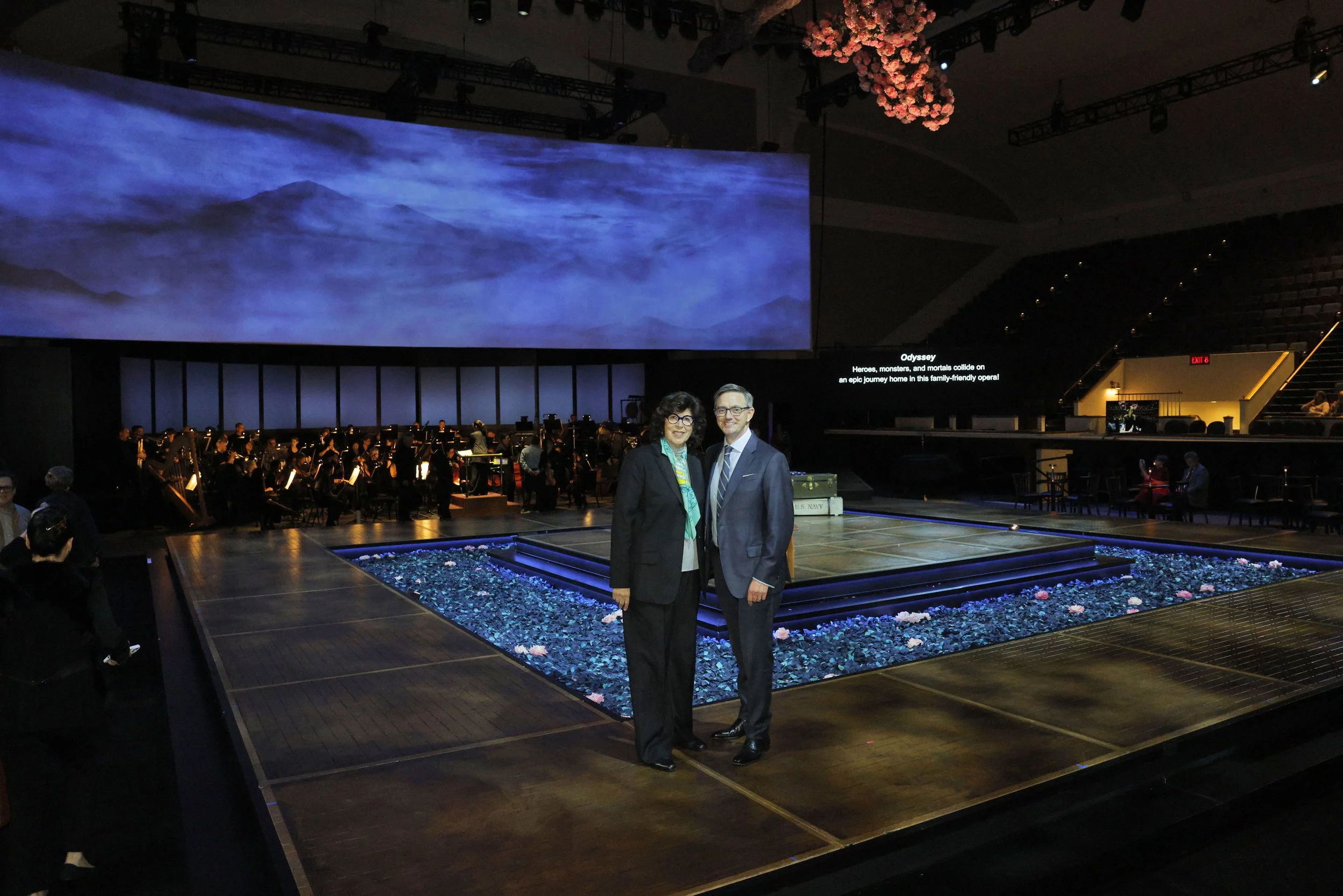
Architects of the new Washington National Opera, Artistic Director Francesca Zambello and General Director and CEO Timothy O’Leary. Photo by Corey Weaver; courtesy of Washington National Opera.
To begin their new season, WNO has alighted in the DAR Constitution Hall, a long-standing DC institution of historical and cultural significance. It offers a fine civic auditorium for concerts and conventions. The National Symphony has played there, and the DAR has hosted many plays and concerts. However, it is not ideal for staged opera, lacking an orchestra pit and by being a massive facility able to accommodate 3700 attendees, stretching the distance between performers and the audience. WNO’s creative solution was to move the proscenium out towards the center of the arena, with the orchestra placed against the back wall to make the experience more immersive for the audience now seated on three sides of the stage. A giant screen on the back wall showed a distant mountain view, changing colors to coordinate with mood or time shifts. In addition, and importantly, they brought in first-rate singers, including a star soprano known for her excellence in the lead role Cio-Cio-San; WNO also increased the inclusion of dance, and presented the opera as Puccini and his librettists Luigi Illica and Giuseppe Giacosa assembled in their fifth and final revision of Madama Butterfly.
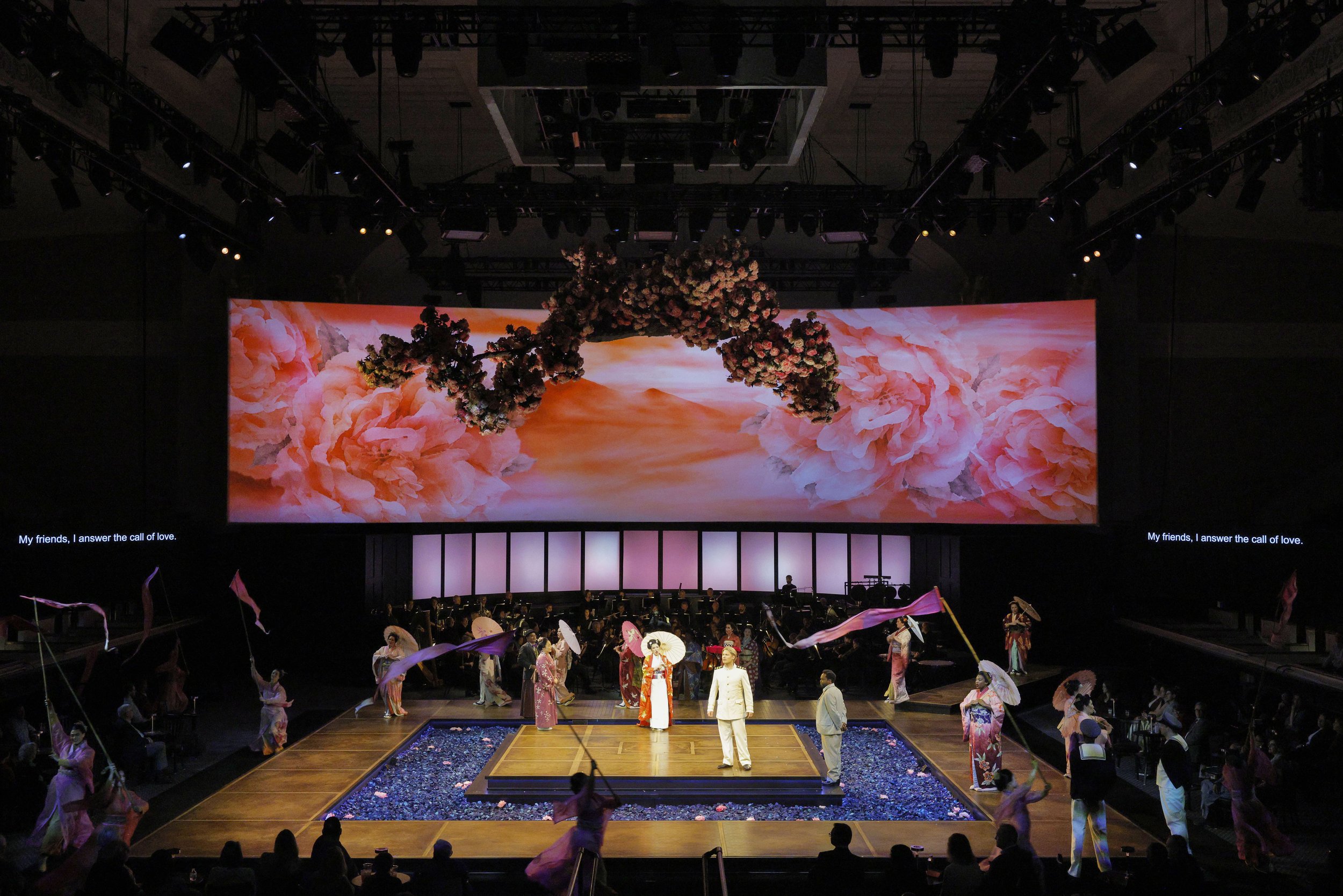
Cio-Cio-San (Karah Son, center back), comes to unite with Lieutenant B.F. Pinkerton (Matthew White, in dress whites) in marriage. Photo by Corey Weaver; courtesy of Washington National Opera.
Butterfly was not well received on opening night in 1904, but since the 5th revision of 1907, it has been one of the most often performed operas in the world. The gripping story takes place in Nagasaki at the turn of the 19th century; an American navy officer, B.F. Pinkerton, stationed in Japan, marries a 15-year-old Geisha, Cio-Cio-San, because he finds her enchanting, knowing that under Japanese law he can divorce her simply by leaving her, which he intends to do. She, totally committed to the marriage, converts to his religion, and is thus abandoned by her family which had already fallen on bad times. He is reassigned to the States and leaves with false promises that he will return to her, unaware that she will soon bear his son. He does return, three years later, but only to claim his son to raise with his new American wife. As you can see, this is not headed for a happy ending. Puccini’s beautiful music coupled with the heart-breaking story of Cio-Cio-San is an irresistible combination.
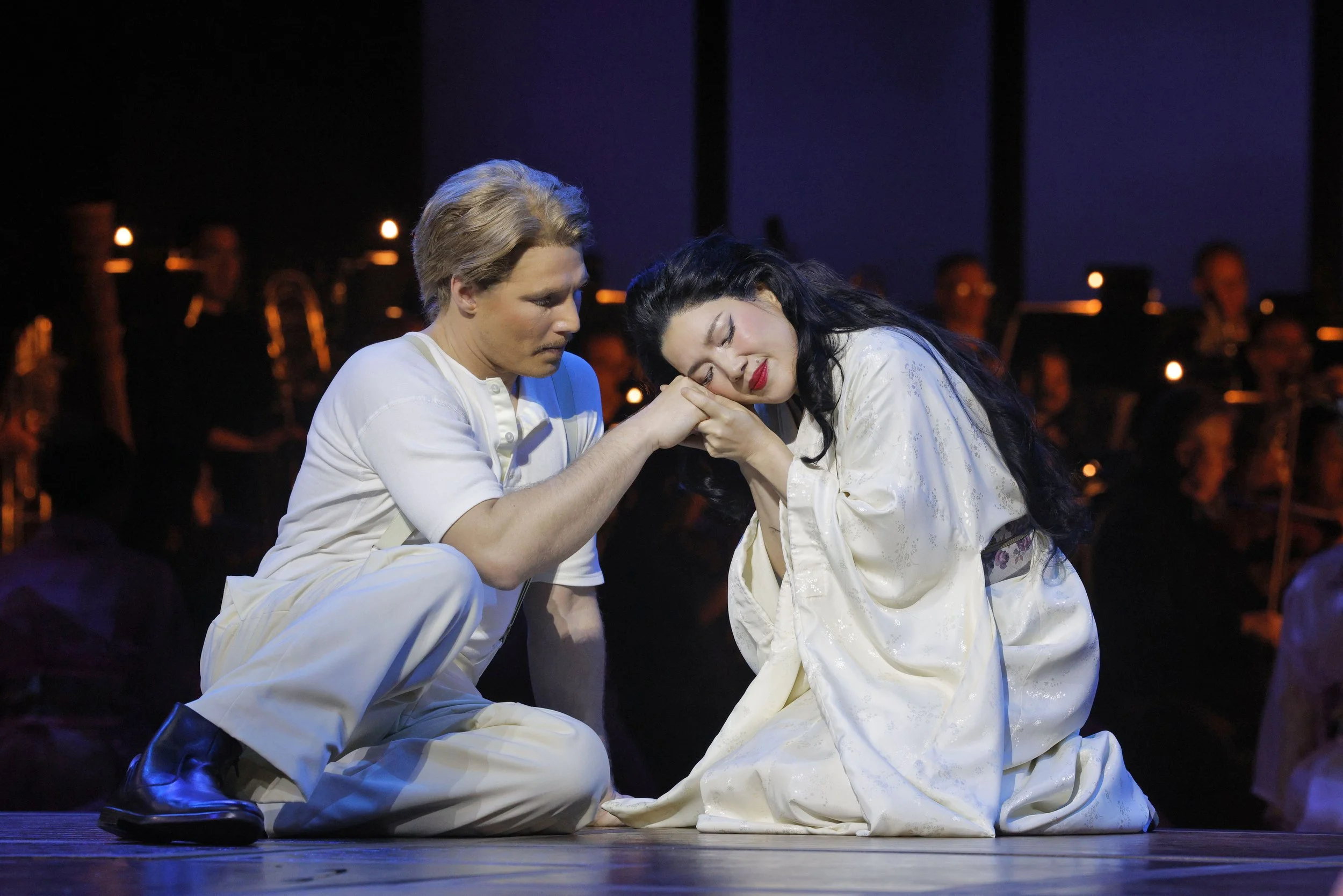
Pinkerton (Matthew White) and Cio-Cio-San (Karah Son) on their wedding night. Photo by Corey Weaver; courtesy of Washington National Opera.
As I settled into my seat and surveyed the huge auditorium with arena seating, I had questions and doubts, in addition to my excitement at seeing Butterfly presented in a new way. Immersive staging: a creative tool or gimmick to cover up insufficiencies. A closer examination of the opera or a distraction? Would we learn or feel something new or just feel distanced? Would this transmit the opera’s messages more clearly or give too much focus to details? I soon encountered a minor annoyance: my ability to see Cio-Cio-San in her first meeting with Pinkerton due to two maidens with umbrellas blocking my view, much like it could happen in real life; this was the only such incidence, though later I did feel a note of compassion for the couple spending their first night together on the floor. At times, the orchestra sound seemed a tad distant from the singing to me; in fairness, my wife did not find this to be an issue. With the new seating arrangement, I did occasionally become aware of the audience, but more than a distraction, it felt soul warming that this large group of people were together sharing this presentation of a great work of art, like this was my team.
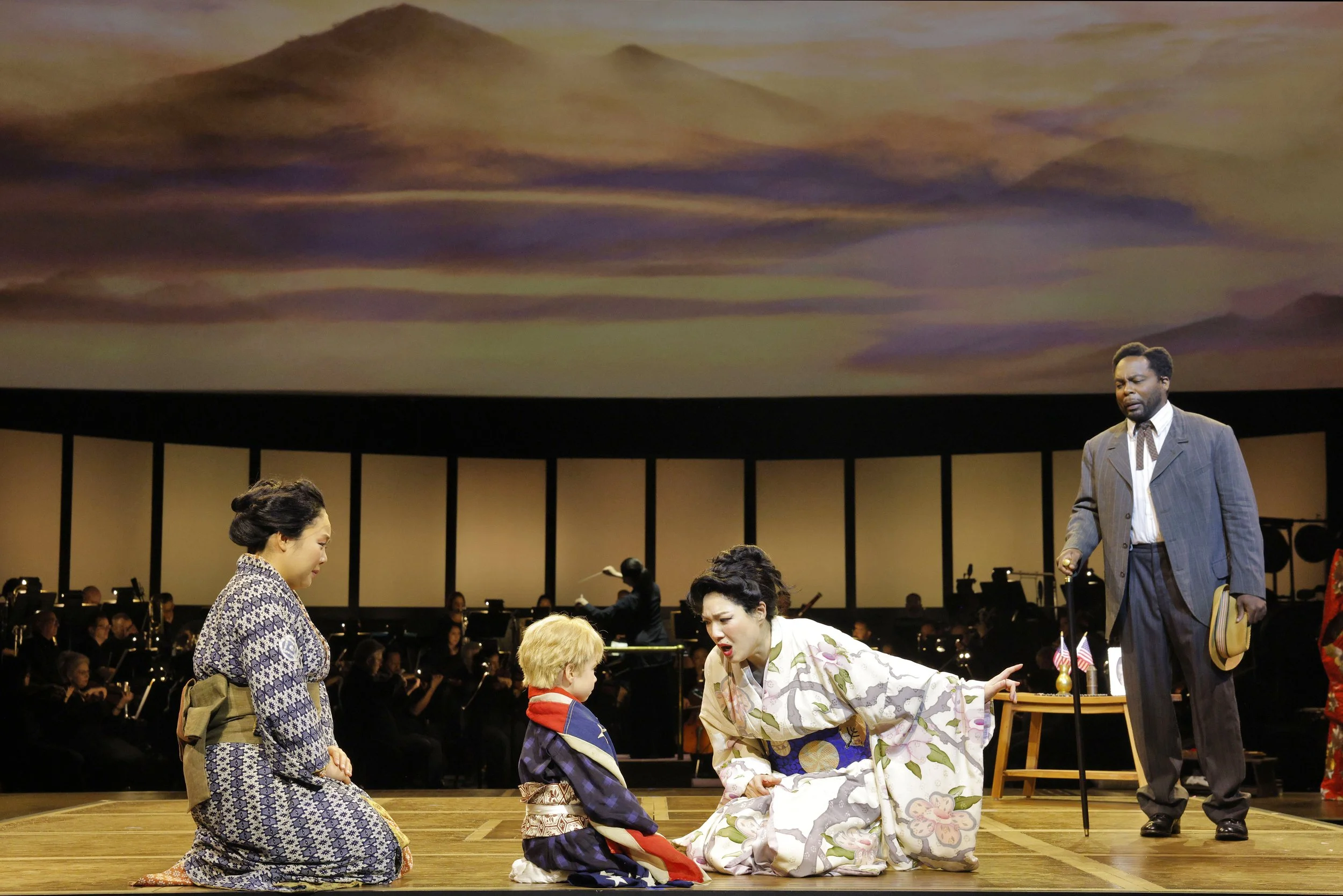
Cio-Cio-San (Karah Son) talks to her son Sorrow (Martenello Arnett) while Suzuki (Michelle Mariposa) and Sharpless (Will Liverman) look on. Photo by Corey Weaver; courtesy of Washington National Opera.
That said, the opera soon began to draw me into its spell. Puccini’s gorgeous music is seductive, and the WNO Orchestra led by Conductor Erina Yashima played the music faithfully in fine form, managing to stay in sync with the singers, even with the Conductor’s back to the singers, relying on video feeds for sight connection. Maestro Yashima is German-born of Japanese parents. The WNO Chorus was outstanding in singing Puccini’s hauntingly beautiful background and transition choruses; I found their vocals to be transcendent. Steven Gathman is credited for Chorus Preparation.
The cast for WNO’s Butterfly was uniformly strong, but this is one of those operas that greatly depends on the lead singer. South Korean soprano Karah Son sang Cio-Cio-San. In a recent interview she stated she had sung the role in over 300 performances around the globe. It was quickly obvious why this is a signature role for her. Her voice is not only beautiful in its clear tone, but it also conveys the tender vulnerability of Cio-Cio-San and, in due measure, the strength of her conviction and character. Her ability to sustain that character in her singing finally drew me into the story once again. Her devoted servant Suzuki was played by the 2025 winner of the Met Opera Laffont Competition, mezzo-soprano Michelle Mariposa, whom we have seen perform on multiple occasions as a Cafritz Young Artist. The beauty of her voice and singing was demonstrated early in her interactions with Pinkerton early on; her dramatic acting in late scenes with Cio-Cio-San was impressive.
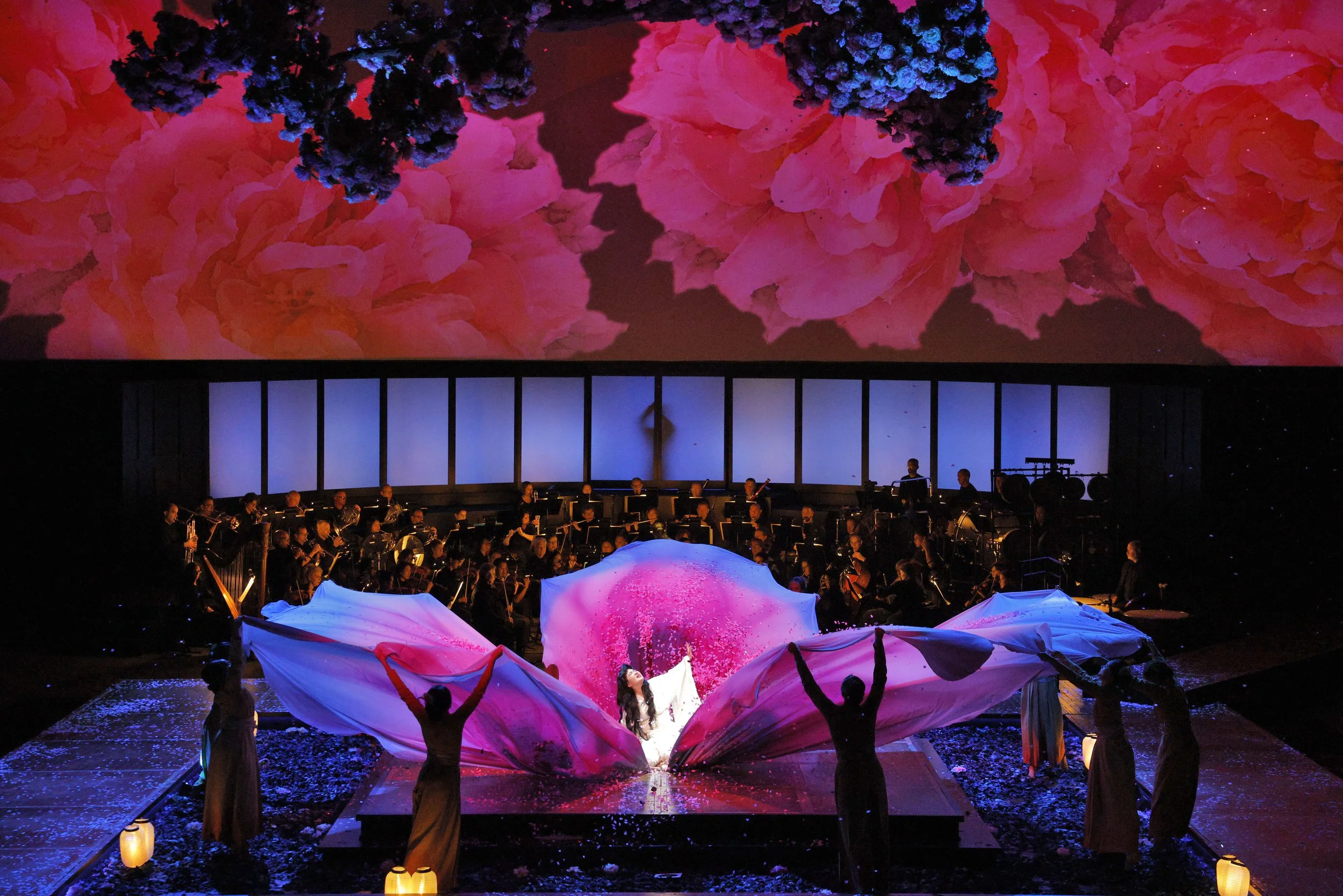
The Washington National Opera Corps Dancers form petals around Cio-Cio-San (Karah San) in the middle - my interpretation; yours may differ. Photo by Corey Weaver; courtesy of Washington National Opera.
The lead male role of Pinkerton was sung by tenor Matthew White. With a bright, resonant tenor, he sang beautifully and was excellent in portraying the lieutenant as an arrogant young man devoted to satisfying his lust for adventure and pleasure in a foreign country, eschewing the reins of responsibility. His demonstrations of remorse in the ending scenes at what he had done to Cio-Cio-San were strongly presented but did not generate much empathy in the audience. Star baritone Will Liverman, now seemingly part of the WNO family, was again excellent in portraying the American Consul Sharpless trying to open Pinkerton up to what he was doing. The pathos in his voice in later scenes with Cio-Cio-San was touching. The supporting cast was quite good, with tenor Rodell Rosel’s performance as the marriage broker Goro, an especially notable performance, with a voice that gets notice immediately. The colorful costumes added a great deal of eye appeal; kudos to Costume Designers Florence Klotz and Timm Burrows.
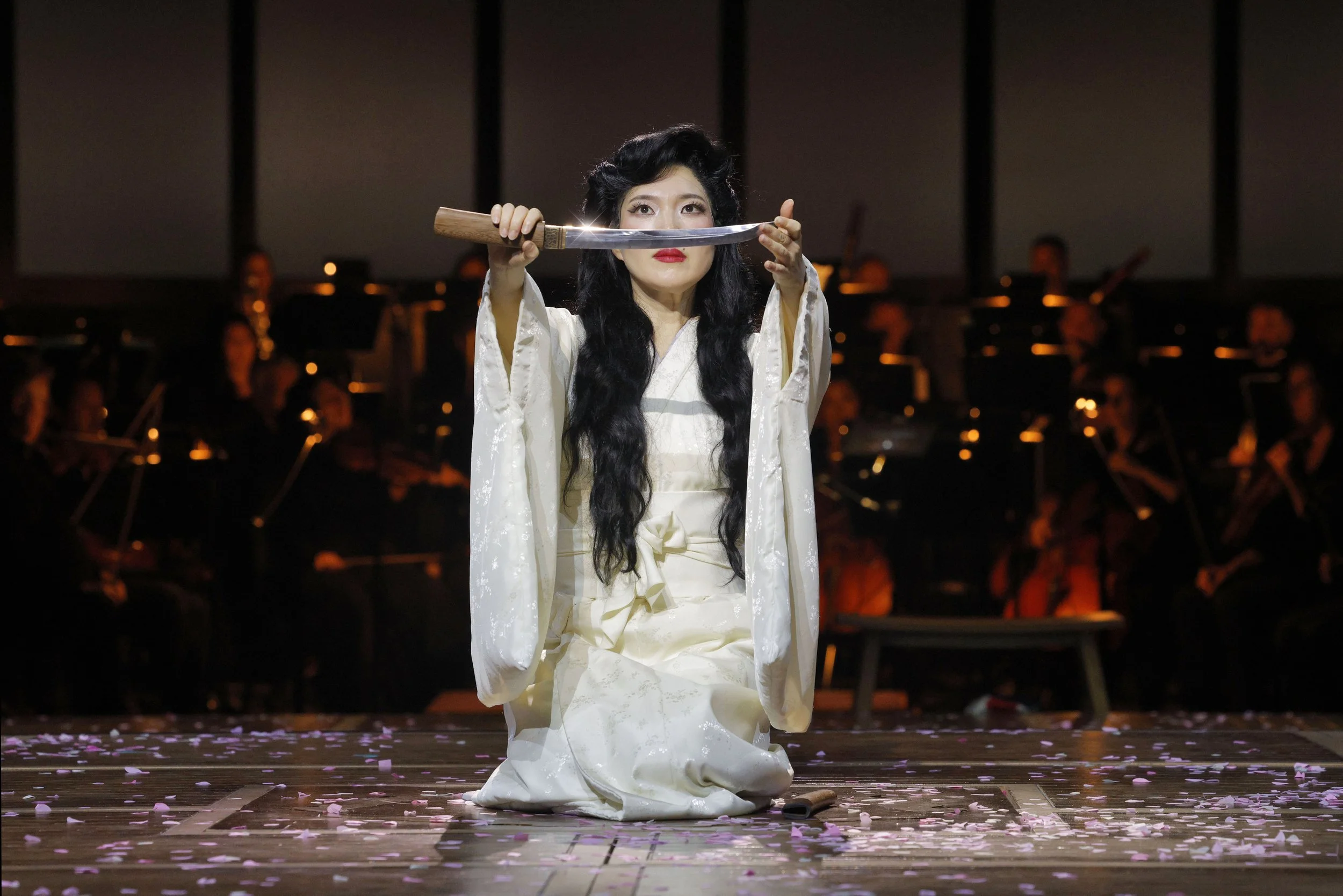
Cio-Cio-San weighs the value of life without honor. Photo by Corey Weaver; courtesy of Washington National Opera.
Director E. Loren Meeker did a marvelous job in conveying the critical elements of the opera with a bare-bones set and the performance taking place on three sides of a square stage. She is an acclaimed stage director and currently serves as the General and Artistic Director of OPERA San Antonio. Director Meeker states, “Rather than attempting to recreate a literal house in a literal Nagasaki, we have embraced the theatrical possibilities of this space to create something more fluid: a world of beauty, fragility, ritual and impermanence…Fabric, light, bodies, movement and translucent layers continually reshape the space…Our dancers are integral to that language—not as decoration, but as extensions of atmosphere. At times they help create the world Butterfly imagines around herself; at others, they become the forces that begin to tear through it.” I will simply say that it cast a spell on me, and the Washington National Opera Corps Dancers were a marvelous addition, used to great effect; kudos to Choreographer Kanji Segawa. This was opera presented differently, with a touch of magic.
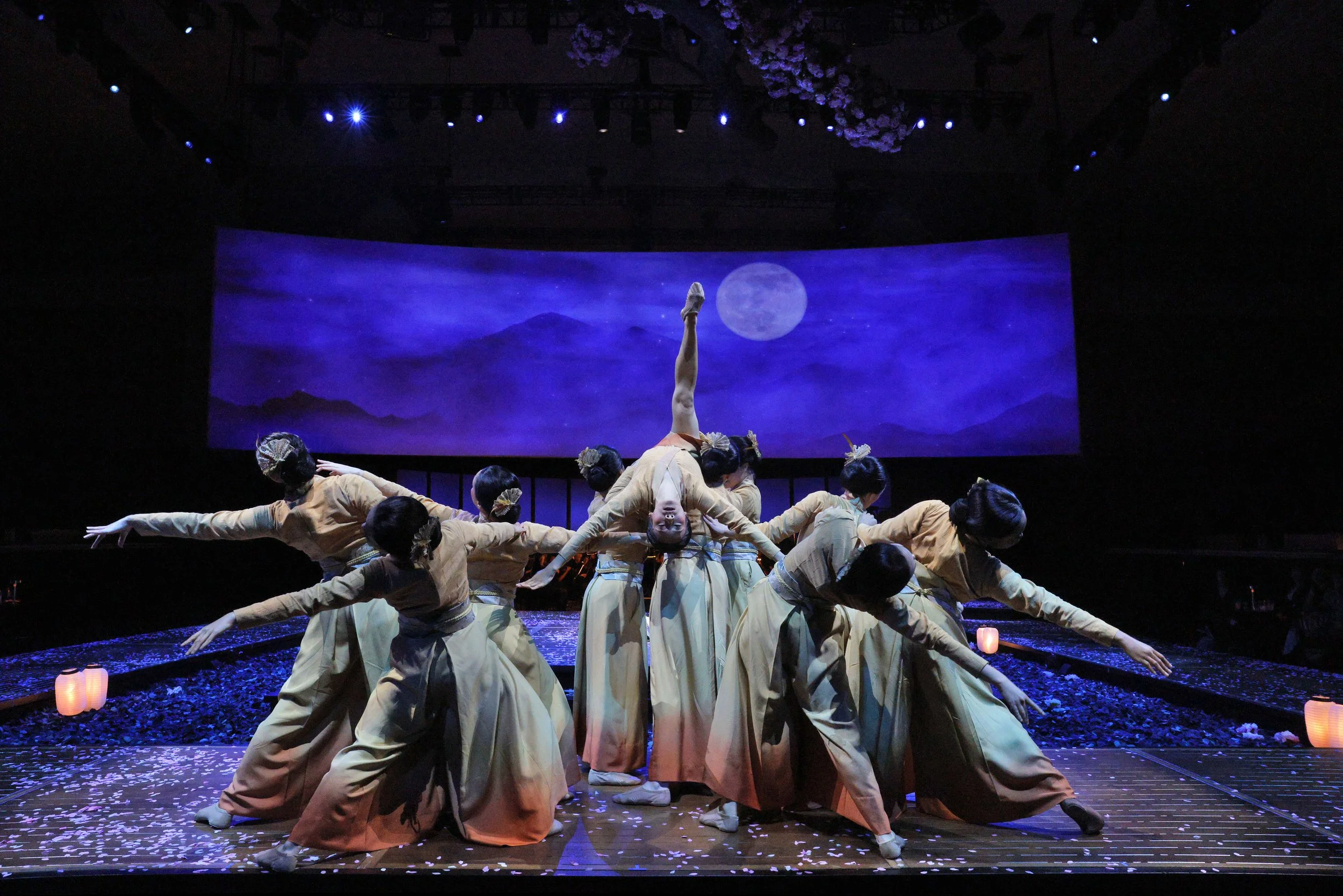
The Washington National Opera Corps Dancers form a funeral pyre - my interpretation; yours may differ. Photo by Corey Weaver; courtesy of Washington National Opera.
This is the fourth Butterfly I have written about, and I have watched several videos as well. Each time my takeaway has shifted. Early on, my focus was the music; for many years, my favorite recording was “Un bel di” sung by Renata Scotto. Then my focus shifted to feeling sorry for Cio-Cio-San, whose fate was determined by the world she had created for herself in response to the one imposed on her. More recently, I struggled with the attempts of modern directors to ameliorate the orientalism and stereotyping of Asian women in this work created over a hundred years ago. But Madama Butterfly endures, propelled by the human heart it unveils. My takeaway this time focused more on two lovers drawn strongly to each other with a predictable crash ahead; that’s a modern storyline, no?
The Fan Experience: WNO scheduled performances of Madama Butterfly for November 7, 13, 15, 18, and 20 in DAR Constitution Hall. Performances are sung in Italian with English titles shown on screens. The opera lasted 2 hours and 45 minutes, including one 25-minute intermission. My impression was that the audience would have brought the Opera House to capacity, but in DAR Constitution Hall seats were still available in most price ranges.
A pre-opera talk is given one hour before the performance begins in a classroom one level down from the entrance hallway. The talk we heard was given by Ken Weiss, principal coach for the Cafritz Young Artists. His talk offered many insights into how this opera came to be with so many people and factors involved, a highly informative and entertaining lecture.
DAR Constitution Hall offered bars set up in the hallways before the performance and during the intermission. The Hall does not have its own parking facility. For recommendations on parking, see their website.