
This recent opera by composer Jake Heggie and librettist Gene Scheer had great music, great performances, and a blockbuster story told cleverly, with an impactful bottom line…impressive, so close to being a great opera. In fact, two of the later scenes of the second act were great opera. This was such a rich story; I struggle to explain why I came away feeling that it fell just short of greatness. As I think more about the performance, I can’t escape the feeling that it wasn’t as affecting as it could have been. Let me report and try to explain.
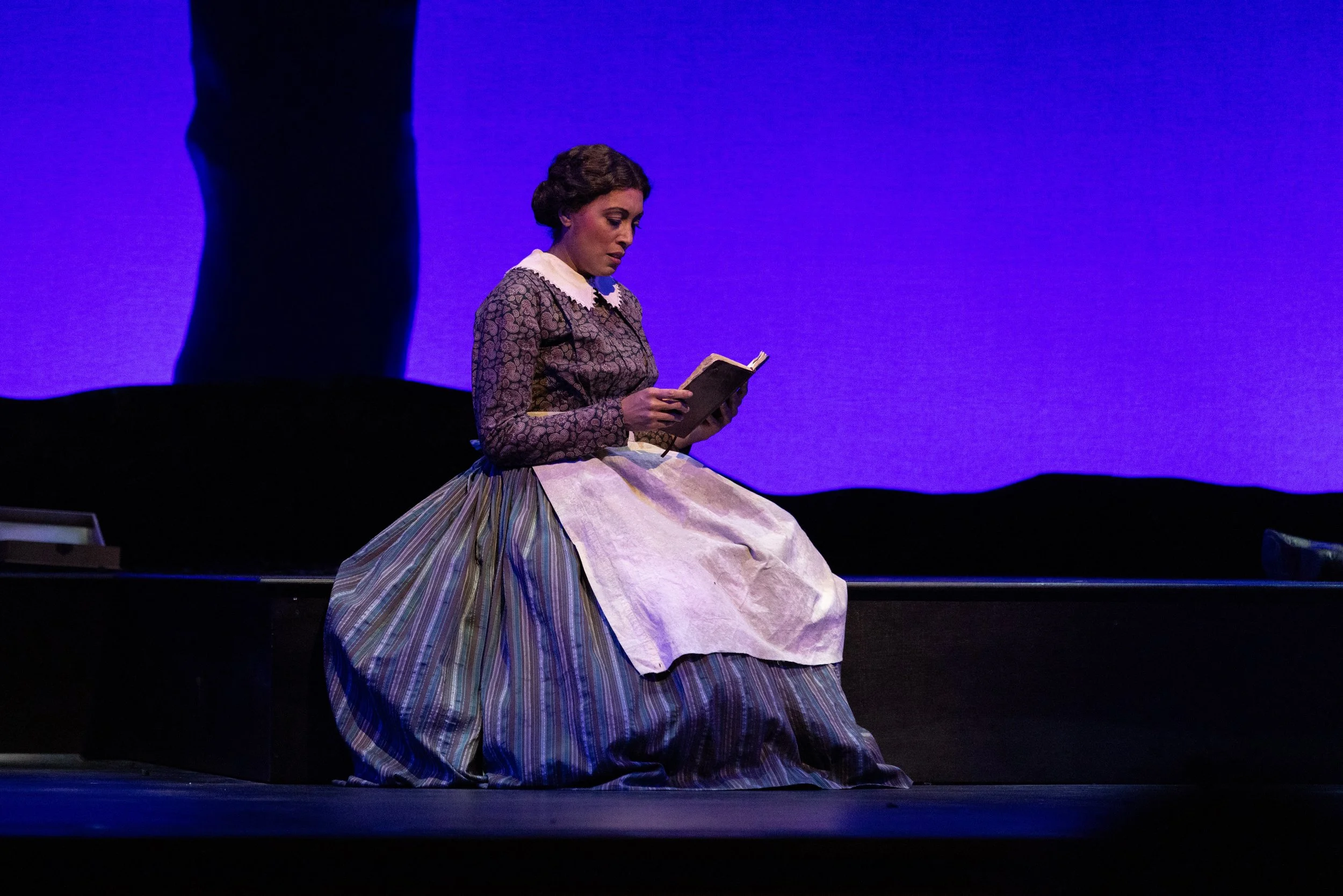
Mary Jane Bowser (Jacqueline Echols McCarley), slave, Civil War spy, can read, write, do math, and remember everything. Photo by Dave Pearson Photography; courtesy of Virginia Opera.
The composer and librettist of Intelligence are two of the most revered opera luminaries working today, already with lists of successes to their names. Virginia Opera has recently produced several excellent modern operas with connections to the Commonwealth. Fellow Travelers in 2023 comes immediately to mind, as does 2022’s production of Three Decembers by Heggie and Scheer, and then 2025’s world premiere of Loving v. Virginia. In just the second production of Intelligence, Virginia Opera brought the opera from Texas to Virginia, where the story takes place, after premiering with Houston Grand Opera in 2023. I caught the final performance of this opera’s run in Fairfax on Sunday afternoon, after it previously played in Norfolk and Richmond, the actual city of the story. I had posted a preview of this Richmond spy story in January.
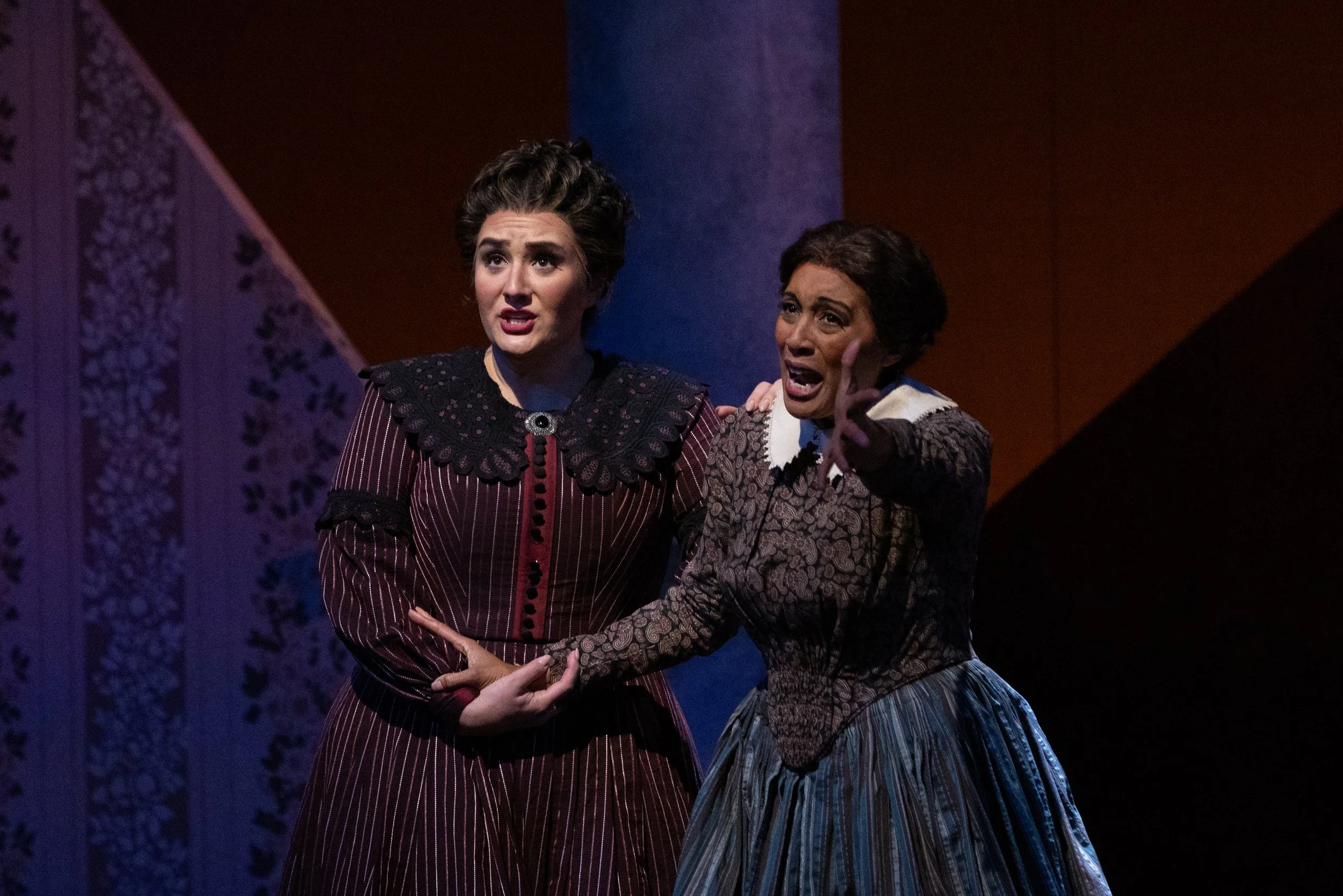
Elizabeth (Ashley Dixon), leader of the spy ring, and her protege, Mary Jane (Jacqueline Echols McCarley), face fear together. Photo by Dave Pearson Photography; courtesy of Virginia Opera.
(This report does have spoilers.) The opera’s plot tells an amazing story of a Richmond pro-Union white woman, Elizabeth Van Lew, and her black slave, Mary Jane Bowser, who worked together at great risk to their lives during the Civil War to provide crucial intelligence to General Sherman, hastening the end of the war. The Van Lews were a wealthy, prominent family in Virginia. Their slave Mary Jane had received special treatment since birth; she had been baptized and married in the Lew’s white church, was sent north to be educated, and sent to spend time in Africa. She could read, write and do math, key elements for spying, and she could remember everything. Her blackness and slave status provided cover for her skills – the white officials and soldiers assumed she lacked the intelligence to read and write, and easily ignored her as she worked as a maid in the Jefferson Davis home. History tells us that Elizabeth and Mary Jane, owner and slave, were real spies, who worked together during the Civil War, though the story of their relationship in the opera is historical fiction. Three other characters in the opera are in the history books, Mary Jane’s husband Wilson, a slave runner for the spy network, Henry, the slave butler in the Jefferson mansion, and Callie, Elizabeth’s sister-in-law living with her. Completely fictional characters in the plot were Travis, an amoral Confederate Home Guard trying to catch the spies, and Lucinda, a ghost/spirit whom only Mary Jane could see. A trio of dancers were also important to connecting Mary Jane to her ancestry.
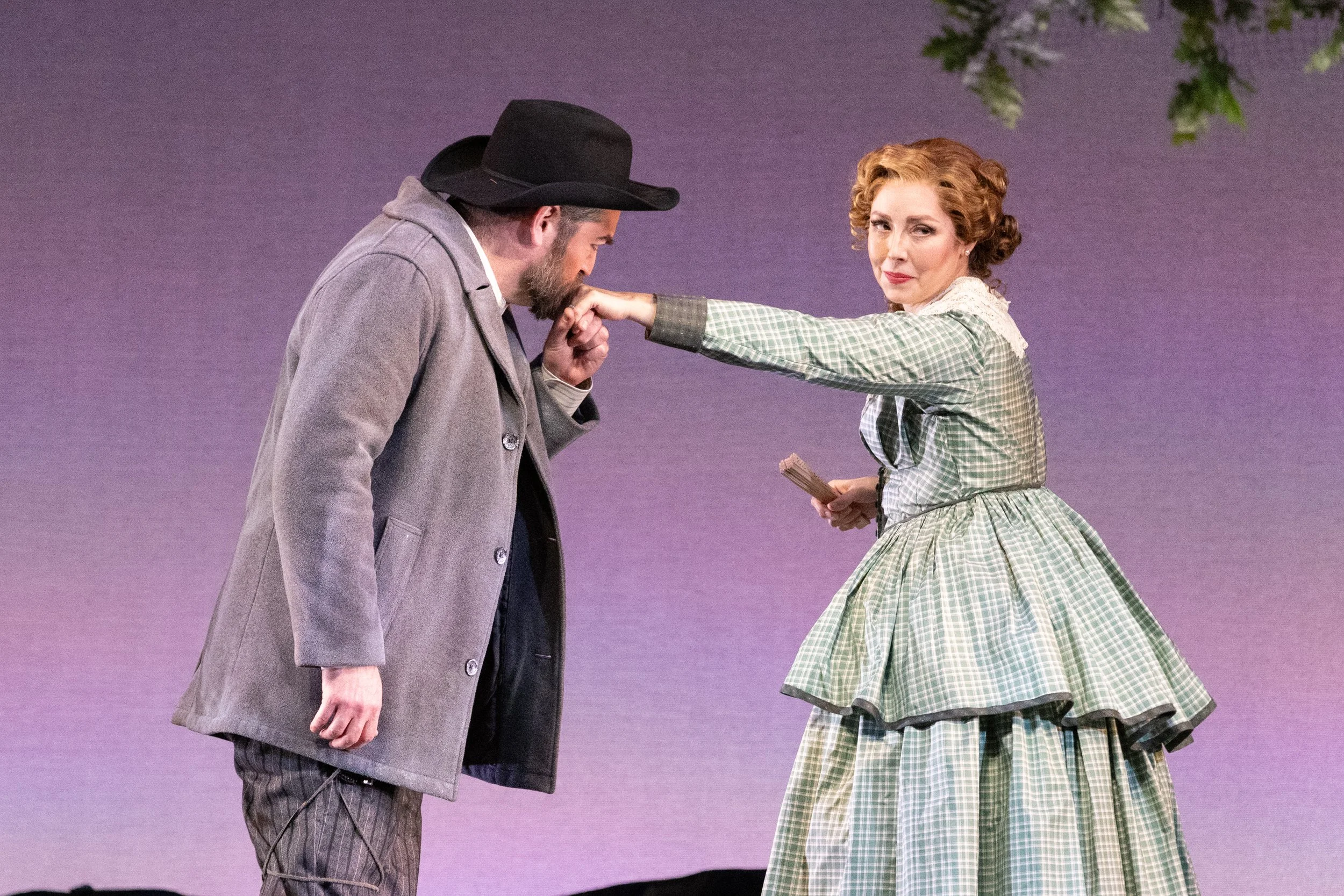
Confederate House Guard Travis (Craig Irvin) meets Callie (Maureen McKay), Elizabeth’s sister-in-law. Photo by Dave Pearson Photography; courtesy of Virginia Opera.
VO assembled a cast for this production to make Virginia proud. Outstanding soprano Mary Jane Bowser was played by Jacqueline Echols McCarley. She has performed with Washington National Opera, Pittsburgh Opera, and Metropolitan Opera, among others (if you are googling her, the use of her married last name in cast listings is recent). Listening to her sing was amazing, like watching Tom Brady play football, a consummate professional with outstanding skills; her voice has a beautiful timbre, and every word sung seemed to carry its own color. Mezzo-soprano Ashley Dixon gave a portrayal of Elizabeth Van Lew that was tone perfect in singing and acting. She has also appeared with established opera companies across the US, and interestingly for this production, she was the cover for Elizabeth in the Houston Grand Opera performance of Intelligence. Young mezzo-soprano Cierra Byrd played Lucinda with such splendor vocally and acting, it was hard to believe she is a recent graduate of the Met Opera Young Artist Development Program; she also covered the role for HGO. Soprano Maureen McKay, who is headed to the Met Opera to play Papagena, was also excellent singing and acting in the role of Callie.
Baritone Craig Irvin, also an established veteran in opera houses across the country, played Travis, giving us the villain and oppressor we love to hate in painfully convincing style, accentuated by well-sung threatening vocals. Bass Kevin Thompson played the love struck butler Henry with a powerful, expressive bass voice. Tenor Edward Graves sang two lovely arias as Mary Jane’s husband Wilson. He also was a cover for the role with HGO. In non-singing roles, dancers Noelani Corey-Bar, Amaya Weston, and Christine C. Wyatt (who was also the choreographer) added beauty and drama to the performance.
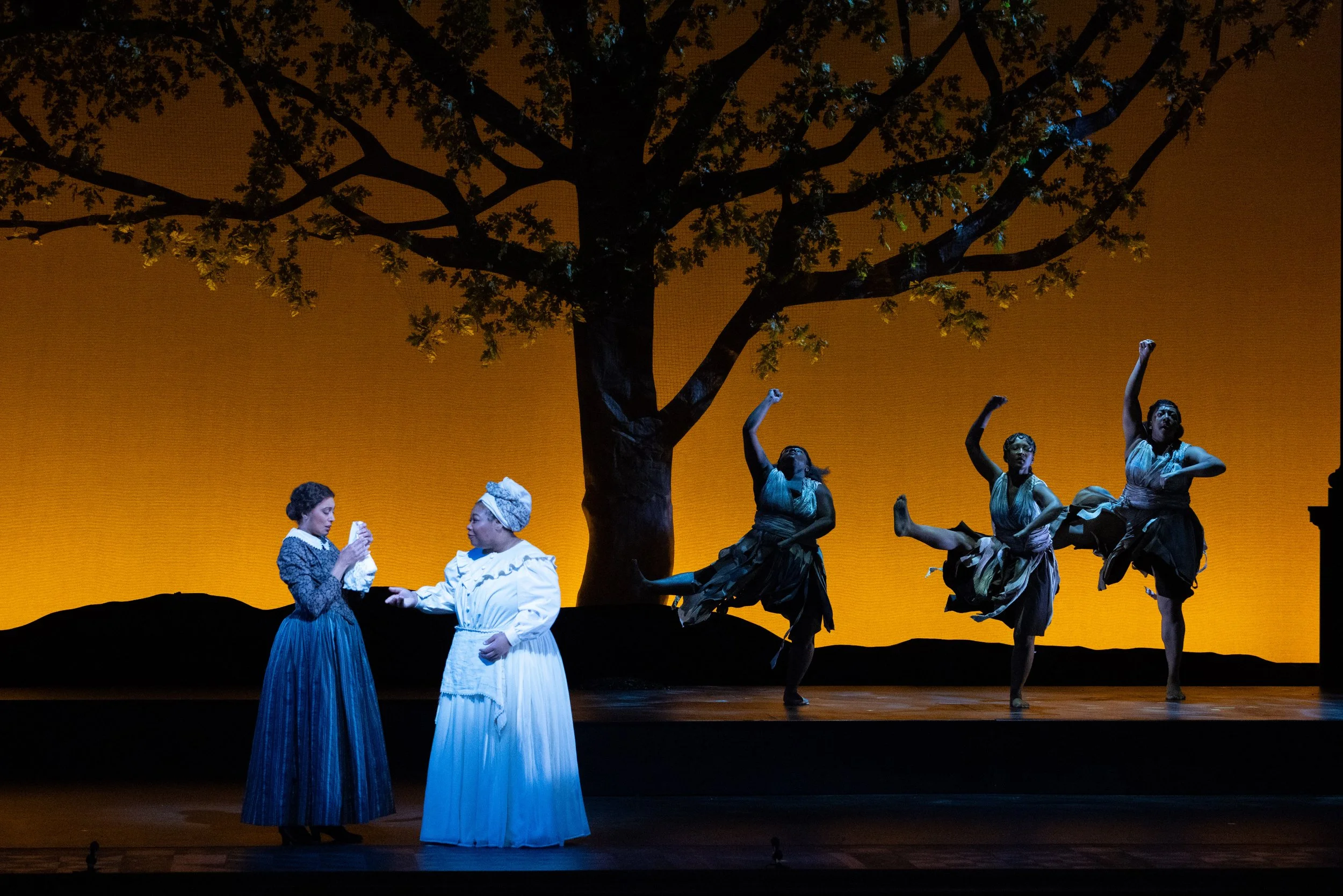
Mary Jane (Jacqueline Echols McCarley) confronts her heritage with Lucinda (Cierra Byrd) and dancers Noelani Corey-Barr, Amaya Weston, and Christine C. Wyatt. Photo by Dave Pearson Photography; courtesy of Virginia Opera.
Guess which opera won best opera recording at this year’s Grammy Awards. Yep, Jake Heggie’s Intelligence. It was deserved. The music was atmospheric in support of the scene, musically interesting, and inventive, with a minimal use of dissonance to reveal unspoken elements in a scene, and a score I immediately wanted to hear again. This was a score where the percussion section got a workout, highly rhythmic and changing, with different sections of the orchestra taking lead, violins, woodwinds, and even a piano. The music incorporated several styles, including classic opera, jazz, and blues. Mr. Heggie’s music was beautifully played and well done, accompanying and embellishing the vocals. Kudos to the Virginia Symphony Orchestra under the direction of Brandon Eldredge.
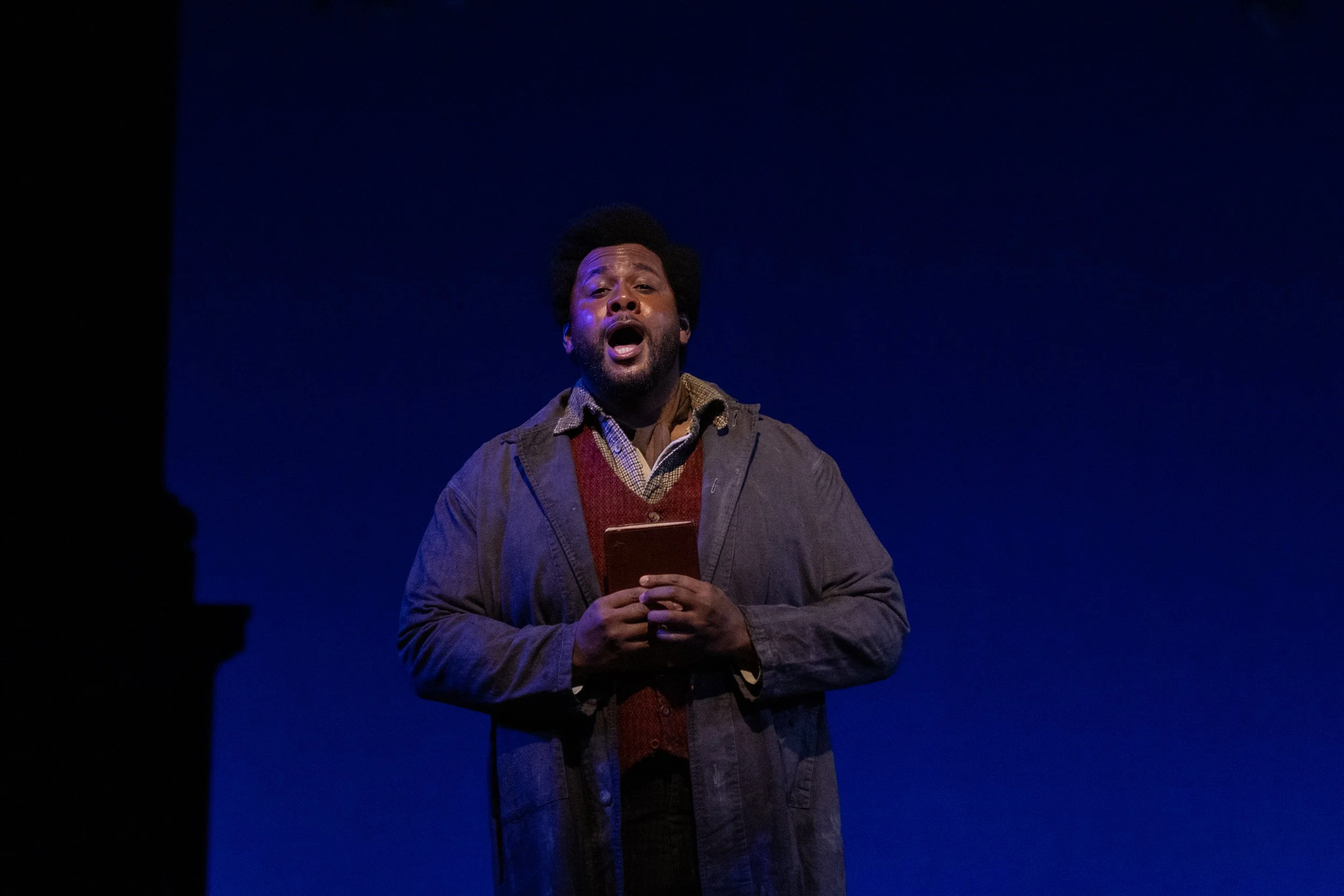
Wilson (Edward Graves) as Mary Jane’s husband and spy runner. Photo by Dave Pearson Photography; courtesy of Virginia Opera.
Because of smaller stages of the venues used by the Virginia Opera, the staging of the opera had to be changed substantially. Veteran Director Kyle Lang, who has directed eleven operas for VO did another fine job with the flow of Intelligence on stage. The design was impressionistic and effective with a large oak tree projected onto a scrim in the back and windows hanging down to indicate a house, with side panels moving in and out to add other features. The costumes by Costume Coordinator Pat Seyller and Wig and Make-up Designer Elysse Mesick were quite good, effectively placing the characters in their roles. The least effective staging was the fire scene; it was not clear what was happening and the urgency of getting critical intelligence to the field got lost.
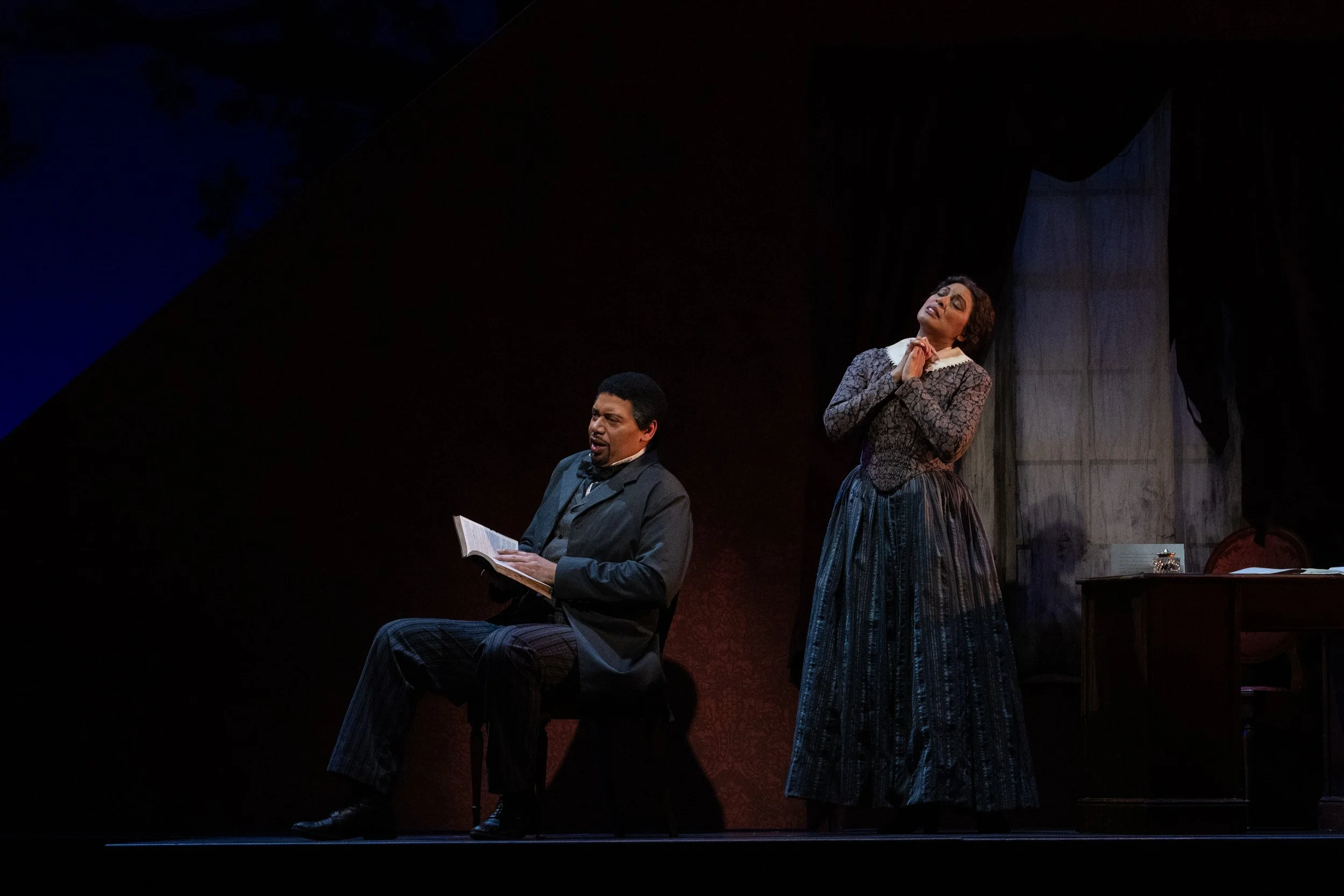
Butler Henry (Kevin Thompson) reads to Mary Jane (Jacqueline Echols McCarley) who claims to be illiterate. Photo by Dave Pearson Photography; courtesy of Virginia Opera.
With all that, what did I find wanting that affected my overall assessment? Even though several highly dramatic scenes were presented in Act 1, I was mainly engaged intellectually. Perhaps because there was so much to tell in a short time. As I expected, the spy story in Act 1 also gave attention to Mary Jane’s need to know more about where she came from and who she was as she was confronted by a ghost from the past, a theme that exploded in Act 2 and landed with the greatest impact. The importance of the women’s efforts to win the Civil War seemed to fade quickly in Act 2. Travis, the Confederate soldier and symbol of oppression, added little to the spy tension, more feared for the guy he was, including his unrestrained lechery for Mary Jane. Subplots abounded. Did we really need Edward the butler pursuing his love interest with Mary Jane, especially in the death scene? Just me perhaps, but I thought the spy story and its dangers were diluted too much. Act 2 was much more engaging.
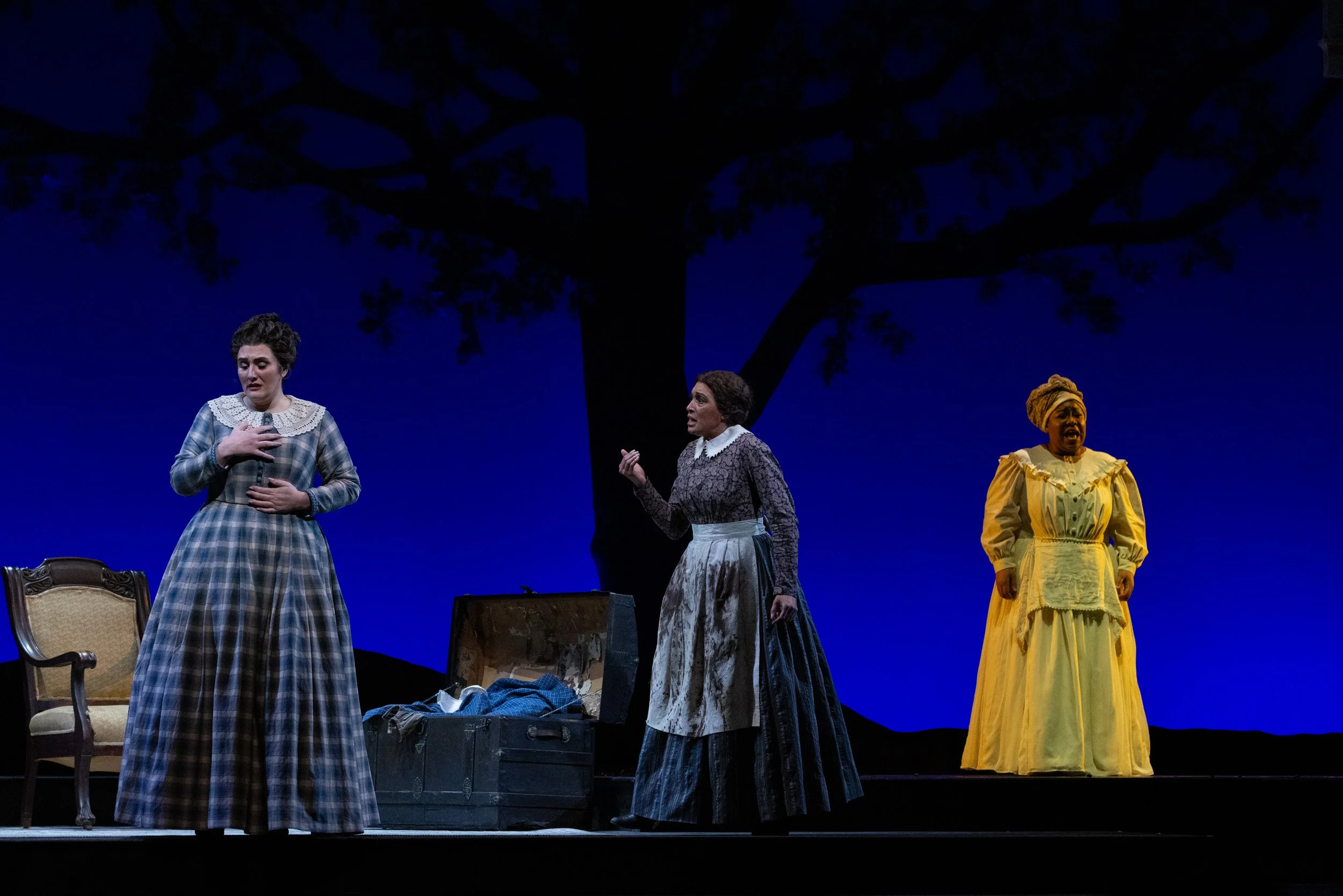
The confrontation between Elizabeth (Ashley Dixon) and Mary Jane (Jacqueline Echols McCarley) with Lucinda (Cierra Byrd) standing by. Photo by Dave Pearson Photography; courtesy of Virginia Opera.
Big spoilers lie ahead. Go back if you want to see the story afresh.
On the other hand, let me address the two scenes I found great. I thought one of the last scenes could win a Tony award. Callie discovers the dead Travis with a partially dug grave outside by the old oak tree. She struggles, on her knees, by the grave, whether to support the South by revealing what has happened or to cover it up by finishing burying Travis to avoid what the scandal would do to her family. At the same time, unknown to her, Elizabeth stands close by, pointing a pistol at her, torn between protecting the cause or her brother’s wife. Both sing repeatedly, “If I do this, I will be chained to you forever”, to music that sounds like the pleasing melodies we take home with us from the best musicals and operas. Oh, I longed for more of that, so clear, and with the music, so little spoken while so much was said.
The final scene was also outstanding. Mary Jane learns her truth. Elizabeth has lied to her. Her relationship with Elizabeth is broken, and Mary Jane plans to move on. She sings to Elizabeth with passion the most important message in the opera: “You don’t control my story now”. This was powerful, crucial to understanding race relations as human relations – it is human to want to control your own story. Don’t tread on me. I demand my inalienable rights. Let freedom ring for all. It is what the appeal of America is about, is it not? It is the essence of being human, is it not?
Kudos to all involved in this production, and kudos to Virginia Opera for their gift to the Commonwealth! We learned about two meanings of intelligence. We learned about the importance of secrets in war and secrets in our personal lives. And we were entertained while we learned. Not bad for an afternoon, hey?
The Fan Experience: Virginia Opera scheduled performances of Intelligence for Norfolk, January 30, February 1; Richmond, February 6, 8; and Fairfax, February 14, 15. The opera lasted around three hours including one intermission. It was sung in English with projected English subtitles. As of this posting, the online program for Intelligence can be accessed at https://dpb-web.instantencore.com/program/50512/virginia-operabriintellig/page/278875/home?cid=5206347.
Virginia Opera’s next production will be Aida, to be performed in Norfolk on March 13, 15 and in Richmond on March 20, 22. OV’s website states that the expense of moving Aida to another location was prohibitive, so this production will not travel to Fairfax. I would also add that to ensure that future productions do appear in Fairfax, increased attendance and generous donations would help.