
“Isn’t reality itself kind of a dream?” asks the Stranger in Sleepers Awake. Have you ever had an experience awake that felt like a dream, or a dream that seemed so real? We speak of time passing slowly or fast, depending on the circumstances. There is much about this opera’s creation, as well as its music and performance, that I found engaging. The music is complex, the story multilayered, and the performance dazzling.
A world premiere of a new opera by composer Gregory Spears is sufficient inducement for me to drive from Tysons Corner to Philadelphia. I became a Spears fan after attending Fellow Travelers, performed by Virginia Opera, and then The Righteous at Santa Fe Opera. I liked the stories, and importantly, I liked the music. I felt excitement awaiting this performance, and great curiosity about what the composer would serve up in an opera based on “Sleeping Beauty” for Opera Philadelphia’s 50th season.
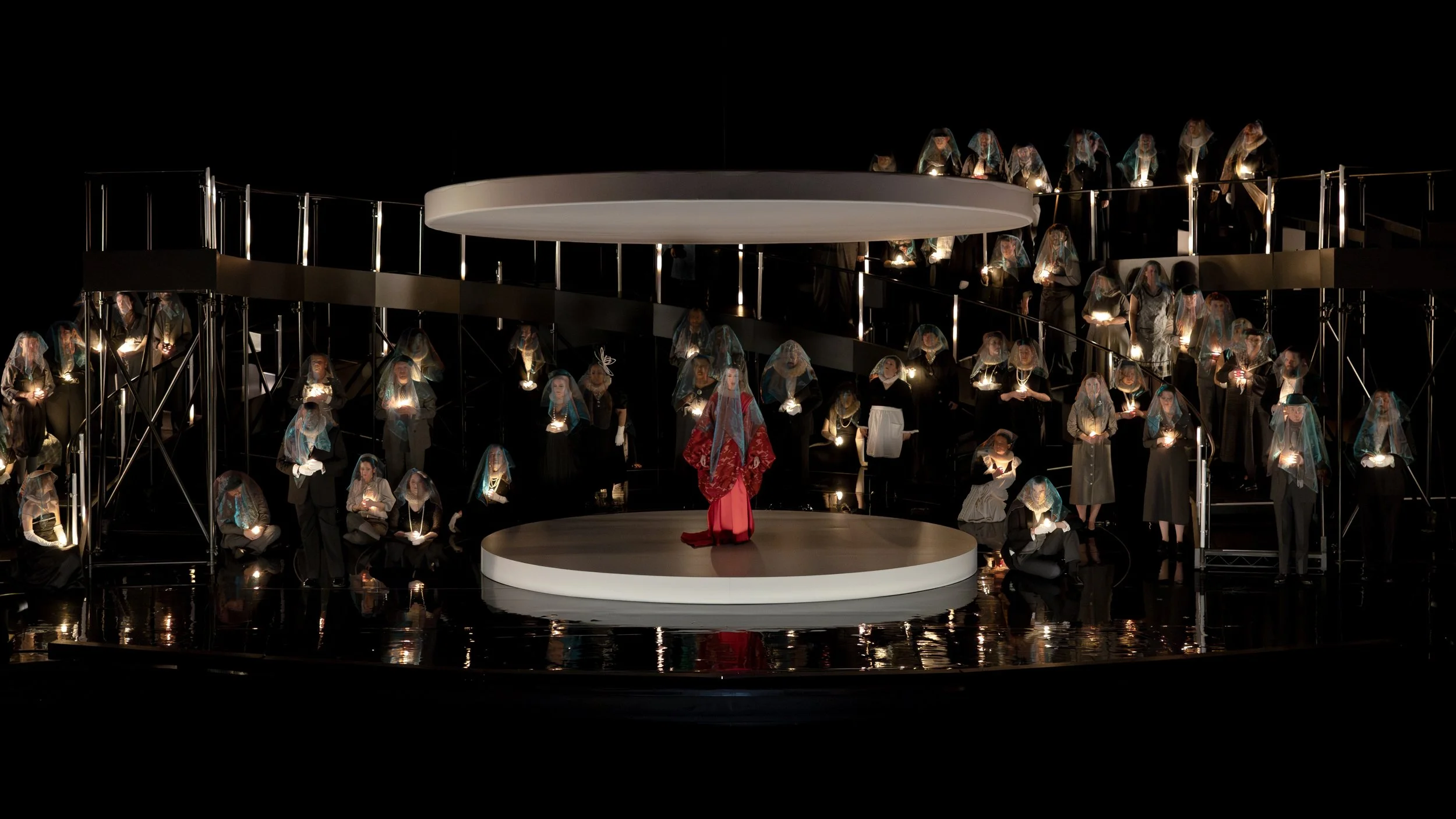
Susanne Burgess as Thorn Rose, center stage, with the Opera Philadelphia Chorus wearing veils of sleep in the world premiere of Sleepers Awake. Photo by Jason Ardizzone-West; courtesy of Opera Philadelphia.
Now, you are probably still thinking “Sleeping Beauty”, the Disney version we all know and love? No, think what if it had been presented in an episode of The Twilight Zone. In this version, the sleeping beauty, Rose Thorn, is not happy about being awakened from such a darn good 100-year nap, even with a kiss, and neither are the awakening courtiers, workers, and townspeople. And the would-be marital partner isn’t really her type.
How did this opera come to be? To quote another book character, “…sometimes life seems programmed”; the genesis of ‘Sleepers Awake” provides strong evidence for that view. Let’s start in 2024, when superstar counter-tenor Anthony Roth Costanzo became General Director and President of Opera Philadelphia; he was performing in that year’s new opera by composer Spears, The Righteous, which was premiering at the Santa Fe Opera. The choral music in The Righteous is impressive (I attended). Corrado Rovaris, Music Director and Conductor for Opera Philadelphia, encouraged Costanzo to commission a new work by Spears, and from this composer, they wanted an opera with a dominant choral focus. Bring it on!
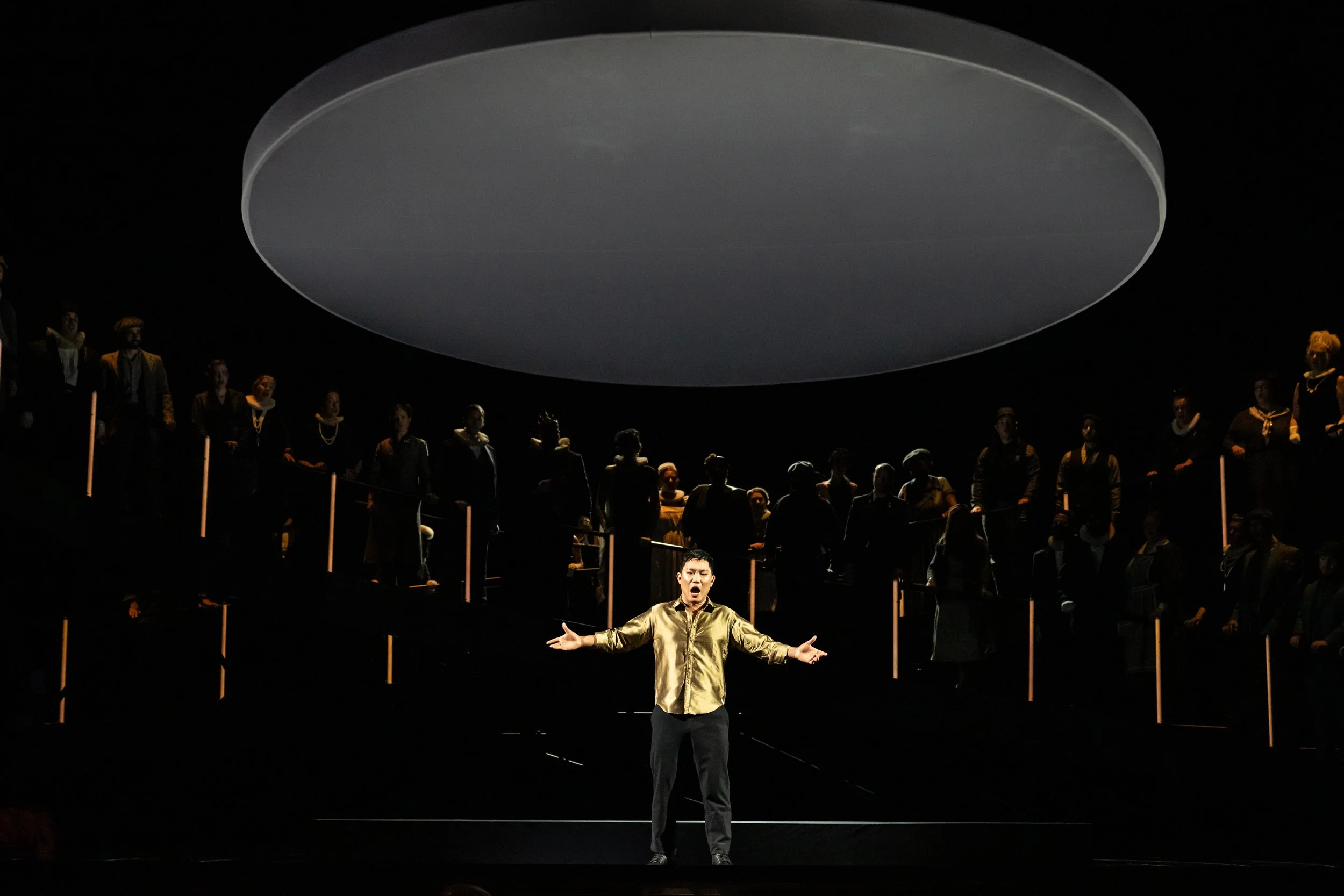
Johghyun Park as the Stranger. Photo by Steven Pisano; courtesy of Opera Philadelphia.
Next, how did the acclaimed theater director Jenny Koons, known for immersive experiences, become involved in what would be her first opera production? In response to a question, she replied, “Greg and I were matched by Zack Winokur at Little Island. We had individually been speaking with them about wanting to create something for a large group. In our initial artist blind date, we discovered a similar interest and obsession with ritual, myth, and the ways humans tell stories to, and about, ourselves. It was such a gift to be part of a development process so full of asking big questions and shaping a world so collaboratively”. She fit perfectly with Costanzo’s desire to target "transformative" creators for OP’s 50th-anniversary season.
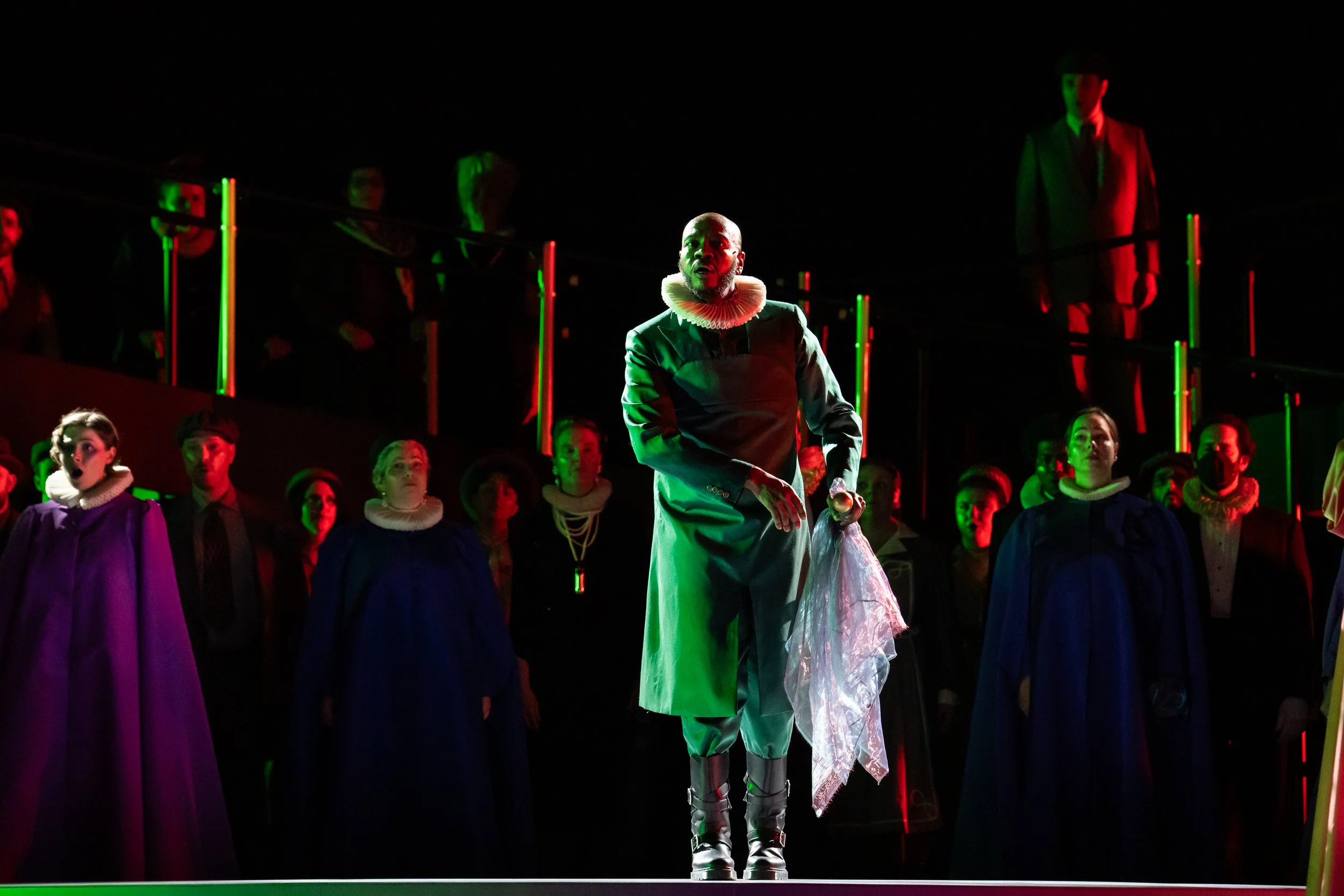
Brian Major as Court Poet. Photo by Steven Pisano; courtesy of Opera Philadelphia.
Composer Spears wrote the libretto in consultation with Director Koons. He chose works from three individuals as its basis: the main source was three versions (1919, 1920, and 1927) of the sleeping beauty myth written in a questioning fashion by Swiss author Robert Walser, as translated from German by Robert Sadan; a more traditional 1911 version by British author Arthur Quiller-Couch; and verses adapted from the 1599 hymn “Sleepers Awake” by Philip Nicolai, a German Lutheran pastor (translated from German by Frances Cox). I learned of author and poet Walser when reading background for the opera. He was a different dude, an original thinker, schizophrenic, passing away in a mental institution; his life has been described as meandering from job to job, and he did not achieve fame in his lifetime, though now he is highly regarded. I have been reading some of his poetry, and am hooked; I am still pondering the last stanza from his poem, “The Brook”:
A poet sits by lamplight
and scribbles a short poem,
life forms a circle dance,
some are talking, others are silent.
What he shall not accomplish,
he gives and takes in abundance.
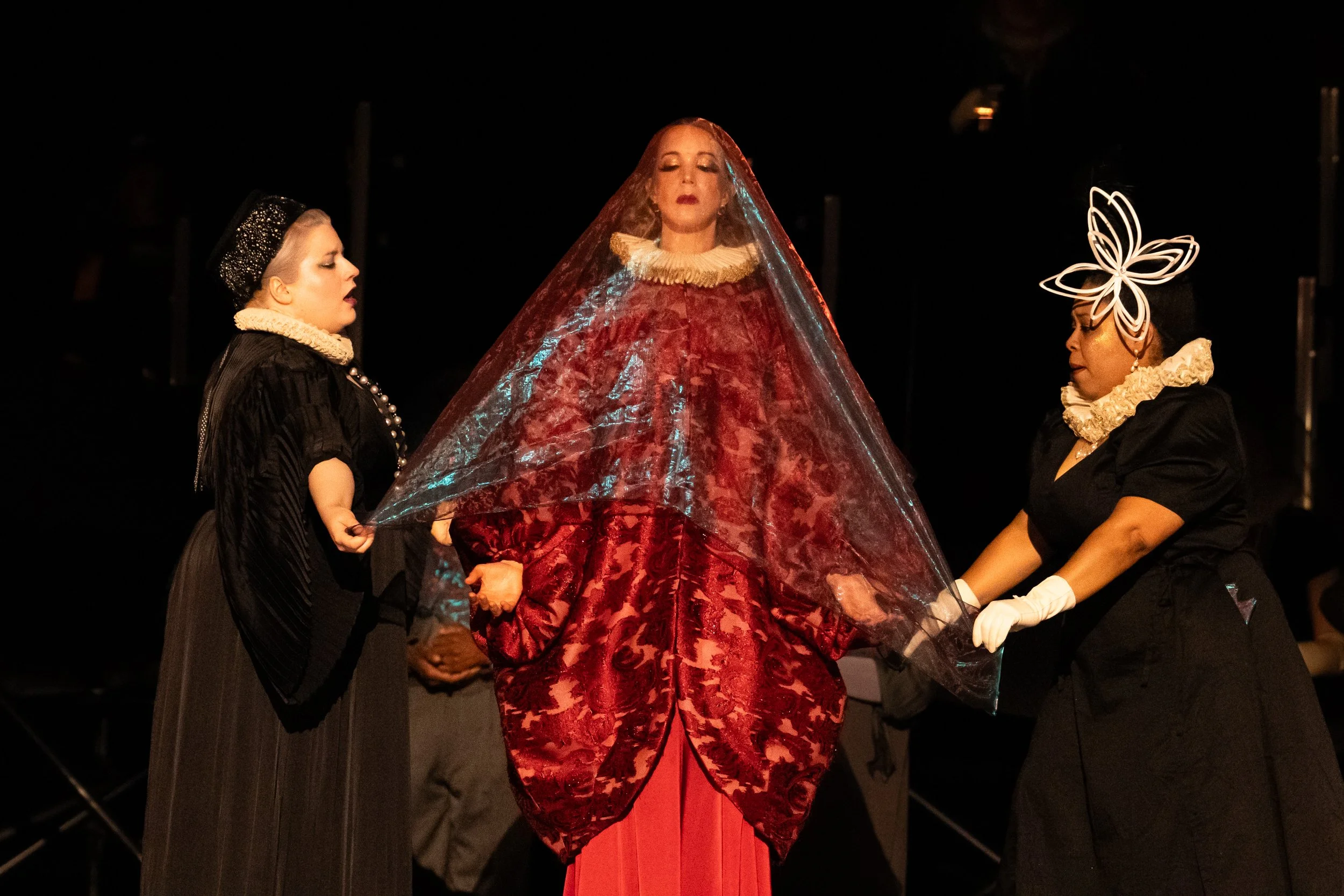
Katlyn Thierney as Lady-in-Waiting, Susanne Burgess as Thorn Rose, and Veronica Chapman-Smith as Mamselle. Photo by Steven Pisano; courtesy of Opera Philadelphia.
In Sleepers Awake, there are separate roles for Thorn Rose, the Stranger (aka, the prince and outsider to the community), the Court Poet, and the Godmothers. However, the chorus is given the main role and accounts for about 70% of the singing. The chorus also plays the characters of the courtiers, workers, and townspeople, with many stepping forward briefly from time to time to express their sentiments in more defined roles: Lady-in-Waiting, King, Chamberlain, Cook, Scullery Maid, and Mamselle. After the first awakening, the community questions and shuns the Stranger. Then, led by the Court Poet, they tell their story of Thorn Rose’s birth, the curse of death on her 16th birthday, the King’s threatening decree to the community made to protect his newborn, Thorn Rose wounding herself with the poisoned spindle, and the youngest Godmother’s changing the curse from death for Thorn Rose to sleep for her, and again the group sans the Stranger falls asleep. Another kiss, another awakening. The Stranger tells his background and efforts, and Thorn Rose expresses empathy for all who tried and failed, and her role in the story. The group begins to accept and embrace the Stranger while sleep comes again to all, the last being Rose Thorn and the Stranger.
Talk about immersive, the staging by Director Koons begins in the lobby before curtain time as village sleepwalkers stroll around (good photo ops). The beginning of the opera seemed defined by a single monotone chord that plays for several minutes as the characters come to and assemble on stage. The set by Jason Ardizzone West is a semi-circle with an upper level, a large pie-shaped center stage, and a large undulating disc, immersing all players in a community and a center for them to step forward from the sidelines. Lighting by Yuki Link on the stage reflected moods, and effectively moved later out from the stage to incorporate the community in the audience. Costumes by Maiko Matsushima were reflective of roles, not always time period. There were usually over sixty performers on stage, chorus members, and other players, a challenge for the director. Koons moved them around well with a charming ending touch of a dance having all members pair and march forward in a couple parade. All in all, the staging was very well done, with great eye appeal, while bringing forward the themes presented in Sleepers Awake.
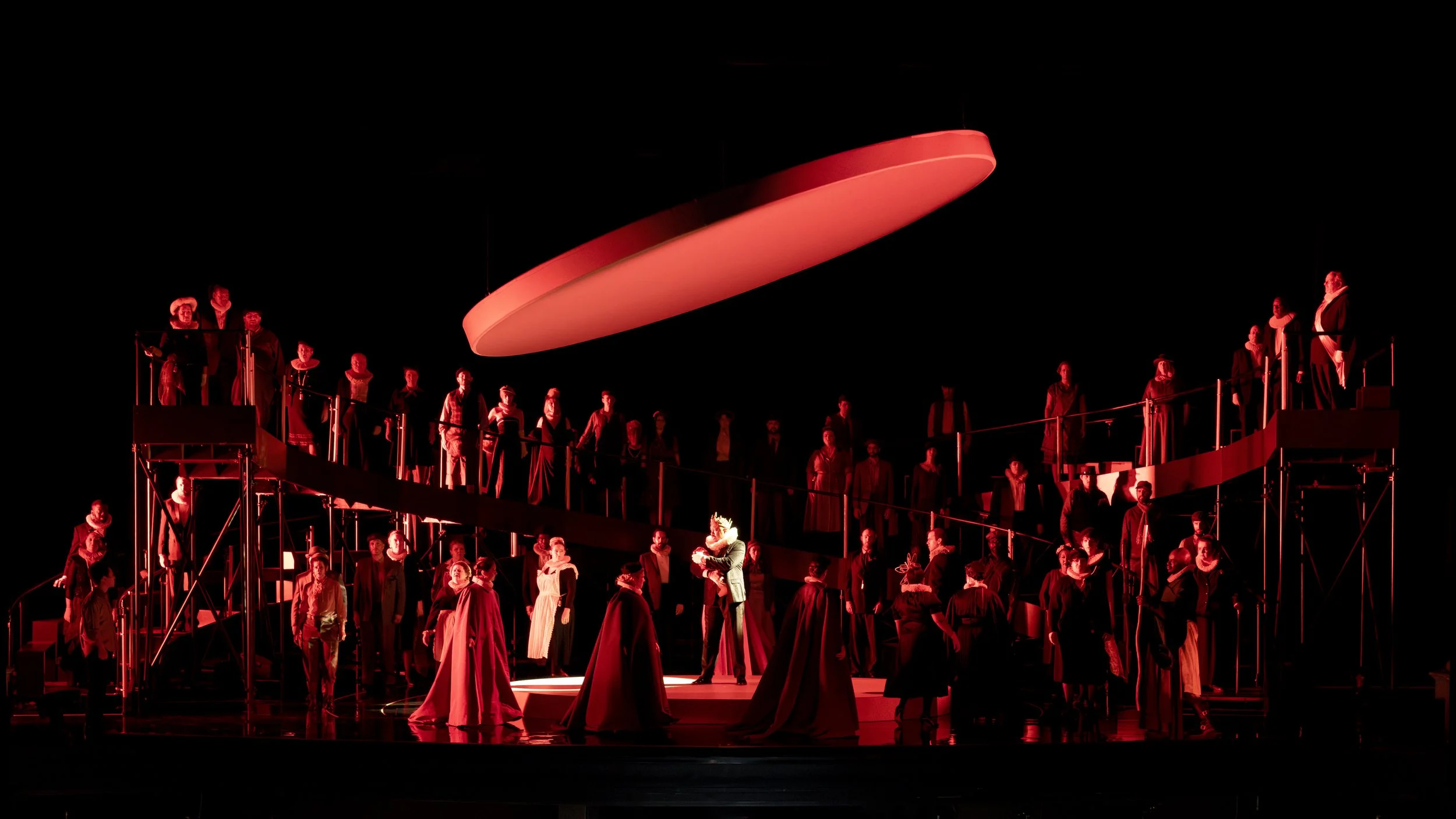
Brenton Mattox-Scott as the King holding baby Thorn Rose. Photo by Jason Ardizzone-West; courtesy of Opera Philadelphia.
The Opera Philadelphia Orchestra ensemble under the direction of Maestro Rovaris gave their typically excellent performance, likely challenging in timing aspects with the in and out of the spotlight for various soloists, instruments placed in side boxes, and the number of percussive highlights employed by the composer. Composer Spears’ operas draw from many genres of classical music, from Medieval music to modern minimalism. While he is well known for his use of minimalism, mainly recurring and evolving themes, I am most attracted to the beauty of his music and its tight support of storylines developing on stage. His approach to Sleepers Awake was inventive. Prominent players included two harps, one on either side of the stage, and a theorbo on the left. For me, these added a fairy-tale feeling, appropriate for this production. Instrumentation in the orchestra was limited to strings, a bassoon, two horns, and a variety of percussion instruments, one a slapstick used as a wake-up or call to attention, somewhat unsettling for those in the audience. My one lingering concern with the music is in the middle section, when Rose Thorn’s curse was told and reenacted, it felt more repetitive without evolving, losing some of the interest piqued in the opening section, before heading into a standout final section. That said, it was only one hearing, and I enjoyed the music overall and hope to hear it again; there was much new to experience and absorb.
Opera Philadelphia has an excellent chorus, and while the score allows for a smaller group, they were present in full 60-something-member force for this new opera, with a major role for the chorus. They were excellent again under the direction of Chorus Master Elizabeth Braden. Those who stepped forward to express sentiments as an individual character performed in a manner that added further enjoyment of the opera. The four Godmothers stepping forward were particularly enjoyable separately and as a quartet: soprano Sophia Santiago, mezzo-soprano Annalise Dzwonczyk, mezzo-soprano Maren Montalbano, and alto Robin Bier.
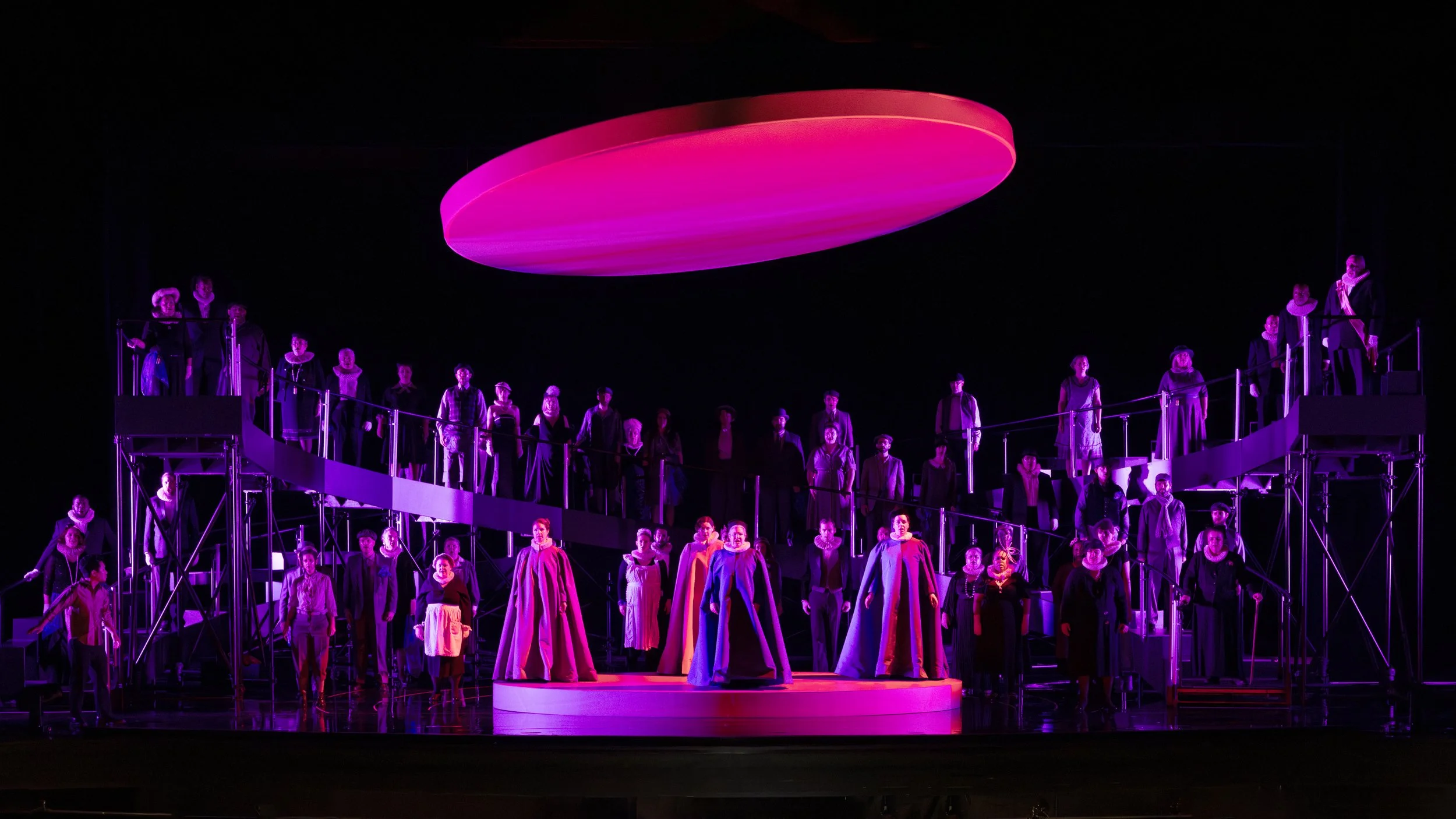
The Opera Philadelphia Chorus. Photo by Jason Ardizzone-West; courtesy of Opera Philadelphia.
Much was required of the individual singers to sing in the style specified by the composer. They responded beautifully. Rose Thorn was played by soprano Susanne Burgess, who sang well in style, and her aria expressing compassion for unsuccessful heroes revealed a prettiness in her voice that was at times breathtaking. Tenor Jonghyun Park as The Stranger also sang well, especially in his major aria and in playing half of the evil Carabosse. Baritone Brian Major seemed an assured natural in the role of the Poet and the other half of Carabosse.
I inquired why two singers, the Court Poet and the Stanger, sang the role of Carabosse at the same time; the singing and harmonics of this duet were a highlight for me. Composer Spears’ answer reveals the depth of consideration that went into constructing this opera:
“Carabosse, would of course not have been in the palace when everyone fell asleep, so her role in the retelling would have to be played by someone else in the palace a hundred years later. I decided her voice would be created by the Court Poet and the Stranger singing together in a strange harmony — as if her presence must be conjured paradoxically, as a combination of two entwined perspectives.
The resulting voice is the fusing of the voice of the ultimate insider (the Court Poet) and the only other true outsider in the palace at that time (the Stranger). For me this double voicing is a commentary on how an outcast's identity is often constructed from two perspectives simultaneously: the combination of the outsider’s voice and the voice of a community projecting their irrational fear upon them. You might have noticed that the Court Poet seems to instruct the Stranger in how to play this role of the outcast — guiding (mirroring) him both physically and vocally as they are both dressed up as Carabosse. Based on the Court Poet’s enlistment of the Stranger for this task, we perhaps see how the Stranger and Carabosse (both “uninvited” guests) are perceived as similar, and both subject to the fears, rejections, and projections of the larger group.”
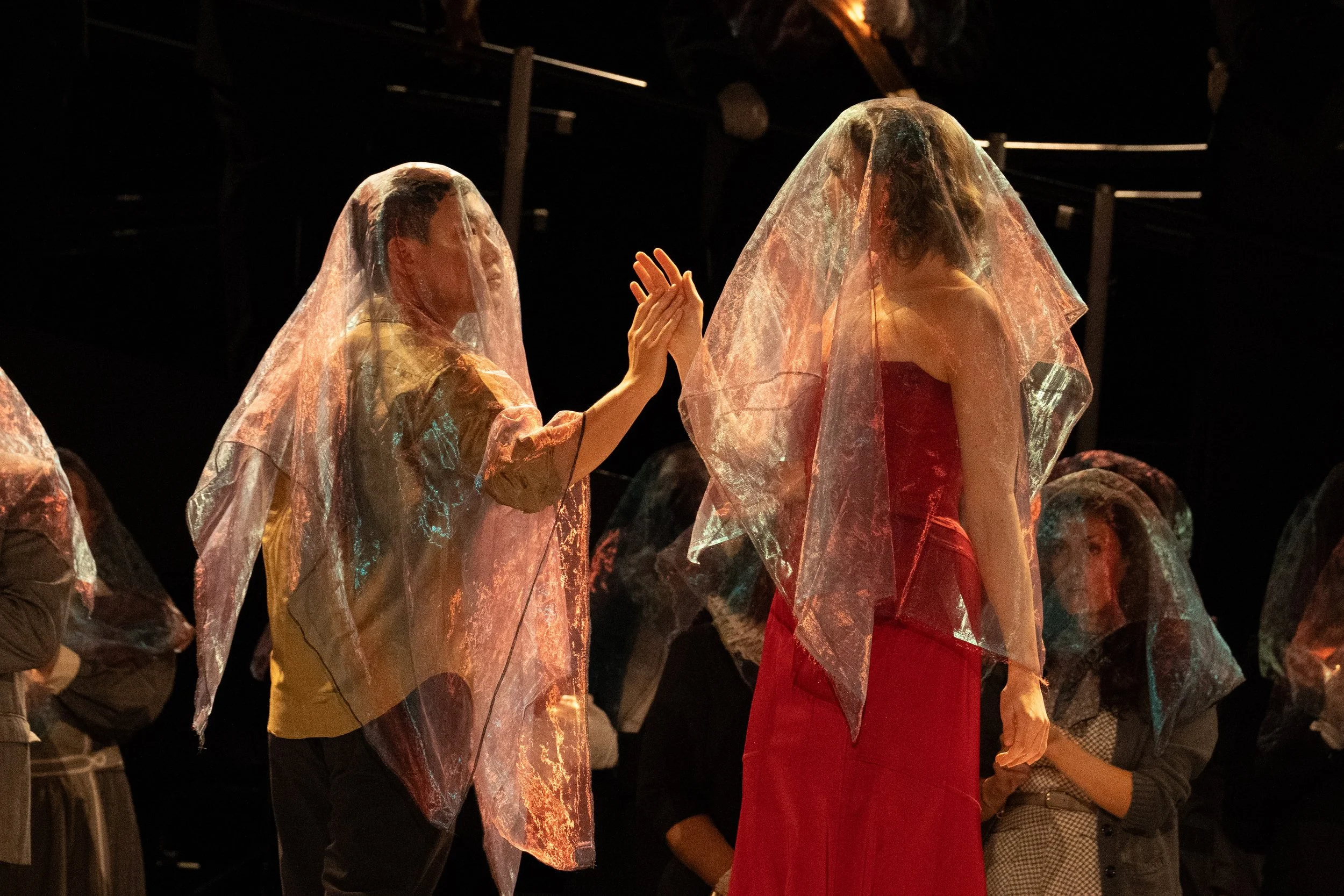
The Stranger (Jonghyun Park) and Thorn Rose (Susanne Burgess) have bonded and are drifting into slumber. Photo by Steven Pisano; courtesy of Opera Philadelphia.
Author and poet Robert Walser was a thinker, and Sleepers Awake is a thinker’s opera. There are no grand passions revealed here (except for Carabosse’s in absentia). The lovers’ bond was formed more by fate (or not understood personal forces) than desire. The elements of the individuals’ impact on the community and the community’s impact on individuals are central themes. The cycles in our lives, exertion then rest then exertion… stand out, as does the time we spend in between. As the composer said in the program notes, are sleeping and awaking puzzles to solve or traps to escape. The music, complex in patterns and instrumentation, clever in creating disorientating awakening and sleep cycles, was enjoyable overall. I loved having an opera with a strong focus on the chorus, and one that grapples deeply with the meaning of our experiences. The feelings the opera evoked are subtle and tentative; even as I reveled in our two protagonists finally pairing, it lacked romance, and then they went to sleep. Even without grand emotions, Sleepers Awake is multisensory in a grand sense. I don’t pretend to have a complete understanding of Sleepers Awake, but I’d like to grapple with it more when it is performed by other companies. Perhaps for this type of opera, as the Stranger sings when Thorn Rose has accepted him, “Eating creates appetite”.
The Fan Experience: Performances of Sleepers Awake were scheduled for April 22, 24, 26 in the Academy of Music. The opera was sung in English with supertitles in English. The opera lasted 90 minutes, without intermission. A highly informative pre-opera lecture and discussion was held one hour prior to the performance with Lily Kass, the Scholar in Residence for Opera Philadelphia.
Next up for Opera Philadelphia is the world premiere of The Black Clown on May 14, 15, 16, and 17. Pick your price ticketing as low as $11 for any seat remains in effect this season. As of this post, tickets remain available.