
This is not your father’s Rodelinda, but then, what King George heard 300 years ago was not what your father heard. If you insist that you want to see old operas staged the way they were hundreds of years ago, forget about it. To enjoy Rodelinda today as audiences did in 1725 when Handel’s Rodelinda premiered, we should allow patrons to use their cell phones during the performance, and chow down on pizza and beer from their seats, while the upper 1% enjoy wine and caviar at their tables, taking important business calls or betting online. Thanks to Wagner, opera became more like a religious experience, dress for church, and sit quietly. Since then, opera has continued to evolve to serve today’s customers through a more relaxed dress code and new staging possibilities. Why not change the old staging to put the main points in a modern context, for impact and entertainment value? Santa Fe Opera’s production has done that effectively, while providing exquisite music and singing. This summer’s production of Rodelinda is Michelin-star-quality baroque opera; let me explain.
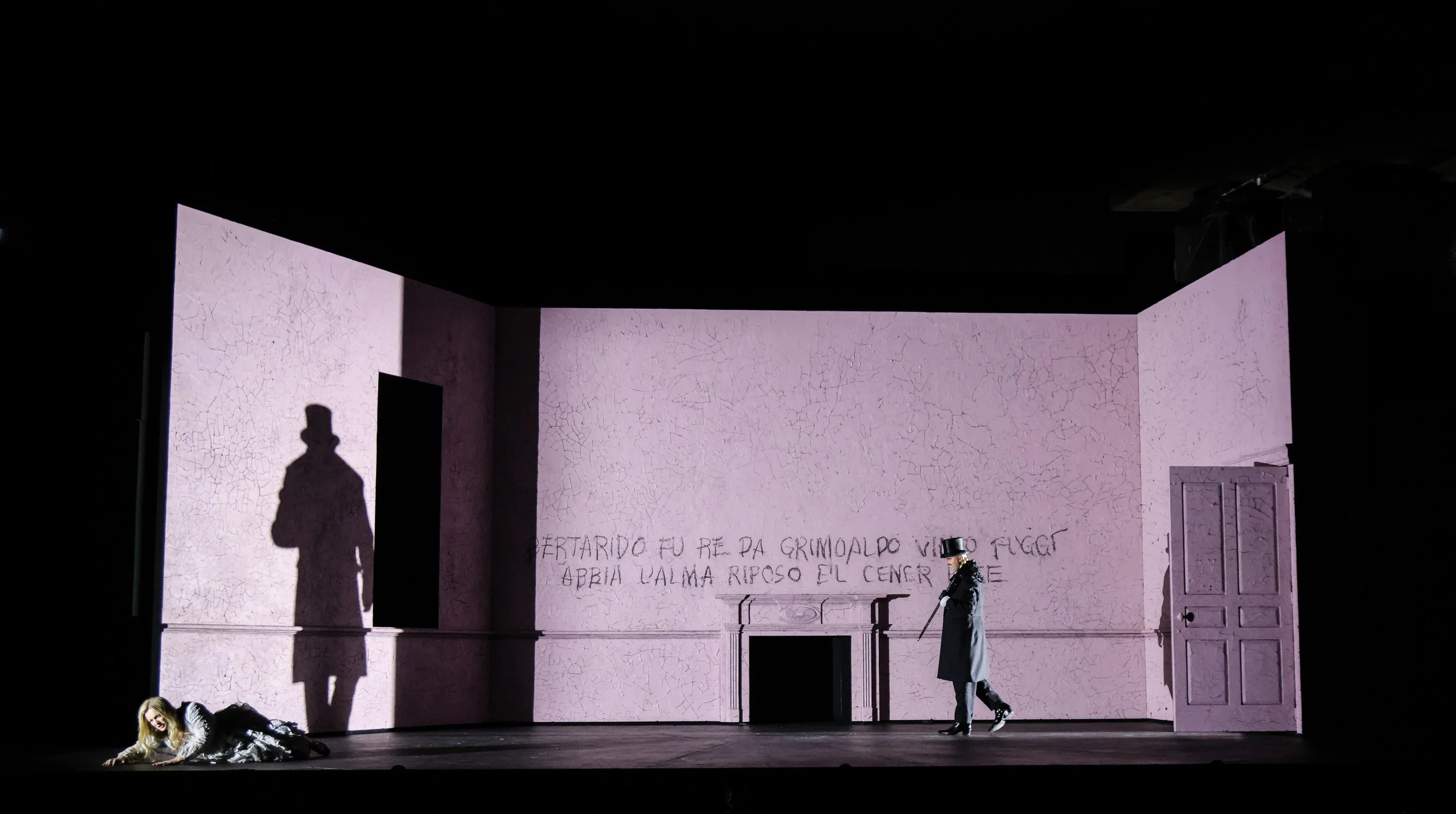
A distraught Rodelinda (Lucy Crowe) is stalked by the victorious Grimaldo (Anthony Gregory). Photo by Bronwen Sharp; courtesy of the Santa Fe Opera.
Composer George Frideric Handel and librettist Nicola Francesco Haym’s Rodelinda was a classic opera seria of its day: members of the royalty and nobility classes struggle with their ambitions, desires, attachments, and morals, and the ending must reward the virtuous. Queen Rodelinda's husband, King Bertarido, has been defeated by Duke Grimoaldo and is presumed dead. Having seized the throne, Grimoaldo now seeks to claim both the crown and the queen, demanding that Rodelinda marry him or watch her young son, Flavio, be executed. To pursue Rodelinda, Grimoaldo casts aside his fiancée Eduige—Bertarido's sister—while his ambitious adviser, Duke Garibaldo, urges him to keep by force what he won in battle.
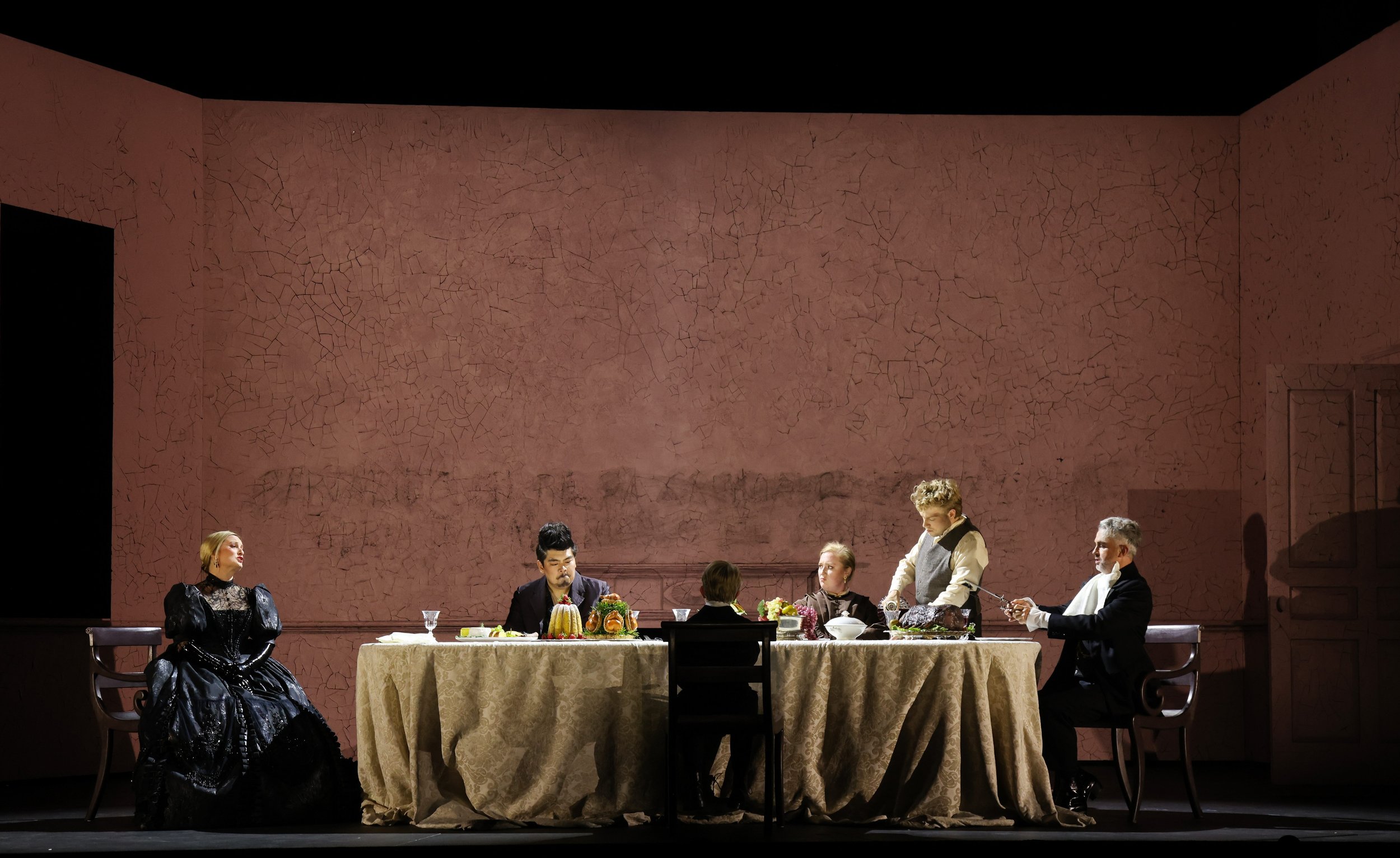
Rodelinda (Lucy Crowe) at one end of the table presents her offer to Grimoaldo (Anthony Gregory) at the other end, while Garibaldo (William Guanbo Su), Eduige (Meridian Pratt) and a standing Unulfo (Hugh Cutting) observe. Photo by Bronwen Sharp; courtesy of the Santa Fe Opera.
Unknown to everyone but a few loyal supporters, Bertarido is alive and living in hiding. A series of reversals follows. For a time, Bertarido mistakenly believes Rodelinda has betrayed him. Rodelinda, however, remains steadfast and presents Grimoaldo with an impossible condition that exposes the depth of her loyalty. Humiliated by her rejection, Eduige plots revenge after being abandoned, while Garibaldo schemes to seize the throne for himself. Bertarido's faithful friend Unulfo reassures the hidden king that Rodelinda has never wavered. When Bertarido finally reveals himself, he is captured, but Unulfo and the remorseful Eduige engineer his escape. In the climactic confrontation, Bertarido kills the treacherous Garibaldo but spares Grimoaldo, whose repentance leads him to relinquish the throne. Husband and wife are reunited, their constancy rewarded, and the rightful order is restored.
Complicated yes, but the plot in Rodelinda is a device to reveal human psychological states and their development. A woman struggles to remain faithful to her husband and protect their child, while the ambitious vie to achieve their desires, some at the sacrifice of moral character. We like the virtuous. We also like benevolence and redemption. As it was in the seventh century Milan, the 1700s, and is today. And with opera, you get music and singing revealing the inner turmoil of the characters. That’s where Santa Fe Opera comes in.
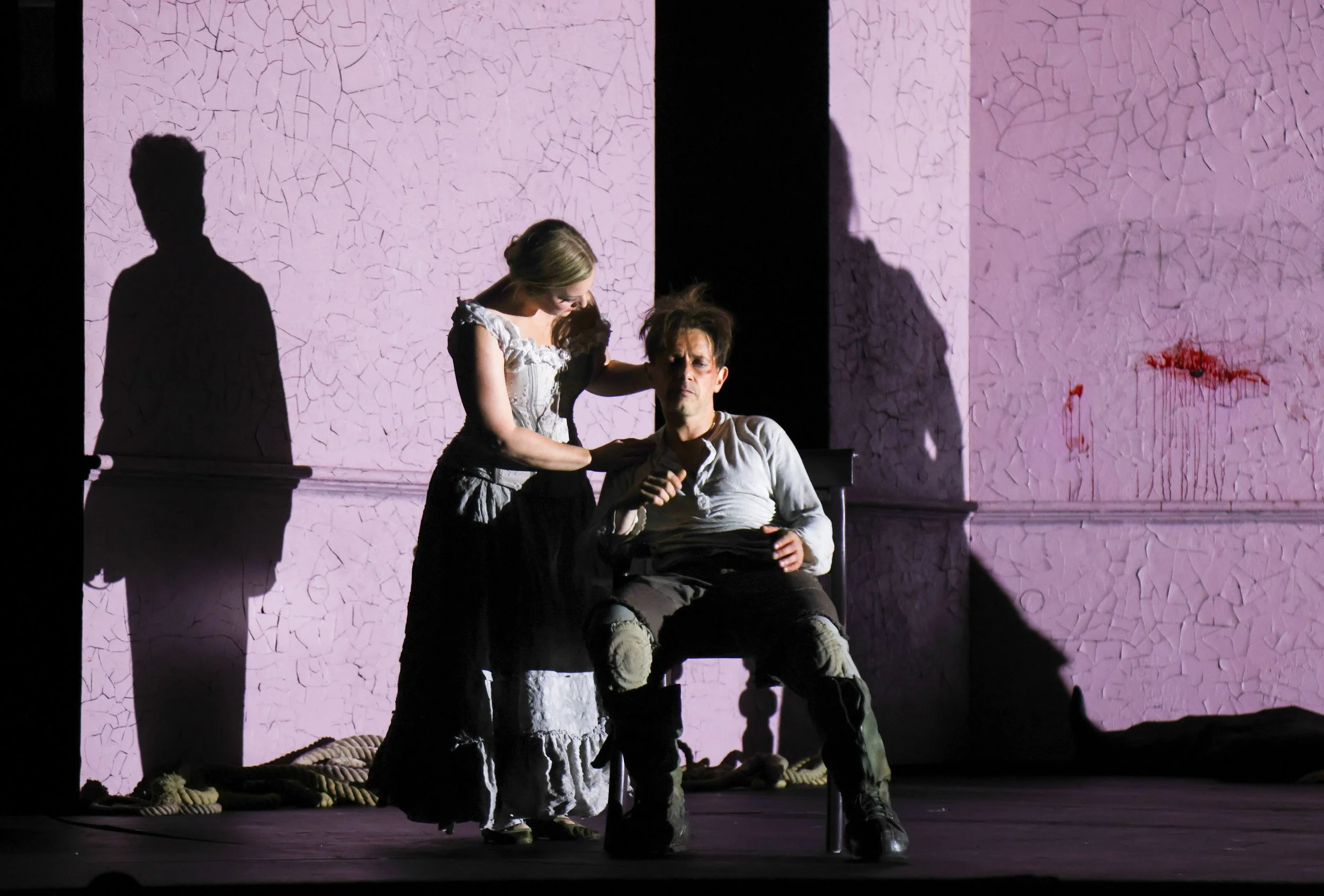
Rodelinda (Lucy Crowe) and Bertarido (Iestyn Davies) are briefly reunited. Photo by Bronwen Sharp; courtesy of the Santa Fe Opera.
SFO brought together an exceptionally accomplished cast for this production. Baroque opera was long out of favor with the large opera houses. The Metropolitan Opera’s first performance of Rodelinda was in 2004, being championed by soprano Rene Fleming, and has been performed in three more seasons since then. The first Met production and two of the others were conducted by Harry Bicket, the conductor for SFO’s production. Star countertenor Iestyn Davies, who sings Bertarido for SFO made his Met debut playing the role of Unulfo in a 2011 production. The teaming of Bicket, Davies, and Lucy Crowe, who plays Rodelinda, began in 2020, and they have performed the opera together multiple times since then, in concert and in staged productions. SFO’s production is highly polished, but all three performers say their Rodelinda continues to evolve; soprano Crowe even states that opportunities for embellishment in baroque opera make her performance different every night.
I found world-renowned star soprano Lucy Crowe’s performance as Rodelinda to be beyond outstanding, occasionally all the way into the realm of transcendent. The power and richness of her voice were rapturous. Her virtuosic singing enhanced every aria she sang, and her acting fully conveyed the powerful emotions Rodelinda was experiencing. Handel enhanced the box office appeal of Rodelinda by casting not one but two castrati. Those roles are most often played today by countertenors or mezzo-sopranos. The role of Bertarido was played by Iestyn Davies, one of today’s most acclaimed and sought-after countertenors. He delivered a character of great complexity and depth. (I still find it hard to believe that Bertarido didn’t have Grimoaldo executed.) His singing was special, also at times transcendent. In an early scene, he sits in a small opening singing of his love for Rodelinda. So beautiful, I felt like it opened a pathway to heaven. The duet between Ms. Crowe and Mr. Davies, just before he is placed in prison, was of the same quality and impact. Seeing and hearing these two singers embody their characters, Rodelinda and Bertarido, is an experience I will long remember.
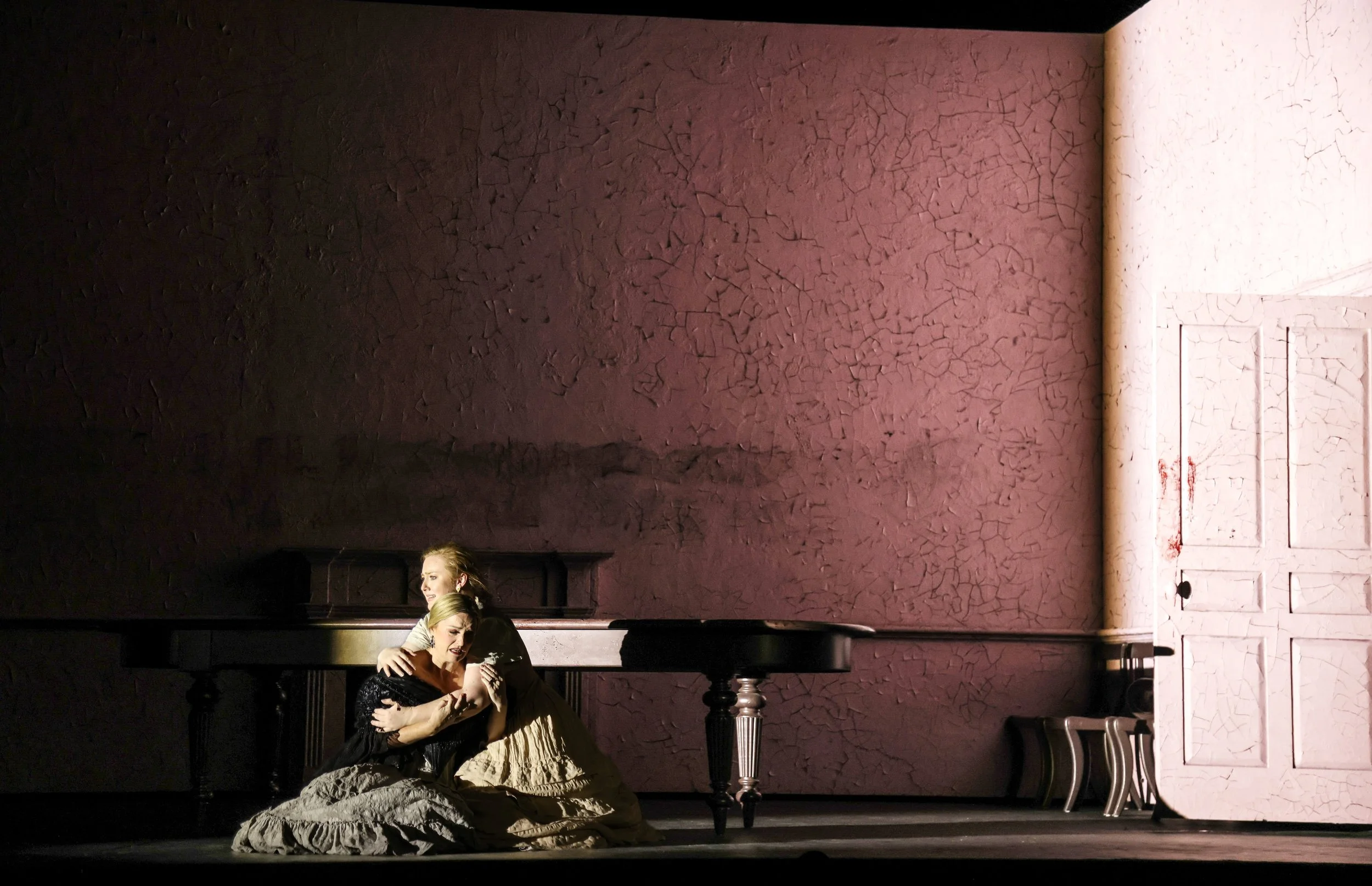
Eduige (Meridian Prall) holds and tries to comfort Rodelinda (Lucy Crowe). Photo by Bronwen Sharp; courtesy of the Santa Fe Opera.
The cast was uniformly strong overall. Handel wrote several excellent and varied arias for every singer. British tenor Anthony Gregory also gave his complex character depth as he desired the throne and the Queen, but there were some bridges he would not cross. He also sang with beauty and great virtuosity. Young mezzo-soprano Meridian Prall also gave a standout performance as Eduige. She is a recent winner of the Met Laffont competition and placed highly in several international competitions. The more I listened to her vocals, the more impressed I became. Bass William Guanbo Su, who plays the evil duke Garibaldo, has the imposing stature and the powerful bass sound to make his character threatening, plus he sings baroque opera expertly. He now heads to the Met for performances in two operas later this year. SRO’s other excellent countertenor for Rodelinda was Hugh Cutting playing Unulfo, Bertarido’s counselor and friend, who also helps tidy up. He is a young, up and coming, countertenor who has sung this role previously and performed in concert with Mr. Bickett. He was a delight, singing and portraying the most even-keeled character in the opera. Young actor Maximilian Moore gave a fine performance portraying Rodelinda’s son Flavio, a non-singing role.
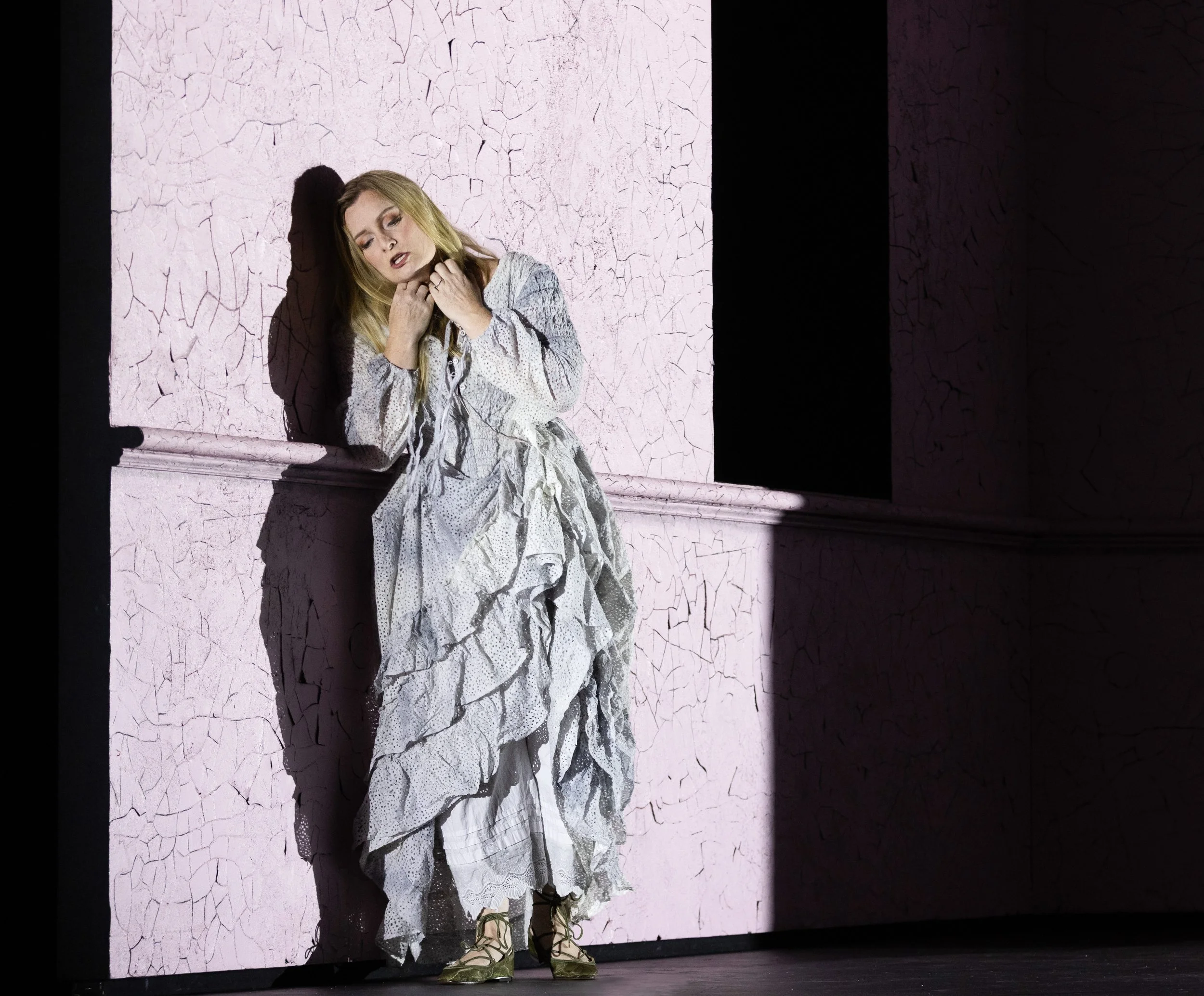
Rodelinda (Lucy Crowe) feels the weight of what has befallen her and her family. Photo by Bronwen Sharp; courtesy of the Santa Fe Opera.
Handel’s gorgeous music was played by the Santa Fe Opera in period style, including harpsichord and two theorboes. The playing was beautiful, sometimes highly dramatic, and sometimes fun, filled with Handel’s enjoyable melodies. Conductor Harry Bickett, who is also the Music Director for SFO, is very expert in baroque music and this opera; he even played the harpsichord for this production. His direction kept the music and the singers in sync in a range of emotional twists and turns. One notable moment that I fancied was the scene where Rodelinda and Flavio visit the cemetery. Early in the aria, she sang short phrases, so beautiful, then they were played gently in response by a solo flute. It seemed like a singer/instrument duet, another transcendent moment.
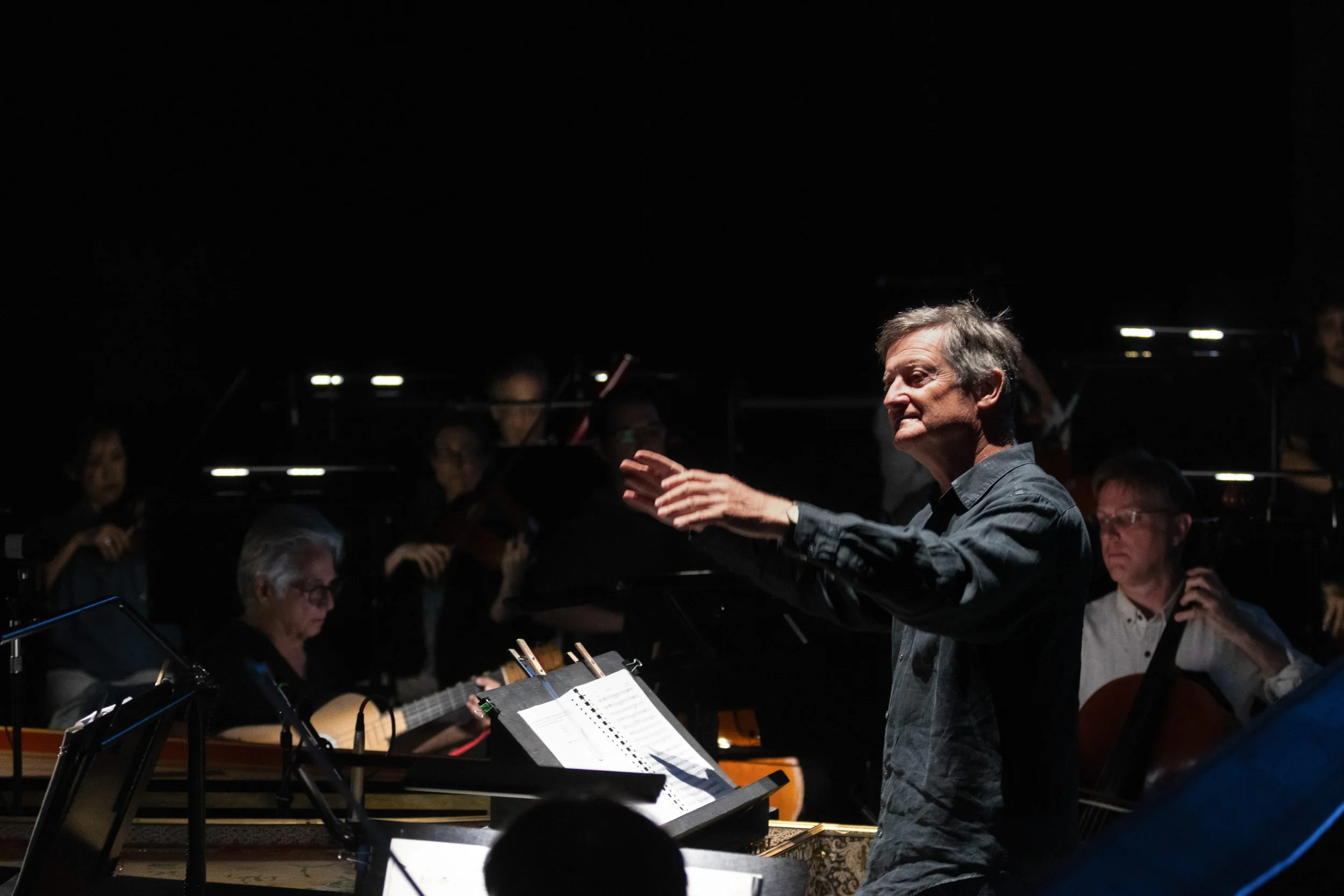
Conductor and harpsichordist Harry Bicket. Photo by Bronwen Sharp; courtesy of the Santa Fe Opera.
For the staging of this story, which takes place in 7th-century Milan, where Bertarido is King of the Lombardy, Director R. B. Schlather reprises the version he originated in a 2023 production at Hudson Hall in NYC, a highly regarded effort. He has chosen a "noir melodrama gangster story" presentation using a black and white motif, except for blood. In this version, lighting plays a critical role using light and shadows to create an unsettling effect. Lighting designer Masha Tsimring did an excellent job with these effects. The set was on a circular rotating platform that made changing scenes run smoothly. The design of the sections was cleverly done to focus attention on the action. The costumes were varied and well done, though I’m not sure what period was targeted. The women wore royal dress and the men seemed 18th-century British, except Garibaldo whose dress seemed more modern and who sported a bouffant (gangster?) hairstyle. My wife thought the staging was outstanding, serving this opera extremely well, and this ‘film noir’ did have a pleasing happy ending. To be honest, I admired it somewhat more than I liked it. It was attention grabbing, very well done, and served the psychodrama well, but there was still a part of me that wanted my first Rodelinda to take place in the Milan of yore.
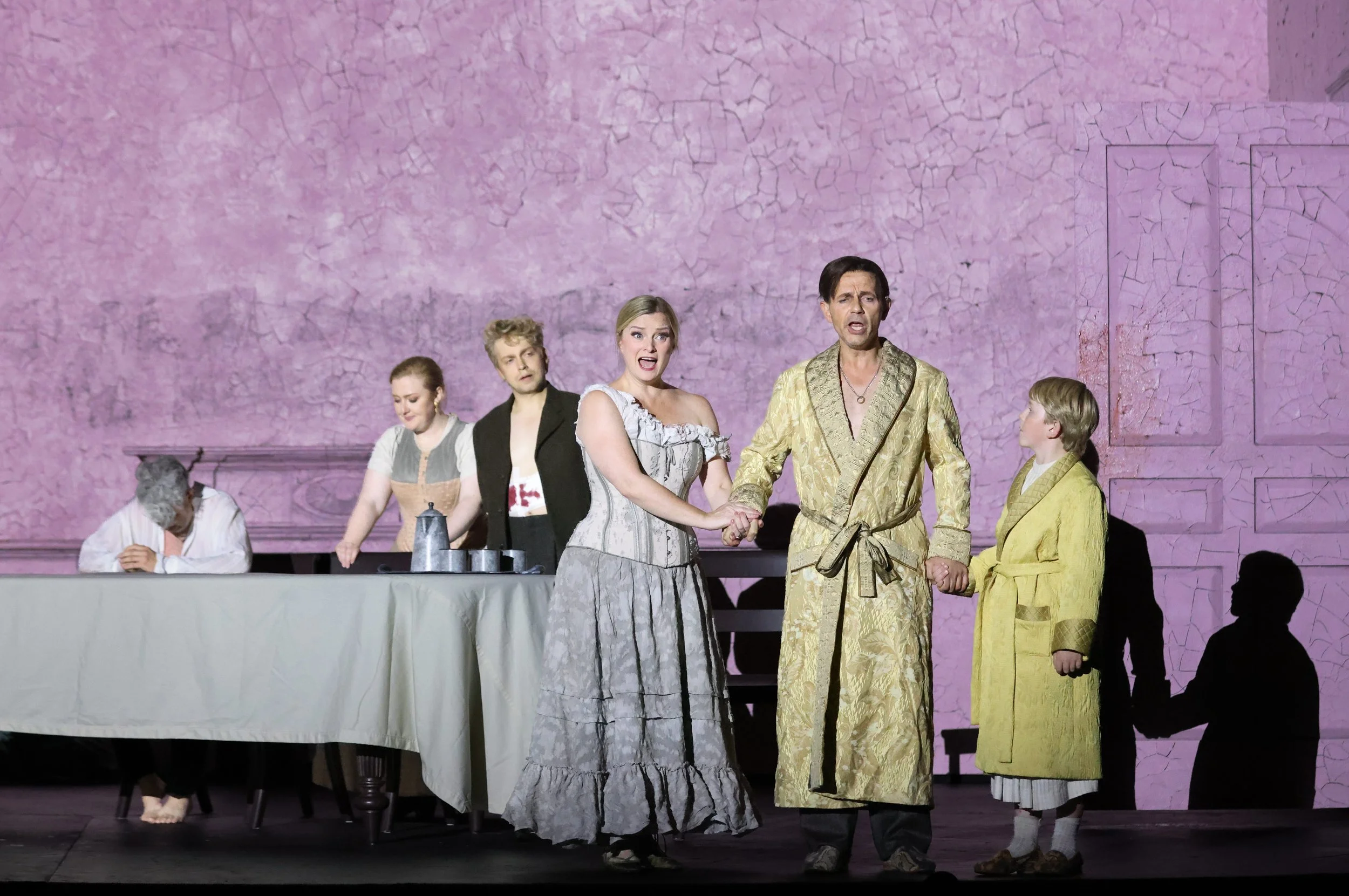
The rightful order is restored: l to r, Grimoaldo (Anthony Spears), Eduige (Meridian Prall), Unulfo (Hugh Cutting), Rodelinda (Lucy Crowe), Bertarido (Iestyn Davies), and Flavio (Maximilian Moore). Photo by Bronwen Sharp; courtesy of the Santa Fe Opera.
Kudos for the staging, but the music and singing are the meat and potatoes of the baroque opera meal, while the story and staging are to make it interesting; otherwise, to some, not me of course, it can become a little boring over three hours of listening to baroque arias and recitatives. My thought is that if you enjoy baroque opera, and I do immensely, you could not do better than Santa Fe Opera’s current production of Rodelinda, which even has some transcendent moments. This was not steak and potatoes; this was Bistecca alla Fiorentina and Millefoglie di patate al forno (subtitles: Steak Florentine and baked potato mille-feuille), with a nice Chianti. If you like baroque opera or want to sample it from an upper-level slice, get thee tickets for a remaining performance, and if you want to hear a terrific soprano sing her role with different embellishments on different nights, attend two performances.
The Fan Experience: Santa Fe Opera scheduled performances of Rodelinda for July 25, 29, August 7, 11, and 21. The opera is sung in Italian with English and Spanish displayed on individual screens on the backs of seats. The performance lasted a little over three hours and included a 25-minute intermission. There is a 30-min pre-opera talk given twice, two hours and one hour before the show, presented by University of New Mexico professor emeritus and oboist Kevin Vigneau, which is very informative and helpful in preparing to enjoy the opera.
Attending the Santa Fe Opera is a special experience. The Crosby Theatre of the Santa Fe Opera, which seats about 2,000 patrons, is an open-air structure on each side and at the back of the stage. The design is modern and attractive. Sunsets and thunderstorms become part of the opera experience. See SFO’s detailed and helpful website for information on food/dining options available and for directions.
The tailgating parties at SFO performances, some astonishingly elegant, are a tradition. In general, the SFO patrons were most often dressed in a casual style, but those in tuxedos and evening gowns seemed to be adding to the fun. Bring a sweater or light jacket; Santa Fe is seven thousand feet above sea level; though warm the night I was there, the nights can be chilly even in July and August, and breezes flowing through the opera house can make it feel cooler.
Santa Fe Opera is located about five miles north of the city with easy access via highways 285/84 or a couple of backroads, if you are adventurous. As you move away from the heart of the city, you quickly enter the vast expanse of sky that New Mexico offers. The SFO program book includes this statement, “We acknowledge and pay deep respect to the people, elders, and ancestors – past, present, and future – of the Tesuque Pueblo whose beautiful lands have provided the stunning backdrop for our theatre and performances for over sixty years.”